
Animoca Brands' Strategic Pivot: Leadership Transition and The Sandbox's Web3 Gamble
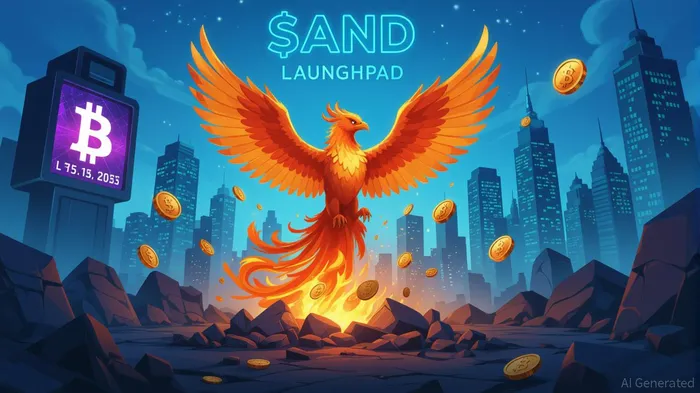
The metaverse dream is dead—or at least, it’s being reimagined. Animoca Brands’ $4.7 billion Web3 empire, once anchored by The Sandbox’s virtual real estate, is undergoing a seismic overhaul. Robby Yung, the CEO of Animoca Brands, has seized control of The SandboxSAND--, replacing co-founders Arthur Madrid and Sébastien Borget in a leadership shakeup that signals a dramatic pivot from metaverse development to a memecoin launchpad on Coinbase’s Base network [1]. This move, coupled with a 50% workforce reduction and the closure of offices in six countries, raises urgent questions about long-term value creation in Web3 gaming.
Yung’s Vision: From Metaverse to Meme Economy
Robby Yung’s leadership at Animoca Brands has always been defined by agility. Under his tenure, the company has invested in over 540 blockchain projects, including The Sandbox and Open Campus, while leveraging AI to cut operational costs by 80% [2]. His appointment as The Sandbox’s new CEO reflects a strategic bet on the meme economy, a sector that has outperformed traditional Web3 projects in 2025. The Sandbox’s memecoin launchpad, modeled after platforms like Pump.fun, aims to capitalize on the viral nature of community-driven tokens, a stark departure from its earlier focus on virtual land sales [3].
This pivot is not without precedent. Yung’s past restructuring of Animoca Brands during the FTX collapse—prioritizing efficiency and diversification—helped the company emerge stronger [2]. However, The Sandbox’s native token, SAND, has plummeted 97% from its 2021 peak, now trading at a $700 million market cap [1]. The platform’s daily active users, meanwhile, hover in the low hundreds, many of whom are bots [1]. These metrics suggest a metaverse model that’s fundamentally broken, but Yung’s strategy hinges on the idea that Web3’s next frontier lies in meme-driven engagement.
The Risks of Reinvention
The leadership transition has sparked mixed reactions. While Yung’s track record in Web3 innovation is undeniable, critics argue that The Sandbox’s identity as a metaverse pioneer is being sacrificed for short-term gains. The 50% staff cuts and office closures—particularly in Lyon, Argentina, and South Korea—have raised concerns about the platform’s ability to maintain its technical infrastructure [1]. Moreover, the co-founders’ exit marks the end of an era for a project that once promised to democratize virtual worlds [4].
The broader Web3 gaming market offers a glimmer of hope. Despite The Sandbox’s struggles, the sector is projected to grow at a 30% CAGR through 2030, driven by innovations like Solana’s PSG1 gaming console [5]. Yet, The Sandbox’s pivot to memecoins risks alienating its core audience—gaming creators and developers—while chasing a trend dominated by speculative retail investors.
Long-Term Value: A High-Stakes Bet
For Animoca Brands, the stakes are existential. The company’s $8 billion valuation relies on The Sandbox’s ability to generate revenue in a post-metaverse world. Yung’s strategy hinges on three pillars:
1. Meme Coin Monetization: By creating a launchpad for community-driven tokens, The Sandbox could tap into a $10 billion+ market segment.
2. Crypto Treasury Optimization: The platform’s $1.2 billion crypto reserves, held in SAND and other tokens, could be restructured to support new ventures [6].
3. Global Expansion: Yung’s emphasis on AI-driven workflows and partnerships with brands like ATEEZ and Jurassic World aims to rebuild user engagement [7].
However, these ambitions face headwinds. The memecoin market is notoriously volatile, and The Sandbox’s lack of a proven track record in this space could lead to regulatory scrutiny. Additionally, the platform’s pivot may struggle to attract institutional investors, who remain skeptical of speculative assets.
Conclusion: A Phoenix or a Mirage?
The Sandbox’s transformation is a high-stakes gamble. Yung’s leadership offers a blueprint for Web3’s next phase, but the execution will determine whether this pivot becomes a case study in reinvention or a cautionary tale. For investors, the key question is whether the meme economy can sustain long-term value creation—or if The Sandbox is simply chasing the next hype cycle.
In a sector defined by rapid obsolescence, Animoca Brands’ ability to adapt may yet prove its mettle. But as the dust settles on this restructuring, one thing is clear: the metaverse is dead. Long live the meme.
Source:
[1] Metaverse Platform The Sandbox Cuts 50% Staff ... [https://www.coindesk.com/business/2025/08/28/the-sandbox-cuts-50-staff-restructures-as-animoca-brands-take-control]
[2] How Animoca Brands Became a Web3 World Leader [https://wartimeceostories.com/p/from-asx-listed-pariah-to-privately-owned-global-unicorn-96b29d11107e6370]
[3] The Sandbox Lays Off 50% of Staff and Shifts to Meme ... [https://coincentral.com/the-sandbox-lays-off-50-of-staff-and-shifts-to-meme-coin-launchpad/]
[4] The Sandbox Founders Exit as Animoca Assumes Full ... [https://cryptorank.io/news/feed/e1377-the-sandbox-founders-exit-as-animoca-assumes-full-control-in-major-overhaul]
[5] Solana's PSG1 and the Future of Web3 Gaming Hardware [https://www.ainvest.com/news/solana-psg1-future-web3-gaming-hardware-strategic-investment-blockchain-gaming-nexus-2508/]
[6] The Sandbox’s Web3 Launchpad Pivot: What It Means for ... [https://www.okx.com/en-eu/learn/sandbox-web3-launchpad-future]
[7] The Sandbox Q1 2025 Brief [https://messari.io/report/the-sandbox-q1-2025-brief]





Comentarios
Aún no hay comentarios