
Anchorage Digital and Mezo: Pioneering Institutional Access to High-Performance Bitcoin DeFi
Institutional-Grade Infrastructure Meets Bitcoin's Programmability
Anchorage Digital's self-custody wallet, Porto, has long been a cornerstone of institutional-grade security, offering features like hardware security module (HSM)-enforced logic and quorum approvals to safeguard assets. Now, through its integration with Mezo, PortoPORTO-- users can access Bitcoin-based DeFi applications without compromising custody. For instance, asset holders can borrow against their BTC using Mezo's MUSD stablecoin at a fixed rate as low as 1%, a feature already live on the platform according to the report. This low-cost liquidity access is critical for institutions seeking to optimize their Bitcoin treasuries without selling their underlying assets.
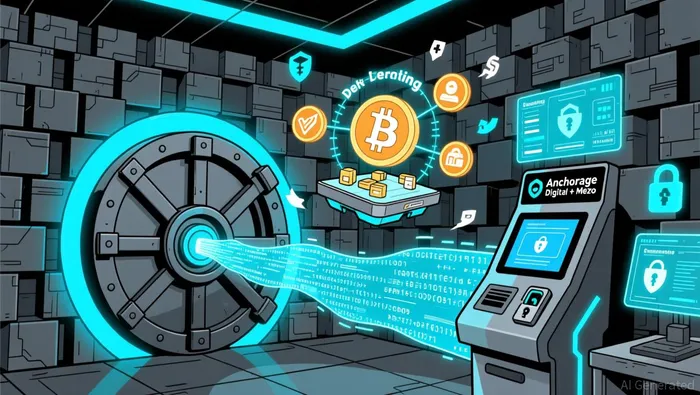 Moreover, the partnership introduces veBTC, a mechanism that allows users to lock their BTC on Mezo and earn rewards via on-chain network fee sharing. This innovation mirrors the yield-generating models of Ethereum-based DeFi but is tailored to Bitcoin's unique architecture. As noted in a recent report by CoinDesk, the total value locked in Bitcoin DeFi has surged from $200 million to over $8 billion in 18 months, though it still constitutes just 0.3% of Bitcoin's market cap. Anchorage and Mezo's collaboration aims to accelerate this growth by providing institutional-grade security and compliance, addressing key barriers to adoption.
Strategic Implications for Institutional Adoption
The partnership's significance lies in its ability to democratize access to Bitcoin's utility while maintaining institutional trust. For example, publicly traded companies and digital asset treasuries (DATs) can now leverage Mezo's platform to generate yield on their BTC holdings without exposing themselves to the volatility of traditional lending markets. As Yahoo Finance highlights, Anchorage's CEO Nathan McCauley emphasized that the maturation of Bitcoin smart contract capabilities is unlocking "meaningful DeFi activities" for institutions. This includes short- and long-term investment strategies, with higher rewards incentivizing longer lock periods-a structure designed to align with institutional risk profiles.
Critically, the collaboration also addresses jurisdictional flexibility. Clients can choose to lock BTC through Anchorage's institutional-grade platforms or via the Porto wallet, depending on their custody preferences and regulatory environments. This adaptability is essential in a fragmented global crypto market, where compliance requirements vary widely.
The Road Ahead: Challenges and Opportunities
While the partnership marks a milestone, challenges remain. Bitcoin DeFi's TVL, though growing rapidly, is still dwarfed by Ethereum's $50+ billion TVL. However, Anchorage and Mezo's focus on institutional-grade infrastructure could tip the balance. By offering transparent, auditable protocols and leveraging Anchorage's regulatory licenses-including its Major Payment Institution License from Singapore's MAS-the partnership mitigates the trust issues that have historically hindered institutional participation in DeFi.
Furthermore, the integration of governance rights via veBTC adds a layer of protocol-level influence for large holders, a feature that could attract institutional investors seeking to shape the future of Bitcoin's financial ecosystem. As Business Insider notes, this governance model allows users to "influence protocol economics," a critical factor in attracting capital from traditional finance players according to market analysis.
Conclusion
Anchorage Digital and Mezo's collaboration is notNOT-- just a technical achievement but a strategic repositioning of Bitcoin as a programmable asset. By combining institutional-grade custody with Bitcoin-based DeFi tools, the partnership addresses the core tension between security and utility in the crypto space. While the confusion with Hyperliquid persists in some circles, the reality is that Anchorage and Mezo are setting a new standard for institutional access to DeFi-one that prioritizes compliance, transparency, and scalability. As Bitcoin's role in global finance evolves, this partnership could serve as a blueprint for future integrations, proving that the future of money is both decentralized and institutional-grade.






Comentarios
Aún no hay comentarios