
Analyzing HYPE Token's Institutional Appeal and Short-Term Price Catalysts
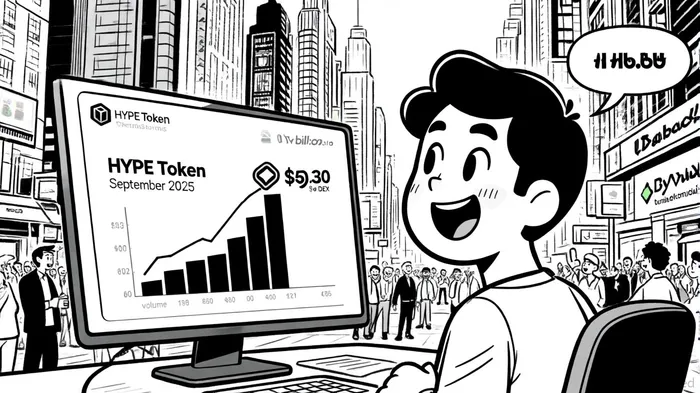
Institutional adoption and speculative momentum have become twin engines driving the HYPE Token's ascent in 2025. As the token navigates a rapidly evolving DeFi landscape, its institutional appeal—bolstered by strategic buybacks, corporate treasury allocations, and deflationary mechanics—has positioned it as a compelling asset for both long-term value creation and short-term volatility. Meanwhile, speculative catalysts, including exchange listings, social media hype, and airdrop-driven liquidity, have amplified its price trajectory. This analysis dissects these dynamics to assess HYPE's current valuation and future potential.
Institutional Buying Patterns: A Structural Tailwind
Hyperliquid's $1.2 billion buyback program, funded by platform transaction fees, has emerged as a cornerstone of HYPE's institutional appeal. By systematically purchasing and burning tokens, the protocol has reduced circulating supply by over 15% in Q3 2025, creating scarcity and reinforcing price resilience [1]. This deflationary model, combined with Hyperliquid's record-high on-chain revenues—exceeding $1.3 billion in September 2025—has attracted institutional investors seeking assets with intrinsic value and governance-driven growth [4].
Publicly traded corporations have further validated HYPE's institutional viability. Hyperliquid Strategies Inc. (HSI), a merger between Sonnet BioTherapeutics and Rorschach I LLC, now holds over $583 million in HYPE tokens, with plans to allocate an additional $305 million for further acquisitions [1]. This bold move mirrors traditional corporate treasury strategies, where firms like MicroStrategy have integrated BitcoinBTC-- into balance sheets. Similarly, Eyenovia, Tony G Holdings, and Lion Group Holding Ltd. have deployed multi-million-dollar buy-ins and validator nodes, treating HYPE as a strategic reserve asset [3].
The formation of HSI and similar entities underscores a broader trend: institutional investors are diversifying beyond Bitcoin and EthereumETH--, seeking high-growth altcoins with robust tokenomics. Hyperliquid's automated buyback mechanism—reinvesting 97% of protocol fees—has amplified this appeal, ensuring a consistent reduction in supply and sustained demand [2].
Short-Term Price Catalysts: Listings, Sentiment, and Liquidity
While institutional fundamentals provide a long-term foundation, HYPE's short-term price action has been fueled by speculative catalysts. A key driver has been its strategic exchange listings. The token's September 2025 listing on BitGo and Bitfinex injected $293 million in 24-hour liquidity, with open interest rebounding to $2.1 billion [2]. These tier-1 listings have enhanced price discovery and accessibility, attracting retail and institutional traders alike.
Social sentiment has also played a pivotal role. The broader memeMEME-- coin market, exemplified by projects like AlphaPepe (ALPE) and Maxi Doge (MAXI), has created a fertile environment for speculative trading. AlphaPepe's $187,000 presale and 85% staking APRs, coupled with Maxi Doge's 1000x trading narrative, have driven retail inflows into the crypto space, indirectly boosting HYPE's visibility [1]. Meanwhile, HYPE's Telegram community and X (Twitter) engagement remain robust, with influencer wallets and smart contracts holding $86 million in long positions [2].
On-chain metrics further validate this momentum. Hyperliquid's Total Value Locked (TVL) surged by $300 million in September 2025, reaching $2.7 billion, while DEX trading volume hit $1.3 billion—a 87% month-over-month increase [1]. These figures highlight the platform's growing utility and the token's role in facilitating high-liquidity trades.
Balancing Valuation and Risk
Despite these positives, HYPE's valuation remains a contentious topic. The token reached an all-time high of $59.30 in late September 2025 but has since retreated to $44.78, reflecting profit-taking and short-term volatility [3]. Analysts are divided: some argue HYPE's price could reach $77 based on revenue multiples, while others caution that token unlocks in November 2025 may introduce selling pressure [4].
The key risk lies in overvaluation. With a market cap exceeding $2.4 billion, HYPE's price-to-revenue ratio appears stretched compared to traditional equities. However, its institutional adoption and deflationary model suggest a floor for the token, even in a bearish scenario.
Conclusion: A Dual-Driven Asset
HYPE Token's institutional appeal and speculative momentum create a unique investment profile. While corporate treasuries and buyback programs provide structural support, exchange listings and social sentiment drive short-term volatility. For investors, the challenge lies in balancing these factors—leveraging institutional strength while hedging against speculative risks. As Hyperliquid's ecosystem matures, HYPE may well cement its position as a hybrid asset, bridging the gap between traditional finance and decentralized innovation.






Comentarios
Aún no hay comentarios