
Analyzing Eckert & Ziegler's Recent Outperformance Amid Lagging Earnings: A Strategic Buy Opportunity or Mispriced Optimism?
In the volatile landscape of European equities, Eckert & Ziegler SE (EUZ) has emerged as a case study in market dislocation. The isotope technology and medical components firm has seen its stock price surge despite mixed earnings signals, sparking debates among investors about whether this reflects a contrarian value opportunity or a speculative overreach. By dissecting the interplay of sector rotation dynamics, valuation metrics, and parallels to home improvement/service sectors, this analysis evaluates whether EUZ's divergence from long-term trends warrants a strategic allocation.
Divergence and Analyst Optimism: A Contrarian Signal?
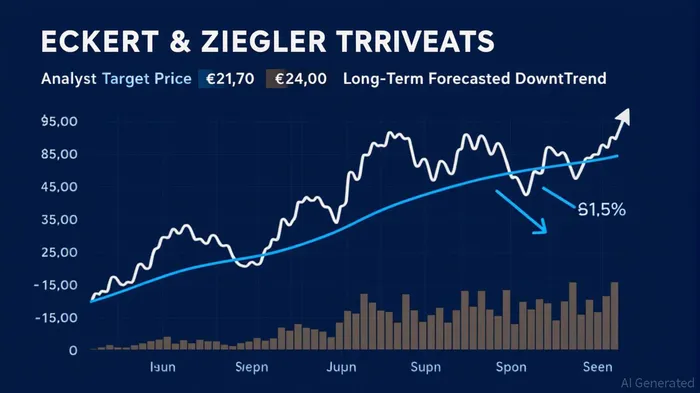
Eckert & Ziegler's stock has oscillated between €12.27 and €23.25 over the past 52 weeks, with recent analyst upgrades from Hauck Aufhäuser and Berenberg raising target prices to €21.70 and €24.00, respectively[3]. These upgrades contrast with long-term forecasts predicting a potential 100% loss over several years[3], creating a stark valuation divide. For contrarian investors, such dissonance often signals market overreaction—either to short-term risks or to overlooked fundamentals.
The company's core operations in radiopharmaceuticals and medical treatments position it as a niche player in the healthcare sector, which has historically exhibited defensive characteristics during economic downturns. However, EUZ's recent volatility suggests it may be absorbing cyclical sector dynamics, akin to home improvement or service industries that face seasonal demand swings. This duality—defensive fundamentals versus cyclical price behavior—mirrors patterns observed in Reddit-driven sentiment shifts, where retail investors often amplify sector rotations based on macroeconomic narratives[1].
Sector Rotation and Contrarian Frameworks
Sector rotation strategies hinge on aligning investments with the economic cycle. Defensive sectors like utilities and consumer staples typically outperform during uncertainty, while cyclical sectors such as industrials and energy lag[3]. Home improvement services, for instance, often underperform during interest rate hikes but rebound sharply in low-rate environments. EUZ's recent price action—rising despite lagging earnings—parallels this pattern, suggesting investors may be anticipating a shift in the economic cycle rather than reacting to current financials.
Contrarian value investing, as articulated by Warren Buffett and others, emphasizes buying undervalued assets when sentiment turns negative. EUZ's mixed signals—analyst optimism versus long-term bearish forecasts—create a fertile ground for such strategies. By applying valuation metrics like price-to-book (P/B) ratios and dividend yields, investors can assess whether the stock's current price reflects intrinsic value or market panic[2]. While EUZ's specific metrics are not disclosed in the research, its €1.11 billion market cap and recent analyst upgrades imply a potential re-rating if macroeconomic conditions stabilize.
Risk and Reward: Navigating the Contrarian Edge
The primary risk lies in the stock's volatility and the possibility of further divergence from long-term trends. If economic conditions deteriorate, EUZ's healthcare niche may not provide sufficient insulation, particularly if its medical technology clients face funding constraints. Conversely, a sector rotation toward healthcare and isotope technology—driven by aging populations or regulatory tailwinds—could unlock significant upside.
Reddit sentiment analysis, though lacking direct parallels for EUZ, highlights how retail investors often drive momentum in undervalued sectors[1]. For example, home improvement stocks have historically seen short-term rallies during periods of low interest rates, even if earnings growth lags. This behavioral dynamic suggests that EUZ's recent outperformance could be part of a broader narrative, where investors are positioning for a healthcare sector rebound.
Conclusion: A Calculated Contrarian Bet
Eckert & Ziegler's stock divergence presents a nuanced case for contrarian value investors. While its recent outperformance may reflect premature optimism, the interplay of sector rotation dynamics and valuation dislocation suggests a strategic entry point for those willing to navigate macroeconomic uncertainty. By drawing parallels to home improvement/service sectors—where sentiment-driven rotations often precede earnings recovery—investors can frame EUZ's trajectory as a test of market timing rather than a pure value play. However, the risks of further volatility and long-term bearish forecasts necessitate a disciplined approach, emphasizing position sizing and scenario analysis.







Comentarios
Aún no hay comentarios