
Analyzing CEX Bitcoin Netflow Trends and Their Implications for Institutional and Retail Investor Behavior in 2025
On-chain data has emerged as a critical lens for understanding Bitcoin's market dynamics in 2025, offering real-time insights into capital reallocation and sentiment shifts. Central to this analysis is the examination of CEX (centralized exchange) netflows, which reveal how institutional and retail investors are navigating a rapidly evolving landscape. By dissecting these trends alongside metrics like the MVRV ratio and whale activity, we can discern the divergent strategies shaping Bitcoin's trajectory.
CEX Netflows: A Barometer of Investor Sentiment
Since March 2025, BitcoinBTC-- has experienced a consistent outflow from centralized exchanges, with withdrawals exceeding deposits by nearly 10,000 BTC in the past seven days alone. Platforms like Binance, Gemini, and Bybit have been central to these movements. This pattern suggests a shift in investor priorities: individuals and institutions are increasingly transferring assets to private wallets or institutional custodians, likely to hedge against volatility or secure long-term holdings. Such outflows contrast with traditional bear market behavior, where panic selling often drives inflows to exchanges. Instead, 2025's trends reflect a more calculated approach to capital preservation.
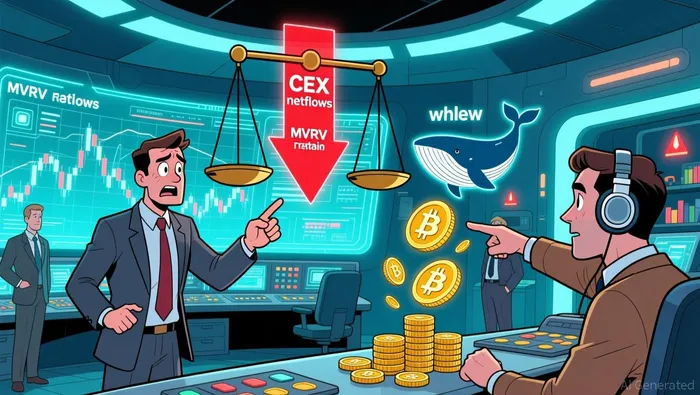
The MVRV (Market Value to Realized Value) ratio, a key on-chain metric, remains in a moderate range, indicating a healthy accumulation phase without extreme capitulation. This stability suggests that while retail investors may be dipping into the market during price dips, long-term holders are maintaining disciplined positions. Meanwhile, active addresses and transaction volume have shown a strong correlation with Bitcoin's price trends, with high activity typically preceding bullish phases. These metrics underscore the importance of on-chain data in predicting short-term market direction.
Institutional Dominance and Regulatory Tailwinds
Institutional demand for Bitcoin has surged in 2025, driven by regulatory clarity and the approval of spot Bitcoin ETFs in the U.S. and other jurisdictions. These products have not only simplified access for institutions but also anchored Bitcoin's liquidity, with off-chain financial instruments now dominating trading volume. For instance, the Chicago Mercantile Exchange (CME) now accounts for nearly 30% of global open interest in Bitcoin futures and perpetual swaps. This institutional participation has shifted market structure, reducing reliance on on-chain trading and amplifying the influence of macroeconomic factors.
Whale activity further highlights institutional caution. In late 2025, whale deposits to exchanges like Binance surged, with inflows exceeding 100 BTC doubling compared to previous highs. Such movements often signal hedging, liquidation, or portfolio rebalancing, reflecting a defensive stance amid market uncertainty. Analysts note that whale behavior typically precedes broader market shifts, as these actors operate with macro-strategic mindsets.
Retail Behavior: AI Tools and Divergent Narratives
Retail investors, meanwhile, have shown a mixed response to on-chain signals. When Bitcoin prices dipped below $86,000 in late 2025, smaller buyers increased purchasing activity, interpreting the decline as a low-risk entry point. This contrasts with long-term holders and whales, who slowed accumulation, suggesting a market in late-cycle dynamics. Retail participation is also increasingly mediated by AI-powered platforms like Token Metrics and ArkhamARKM-- Intelligence, which provide real-time analytics and sentiment tracking. These tools enable retail investors to align their strategies with institutional-grade insights, though their influence remains secondary to institutional flows.
The re-entry of dormant Bitcoin supply into the market has also spiked, as measured by rising Coin Days Destroyed. This metric indicates heightened short-term trading activity, a hallmark of retail-driven cycles. However, as institutional activity dominates price formation, retail investors are increasingly accessing Bitcoin through traditional brokerages rather than on-chain transactions.
Divergence and Market Implications
The divergence between institutional and retail behavior in 2025 underscores a transitional phase in market sentiment. While institutions adopt defensive positions-evidenced by whale inflows and ETF-driven liquidity-retail investors remain relatively passive, buying dips but lacking the capital to significantly impact price trends. This dynamic raises questions about market fragility, as large holders' cautious strategies could amplify volatility during corrections.
The MVRV ratio's moderate range further complicates this picture. Retail investors may interpret a declining MVRV as a sign of accumulation, but institutions view it as a signal to rebalance portfolios. This disconnect highlights the need for nuanced on-chain analysis, as conflicting signals from different investor classes can obscure broader trends.
Conclusion: On-Chain Data as a Strategic Tool
In 2025, on-chain data has proven indispensable for parsing the interplay between institutional and retail behavior. CEX netflows, whale activity, and metrics like the MVRV ratio offer a granular view of capital reallocation, revealing both caution and opportunism across investor segments. As regulatory frameworks solidify and AI tools democratize access to on-chain analytics, the ability to interpret these signals will become a cornerstone of investment strategy. For now, the market remains in a delicate equilibrium-where institutional prudence and retail resilience coexist, shaping Bitcoin's next chapter.






Comentarios
Aún no hay comentarios