
Amkor's Strategic Expansion in Arizona and the Future of Chip Packaging
The U.S. semiconductor industry is undergoing a transformative phase, driven by the CHIPS and Science Act of 2022. This legislation, with its $52.7 billion in federal funding, has become a cornerstone for revitalizing domestic chip manufacturing and securing supply chain resilience. Among the beneficiaries is Amkor TechnologyAMKR--, a leading outsourced semiconductor assembly and test (OSAT) provider, which has secured up to $407 million in direct funding under the CHIPS Incentives Program to build a state-of-the-art advanced packaging facility in Peoria, Arizona, as detailed in Amkor's announcement. This $2 billion project, expected to create over 2,000 high-paying jobs, underscores the strategic importance of chip packaging in the broader semiconductor ecosystem and highlights the long-term investment potential of U.S. manufacturing beneficiaries under federal incentives, according to NIST guidance.
The CHIPS Act: A Catalyst for Domestic Semiconductor Resilience
The CHIPS Act's advanced manufacturing investment credit (AMIC) offers a 25% tax credit for eligible capital expenditures, with an increase to 35% for property placed in service after December 31, 2025, as explained in a Tax Adviser analysis. These provisions, combined with grants and loans, have already catalyzed over $540 billion in private sector investments, aiming to triple U.S. chip manufacturing capacity by 2032, according to the CSIS tracker. For Amkor, the Arizona facility represents a critical step in addressing the global shortage of advanced packaging capabilities, a sector where the U.S. currently holds only 3% of capacity, compared to 81% in East Asia, as noted in a Substack post.
The facility will focus on 2.5D packaging, a technology essential for AI and high-performance computing applications. By localizing this critical process, Amkor is positioning itself to meet the growing demand for advanced packaging, which is projected to account for 30% of the global OSAT market by 2030, according to Kelly's press release. This aligns with the CHIPS Act's goal of creating an end-to-end U.S.-based semiconductor ecosystem, reducing reliance on foreign supply chains, as described in an EY overview.
Strategic Implications for Amkor and the Industry
Amkor's expansion is not an isolated case but part of a broader trend. The CHIPS Act has allocated $1.4 billion specifically for the National Advanced Packaging Manufacturing Program (NAPMP), recognizing packaging as a bottleneck in domestic chip production, as the Manufacturing Dive tracker shows. While companies like Intel, TSMC, and Samsung have dominated early funding allocations, the emphasis on OSATs like Amkor signals a shift toward diversifying the supply chain.
However, challenges remain. The global OSAT market is heavily concentrated in East Asia, with China alone accounting for 38% of capacity, as illustrated by a Visual Capitalist chart. Amkor's Arizona facility must not only compete with established players but also navigate rapid technological advancements. For instance, TSMC's progression from 20 nm to sub-3 nm technologies in a decade highlights the pace of innovation in the sector, a point emphasized in a Commerce Department blog. Amkor's success will depend on its ability to scale advanced packaging capabilities while maintaining cost efficiency.
Long-Term Investment Potential
From an investment perspective, the CHIPS Act's incentives present a compelling case for U.S. semiconductor beneficiaries. The combination of direct funding, tax credits, and workforce development programs creates a favorable environment for companies like Amkor to scale operations. According to a Goodwin Law guide, awardees must comply with national security guardrails, which could limit their exposure to geopolitical risks. Additionally, the Act's focus on job creation-Amkor's project alone will generate 4,000 jobs during peak construction-aligns with broader economic goals, enhancing long-term stability, as AZ Big Media reports.
Yet, investors must remain cautious. The CHIPS Act's success hinges on sustained federal support and the ability of companies to meet evolving technological standards. For example, the definition of "leading-edge" manufacturing is fluid, requiring continuous R&D investment. Amkor's partnerships with educational institutions to develop a skilled workforce are outlined in a Commerce press release, and its focus on 2.5D packaging is reinforced by an Arizona Commerce announcement, suggesting a proactive approach to these challenges.
Conclusion
Amkor's Arizona expansion exemplifies the strategic and financial opportunities unlocked by the CHIPS Act. By securing federal incentives to build advanced packaging capacity, the company is addressing a critical gap in the U.S. semiconductor supply chain while positioning itself for long-term growth. However, the path to domestic resilience is complex, requiring sustained innovation and geopolitical agility. For investors, the key takeaway is clear: U.S. semiconductor beneficiaries, particularly those leveraging CHIPS Act incentives, are well-positioned to capitalize on the industry's transformation-provided they navigate the challenges of a rapidly evolving global landscape.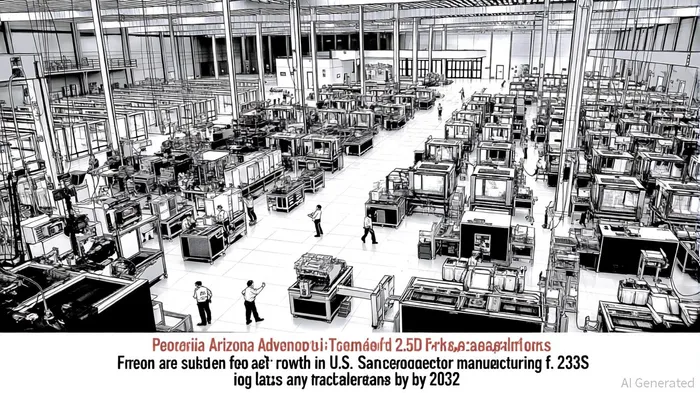





Comentarios
Aún no hay comentarios