
Amgen's $650M US Manufacturing Expansion: A Catalyst for Biotech Sector Resilience and Growth
In September 2025, AmgenAMGN-- announced a $650 million expansion of its U.S. manufacturing network, a strategic move that underscores the biotech giant's commitment to strengthening industrial resilience and reinforcing its leadership in domestic biotechnology production. This investment, focused on its biologics manufacturing facility in Juncos, Puerto Rico, is expected to create nearly 750 jobs and integrate cutting-edge technologies to enhance drug production efficiency [1]. The expansion aligns with broader industry trends, including reshoring efforts and supply chain security initiatives, which have gained urgency amid global economic uncertainties and evolving regulatory frameworks.
Strategic Resilience: Domestic Manufacturing as a Competitive Edge
Amgen's Puerto Rico expansion is part of a multiyear strategy to bolster U.S. biomanufacturing capabilities. The company has already committed $900 million to a facility in Ohio and $1 billion to a second drug substance manufacturing site in North Carolina, bringing its total U.S. investment in 2025 to over $3.4 billion [2]. These projects reflect a deliberate shift toward domestic production, driven by the need to mitigate risks associated with global supply chain disruptions, geopolitical tensions, and pharmaceutical tariffs. For instance, the U.S. Biosecure Act has compelled biotech firms to identify domestic suppliers for active pharmaceutical ingredients (APIs), a challenge Amgen is addressing through its diversified manufacturing footprint and advanced inventory management systems [3].
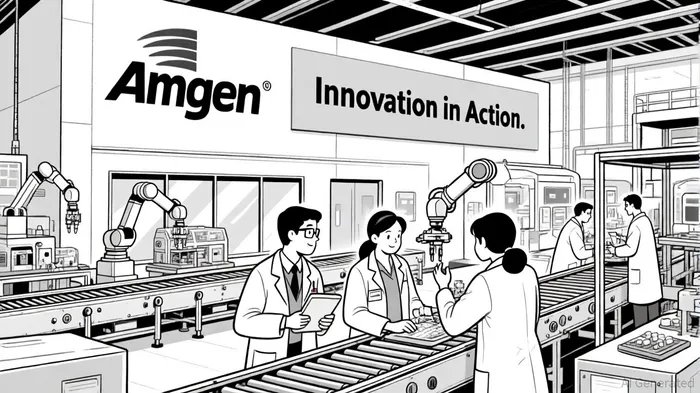
The company's approach to resilience extends beyond physical infrastructure. Amgen leverages AI-driven analytics and automation to optimize production workflows, reduce costs, and accelerate time-to-market for therapies [4]. By integrating these technologies, Amgen not only enhances operational efficiency but also sets a benchmark for the sector, demonstrating how digital transformation can address vulnerabilities in biotech supply chains.
Financial Strength and Innovation Pipeline: Sustaining Growth
Amgen's financial performance in Q1 2025 further validates its strategic direction. The company reported total revenues of $8.1 billion, a 9% year-over-year increase, with double-digit growth in key products like Repatha, BLINCYTO, and TEZSPIRE [5]. Non-GAAP operating income reached $3.6 billion, highlighting Amgen's ability to maintain profitability despite competitive pressures. This financial stability enables continued investment in R&D, with over 70 programs in development and a strong focus on oncology, obesity therapies (including GLP-1 drugs), and biosimilars [6].
The 2023 acquisition of Horizon Therapeutics has also expanded Amgen's portfolio into rare diseases, a high-growth segment expected to contribute significantly to future revenue. These strategic moves position Amgen to navigate patent cliffs for key products like Enbrel while capitalizing on emerging markets [6].
Historical analysis of Amgen's earnings release performance from 2022 to 2025 reveals mixed short-term market reactions. While the stock typically saw a modest average gain of +0.8% within four days of an earnings report (with a 57% win rate), this momentum often faded by day 15, turning negative (-1%) and showing no meaningful abnormal returns relative to benchmarks over a 30-day window. These findings suggest that while Amgen's fundamentals remain robust, investors relying on timing the market around earnings events may find limited value in a simple buy-and-hold strategy during this period.
Industry Implications: Reshoring and Sector-Wide Transformation
Amgen's expansion efforts are emblematic of a broader biotech sector trend. According to a report by Baker Tilly, pharmaceutical tariffs and regulatory shifts have accelerated reshoring, with U.S. companies prioritizing domestic production to ensure supply chain reliability [7]. Amgen's investments in Puerto Rico, Ohio, and North Carolina are not isolated but part of a collective industry response to these pressures. For example, the company's $1.5 billion commitment to North Carolina has helped establish the state as a biotech innovation hub, attracting talent and fostering collaboration with academic institutions [2].
Moreover, Amgen's emphasis on advanced manufacturing technologies aligns with sector-wide efforts to address unstructured data challenges in supply chains. By adopting knowledge management platforms and real-time analytics, Amgen enhances traceability and forecasting accuracy, mitigating risks such as vaccine wastage or regulatory delays [7]. These practices are increasingly being adopted by peers like Roche and Novartis, signaling a transformative shift in biotech operations.
Conclusion: A Model for Future-Proofing Biotech
Amgen's $650 million expansion is more than a capital investment—it is a strategic statement about the future of biotech. By prioritizing domestic manufacturing, technological innovation, and supply chain resilience, Amgen is not only securing its competitive edge but also setting a precedent for the industry. As global demand for biologics grows and regulatory landscapes evolve, companies that follow Amgen's lead in reshoring and digital transformation will likely emerge as leaders in a more resilient and dynamic biotech sector.







Comentarios
Aún no hay comentarios