
Americold Realty Trust's Q1 2025 Earnings: Navigating Challenges with Strategic Resilience
Americold Realty Trust (NYSE: COLD), a global leader in temperature-controlled logistics, reported its Q1 2025 earnings, revealing a mix of operational headwinds and strategic progress. The results highlight the company’s ability to navigate macroeconomic pressures while maintaining its focus on long-term growth. Below, we dissect the key takeaways and evaluate the investment case for COLD.
Financial Performance: Mixed Results Amid Headwinds
The quarter opened with a 5.4% decline in total revenues to $629 million, driven by lower warehouse volumes and reduced transportation services revenue. On a constant currency basis, the drop narrowed to 4.4%, indicating that currency fluctuations exacerbated the decline. Net loss widened to $16.5 million, or $0.06 per share, compared to a $0.03 profit in the prior year, as higher expenses and closed-site charges offset operational improvements.
Adjusted Funds from Operations (AFFO) fell 9% to $0.34 per share, reflecting reduced net operating income (NOI). However, Core EBITDA held at $147.6 million, with a slight margin improvement to 23.5%, thanks to cost controls and productivity gains.
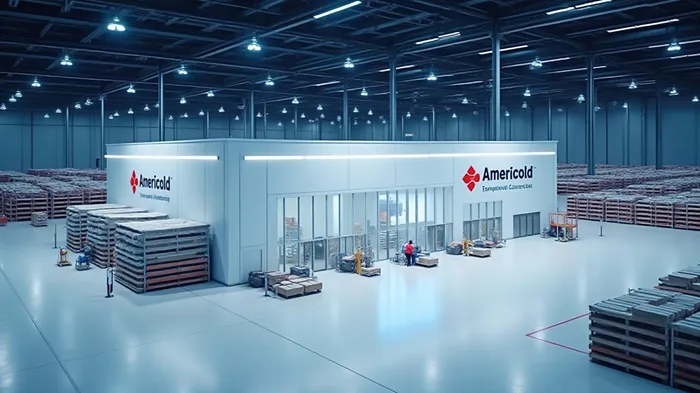
Operational Metrics: Occupancy Declines and Margin Gains
- Same-Store Revenues dropped 2.3% (1.4% on a constant currency basis), linked to softer demand and a high-comparison base from Q1 2024.
- Same-Store NOI fell 4.2%, pressured by lower occupancy rates:
- Economic occupancy slipped to 74.7%, down from 79.4% a year earlier.
- Physical occupancy declined to 63.3%, highlighting reduced inventory levels.
Despite these challenges, services margin improved to 11.3% (from 10.1% in 2024), driven by workforce productivity and cost discipline. Management emphasized that 60% of warehouse revenue now comes from fixed-commitment contracts, reducing exposure to volume volatility.
Strategic Moves and Capital Allocation
- Houston Warehouse Acquisition:
- A new fixed-commitment contract with a major global retailer was secured through the acquisition of a Houston facility. This move expanded Americold’s retail footprint, a high-margin segment requiring specialized infrastructure.
The deal also freed up space at an existing facility, optimizing inventory allocation.
Dividend Increase:
- The company raised its quarterly dividend 5% to $0.23 per share, signaling confidence in its cash flow resilience. This decision aligns with its 5-year dividend growth streak, a key investor appeal.
Balance Sheet Strength and Liquidity
Americold’s financial flexibility remains intact:
- Total liquidity stands at $651 million, including $139 million in cash.
- Net debt is $3.7 billion, with a conservative 5.9x net debt-to-Core EBITDA ratio, well within REIT benchmarks.
- 86% of debt is fixed-rate, mitigating interest rate risks, and no material maturities are due until 2026.
Challenges and Risks
- Macroeconomic Pressures: Reduced consumer spending and inventory levels, particularly in retail, have dampened demand. CEO George Chappelle noted that “credit yield volatility” and inflation continue to weigh on food producers and distributors.
- Occupancy Concerns: The 74.7% economic occupancy rate is the lowest since Q3 2021, underscoring competitive market dynamics.
Outlook: Adjusted Guidance Reflects Pragmatism
Americold revised its 2025 outlook downward but maintained a cautious optimism:
- Warehouse Same-Store Revenue Growth: Trimmed to 0–2% (from 2–4% previously).
- Adjusted FFO per Share: Now guided to $1.42–$1.52, down from $1.51–$1.59.
- Capital Expenditures: Maintained at $200–$300 million for development projects, prioritizing high-demand markets.
Conclusion: A Hold with Long-Term Upside
Americold’s Q1 results reflect the broader retail and food sector slowdowns, yet the company’s fundamentals remain robust:
- Strong Balance Sheet: Liquidity and low leverage provide a cushion for reinvestment.
- Dividend Resilience: The 5% hike underscores management’s confidence in cash flow stability.
- Strategic Wins: The Houston acquisition and fixed-contract focus position COLD to outperform peers as demand recovers.
However, investors should monitor occupancy trends and customer retention in the warehouse segment. The 5.9x debt-to-EBITDA ratio is manageable but leaves less room for margin compression.
For long-term investors, Americold’s dominance in temperature-controlled logistics—a sector critical to global food supply chains—supports a Hold rating, with upside potential if occupancy rebounds in 2025.
In summary, while near-term headwinds persist, Americold’s strategic moves and financial discipline position it to capitalize on long-term demand for cold storage infrastructure.





Comentarios
Aún no hay comentarios