
American Rebel's Share Offering and Its Implications for Investor Value
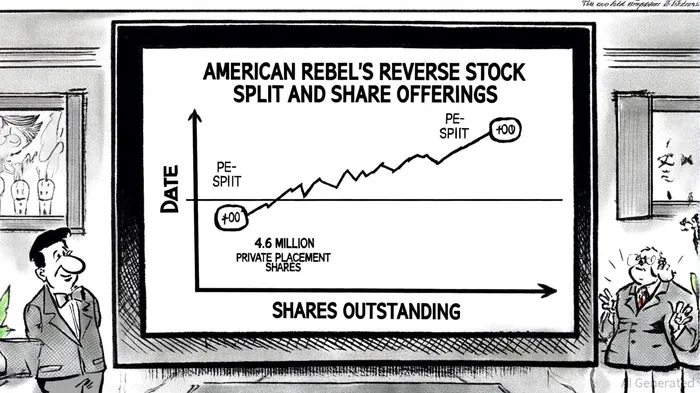
American Rebel Holdings, Inc. (NASDAQ: AREB) has embarked on a series of capital-raising initiatives in 2025, including a reverse stock split, public offerings, and private placements. These moves aim to stabilize its stock price, fund operations, and expand into new markets. However, investors must scrutinize the dilution risks and shareholder impact inherent in these strategies.
The Reverse Stock Split: A Stopgap Measure
On October 3, 2025, American RebelAREB-- will execute a 1-for-20 reverse stock split to comply with Nasdaq's $1.00 minimum bid price requirement, according to the company's announcement. This action will reduce the outstanding shares from approximately 11.27 million to 563,000, excluding round-lot protections. While the split addresses regulatory compliance, it introduces complexity for retail investors. Shareholders holding 100 or more pre-split shares will retain at least 100 post-split shares, with fractional shares rounded up, as stated in a GlobeNewswire release. However, the final post-split price will depend on the last traded price before trading halts on October 2, creating uncertainty for liquidity.
Public Offerings and Private Placements: Dilution Dynamics
In the past quarter, American Rebel raised $2.5 million through a public offering of 724,640 shares at $3.45 per share, with warrants offering an additional $8.5 million if exercised, as described in a GlobeNewswire announcement. Separately, a private placement of up to 4.6 million shares by selling stockholders has raised questions about dilution. Crucially, these shares are being resold by existing shareholders, not newly issued by the company, per the Form 424B2. Thus, the company itself does not receive proceeds from this resale, mitigating direct dilution. However, the registration of 4.76 million shares under an S-1/A filing-including warrants exercisable for up to $8.55 million-introduces indirect dilution risks.
Shareholder Impact: Balancing Capital Needs and Equity Value
The company's reliance on warrants and convertible instruments amplifies long-term dilution concerns. For instance, if all prefunded warrants and Series A/B warrants are exercised, American Rebel could see an influx of capital but at the cost of reduced ownership concentration for existing shareholders, as noted in a MarketScreener report. Additionally, the board's authority to issue further shares or preferred stock without shareholder approval heightens the risk of future dilution, as highlighted in a Yahoo Finance article.
Strategic Rationale and Investor Considerations
American Rebel's capital-raising efforts are tied to its expansion into the beverage market with American Rebel Light Beer and its core business in personal security products, according to the GlobeNewswire announcement. While these ventures could drive growth, investors must weigh the potential returns against the dilutive pressures from multiple offerings. The reverse split, though necessary for regulatory compliance, may also signal underlying financial fragility, as the company continues to seek liquidity solutions.
Conclusion
American Rebel's share offerings reflect a delicate balancing act between securing capital and preserving shareholder value. While the reverse split and private placements address immediate liquidity needs, the proliferation of warrants and potential for future share issuances pose significant dilution risks. Investors should monitor the company's ability to execute its growth strategies without further eroding equity value.





Comentarios
Aún no hay comentarios