
American Express: The Policy Shock and the Expectation Gap
The market's reaction was a classic case of a priced-in rally meeting a new, negative catalyst. American ExpressAXP-- shares fell 5.03% to $356.75 on the news, a sharp reversal after a powerful run. That move is even more telling when viewed against the stock's recent trajectory. Shares had soared 27.5% over the past 52 weeks, significantly outperforming both the broader market and its financial peers. This wasn't a stock trading on a whim; it was a stock that had already baked in a period of strong growth and positive sentiment.
The trigger was President Trump's call for a one-year, 10% cap on credit card interest rates. While not law, the announcement acted as a direct policy shock to a sector whose profitability is heavily tied to interest income. The market's swift sell-off across banks and credit card companies shows how quickly new risks can reset expectations.
This sets up a clear "sell the news" dynamic. After a year of gains, the stock had likely priced in a continuation of the status quo. The proposed rate cap introduced a tangible, near-term threat to revenue and profit models, a risk that was not fully discounted. The drop reflects investors taking profits on a rally that had already run its course, then exiting ahead of potential regulatory overhang.
Assessing the Real Impact: From Headline Risk to Financial Reality
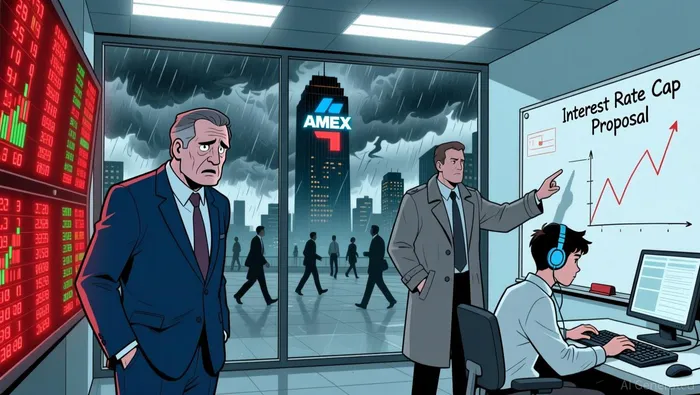
The headline threat is clear: a proposed cap on credit card interest rates directly targets the pricing power that fuels a major revenue stream for card issuers. For American Express, this is not a distant policy debate. The company's profitability is built on a model where interest rates of 20 to 30% are a key source of income, particularly for cardholders who carry balances. A mandatory 10% cap would compress the margins on this high-cost debt, representing a tangible financial risk to earnings.
Yet the market's reaction also reveals a critical expectation gap. Analysts are already questioning the cap's immediate feasibility, noting it would take an Act of Congress and face overwhelming legal challenges if attempted via executive order. This skepticism tempers the near-term threat. The real risk is more about setting a precedent and creating regulatory uncertainty, rather than an imminent, direct hit to the bottom line.
American Express's business model adds a layer of complexity. The company is more than just a card issuer; it is a global payments and premium lifestyle brand that leverages its network and services. This diversification provides a buffer, as its revenue also comes from cardholder fees and transaction processing. However, the core financial engine remains the interest income from its cardholder base. The proposed cap, therefore, threatens to squeeze the very profit center that has historically funded its premium offerings and shareholder returns.
The bottom line is a tension between a severe headline risk and a more muted, uncertain reality. The stock's drop reflects the market pricing in the worst-case scenario-a full implementation of the cap. But with significant legislative and legal hurdles ahead, the actual financial impact may be delayed or mitigated. For now, the expectation gap is wide: the policy shock is real, but its translation into financial reality is far from certain.
The Forward Look: Catalysts, Scenarios, and What to Watch
The market's sharp reaction has set the stage for a critical period of expectation calibration. The coming weeks will test whether this is a temporary overreaction to a policy shock or the start of a sustained valuation reset. Three key catalysts will determine the path.
First, the next major catalyst is the fiscal Q4 2025 earnings report scheduled for January 30. This event is pivotal. After a year of strong beats and raised guidance, the market will scrutinize management's commentary on the policy risk. The key question is guidance. If executives downplay the threat or offer no specific update, it could signal the risk is being managed. But if they acknowledge the uncertainty and adjust forward-looking metrics, even slightly, it would confirm the policy is now a priced-in headwind, likely pressuring the stock further. The whisper number for profit is already high at $3.56 per share, up 17% from a year ago. Beating that is expected; the real test is the forward view.
Second, the primary scenario to watch is the legislative timeline. The market's initial skepticism that the cap requires an Act of Congress is a crucial buffer. The real near-term driver will be whether the proposal moves from a social media post to a formal bill. As one Republican senator noted, there is "full support" for working on a bill. The progress of that bill through Congress will be a key near-term driver. A swift, bipartisan push would validate the policy threat and likely keep sector sentiment weak. Conversely, a slow or stalled legislative process would reinforce the view that the risk is overblown, potentially allowing a sector-wide rebound. The clock starts now.
Finally, a secondary but potent risk is a broader market sentiment shift. Policy concerns could dampen the sector's appeal even if the cap ultimately fails. The recent sell-off has already dulled the potential benefit from a shift toward value stocks. If the regulatory overhang persists, it may keep financial stocks in a defensive posture, limiting their ability to rally alongside the broader market. This creates a scenario where the stock's multiple compresses on uncertainty, regardless of the final legislative outcome.
The setup is clear. The January 30 earnings report will provide the first concrete look at how management sees the storm. The legislative path will determine its duration. And sector sentiment will dictate the pace of any recovery. For now, the expectation gap is wide, but the catalysts are lining up.





Comentarios
Aún no hay comentarios