
American Airlines Shares Rally 3.62% Despite 170th-Ranked Volume Amid Government Shutdown and Leadership Shifts
Market Snapshot
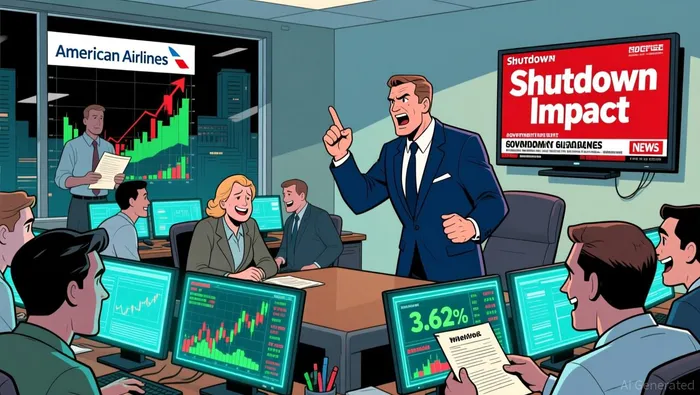
On November 12, 2025, American AirlinesAAL-- (AAL) closed with a 3.62% increase in share price, outperforming the broader market. The stock’s trading volume of $0.62 billion ranked it 170th among U.S. equities for the day, reflecting moderate liquidity. While the rally occurred amid ongoing operational challenges tied to the record-breaking U.S. government shutdown, the price movement suggests investor optimism about the company’s ability to navigate short-term disruptions.
Key Drivers
Operational Disruptions and Leadership Adjustments
American Airlines’ recent performance was shaped by a confluence of external shocks and strategic changes. The prolonged government shutdown exacerbated air traffic controller shortages, forcing the airline to cancel over 220 flights daily between November 7 and 10. CEO Robert Isom cited FAA-mandated traffic reductions of up to 10% as a compounding factor, with smaller routes like Miami-Orlando and Dallas-Fort Worth-Corpus Christi disproportionately affected. These cancellations not only strained customer relations but also highlighted the airline’s vulnerability to macroeconomic and regulatory risks.
Amid these operational headwinds, the appointment of Nat Pieper as Chief Commercial Officer on November 3, 2025, marked a strategic pivot. Pieper’s elevation to a pivotal role underscored the company’s focus on adapting to shifting demand patterns and scheduling constraints. Leadership continuity in such high-stakes roles is critical for airlines, as operational agility often determines the ability to recover lost revenue and maintain market share during crises.
Financial Projections and Investor Sentiment
Despite the immediate challenges, long-term financial forecasts for American Airlines remain cautiously optimistic. Analysts project $61.8 billion in revenue and $1.8 billion in earnings by 2028, requiring a 4.5% annual revenue growth rate and a $1.2 billion earnings expansion from 2025 levels. These projections imply a $15.02 fair value per share—a 16% upside to the current price—based on improved domestic travel demand, enhanced customer experience initiatives, and growth in high-margin loyalty programs.
However, the Simply Wall St community’s wide range of fair value estimates (from $9 to $23.15 per share) reflects divergent views on the company’s ability to offset persistent labor costs and margin pressures. While the recent flight cancellations are seen as temporary, investors remain wary of structural issues, including union negotiations and fuel price volatility, which could erode profitability even as demand rebounds.
Regulatory and Labor Dynamics
The government shutdown’s impact extended beyond operational disruptions. Transportation Secretary Sean Duffy’s warning that air traffic controllers could not afford a second missed paycheck underscored the labor crisis. With controllers calling in sick to take secondary jobs, staffing shortages worsened, compounding flight delays. This labor instability raises questions about the FAA’s capacity to manage air traffic safely and efficiently in the long term, potentially leading to recurring operational risks for airlines.
President Donald Trump’s public pressure on controllers to return to work, including threats of pay dockings, added political uncertainty. While the FAA’s phased reduction of flight traffic (from 4% to 10%) was designed to mitigate chaos, the lack of a clear resolution for the shutdown left airlines in a state of flux. American’s customer waivers and refunds for affected travelers signaled a commitment to retaining trust, but such measures come at a cost, further squeezing already thin margins.
Conclusion: Balancing Short-Term Pain and Long-Term Gains
The interplay of operational setbacks, leadership changes, and regulatory uncertainty paints a mixed picture for American Airlines. While the stock’s 3.62% gain on November 12 suggests investor confidence in the company’s resilience, the broader narrative highlights systemic vulnerabilities. The ability to execute on its 2028 financial targets will depend on resolving labor disputes, stabilizing air traffic management, and leveraging loyalty programs to offset cost pressures. For now, the airline’s performance remains a barometer of the industry’s capacity to adapt to unprecedented challenges.





Comentarios
Aún no hay comentarios