
American Airlines: Building Momentum But Still Constrained by Execution Risks
American Airlines' core revenue recovery is increasingly anchored to two levers: its loyalty program and a targeted network expansion. The carrier's AAdvantage program demonstrated tangible strength, with active accounts climbing 7% year-over-year according to the latest report. This engagement surge directly underpinned premium cabin revenue growth, a key differentiator in the current environment where cabin mix significantly influences profitability. By deepening loyalty, American not only boosts immediate premium sales but also enhances long-term customer retention and higher lifetime value, creating a more stable revenue base less vulnerable to fare volatility.
Complementing this, American is optimizing its domestic and short-haul international network through fleet renewal and expansion. The BoeingBA-- 737 MAX 8 fleet is projected to reach 88 aircraft by year-end 2025, with an average age of just 4.1 years. This younger, more fuel-efficient narrowbody fleet allows for more precise capacity deployment on high-demand routes, improving load factors and unit economics (RASM/CASM) without requiring new aircraft orders. The focus on MAX 8s, rather than expanding total seat count indiscriminately, reflects a strategy of refining network density and service frequency where demand justifies it, supporting revenue resilience through better supply-demand alignment.
However, the path forward isn't without friction. The full potential of the loyalty program is contingent on maintaining high engagement and preventing member churn. Simultaneously, integrating an additional 15 MAX 8s by year-end, plus awaiting certification for the larger MAX 10s, demands flawless operational execution to avoid disruption. Any significant delays or technical hiccups could strain capacity plans and impact customer satisfaction.
A third crucial pillar is the strategic shift back to traditional distribution channels after a recent misstep. American abandoned direct sales initiatives that previously eroded revenue share, reverting to established travel agent and online booking partner networks. This move directly targets recapturing business travel revenue, which typically commands higher fares and ancillary spend, positioning the airline more competitively alongside Delta and United on key routes. While this shift should improve revenue per seat, its full impact hinges on effectively renegotiating commission structures and ensuring partner incentives remain aligned. The transition requires careful management to avoid alienating agents or confusing customers mid-campaign.
Cost Efficiency: Margins Under Pressure Despite Annual Gains
American Airlines' cost performance shows a mixed picture in 2025. Quarterly data reveals a 2.4% jump in cost per available seat mile (CASM) to 17.49 cents in Q3, reversing earlier momentum. This rise reflects surging fuel expenses and persistent crew shortages, which squeezed margins despite higher passenger demand. Fuel prices remain volatile, with jet fuel accounting for roughly 25% of total costs, and labor inflation has accelerated as senior pilots demand premium pay.
The 2024 annual result-CASM falling 1.73% to 17.61 cents-masks ongoing structural pressures. Efficiency gains last year stemmed largely from route optimization and slower capacity growth, but those levers are nearing exhaustion. The airline now faces a dilemma: expanding routes risks overstaffing during off-peak seasons, while cutting flights could alienate hubs like Dallas-Fort Worth.
Margin sustainability hinges on navigating these tensions. Even with a 15% fuel surcharge adjustment in Q4, analysts warn that labor costs could climb another 4-6% in 2026 amid contract negotiations. While the 2024 decline proves cost discipline remains possible, the Q3 reversal signals that external frictions-geopolitical oil markets, regulatory shifts, and inflationary wage pressures-are eroding earlier progress. Investors should monitor whether fuel hedges lock in prices below $80/barrel and if workforce productivity metrics stabilize.
Fleet Modernization: Capacity Expansion with Regulatory Uncertainty
American Airlines' recent progress in fleet renewal faces a critical crossroads as regulatory hurdles threaten near-term expansion plans. The carrier's strategy hinges on two distinct BoeingBA-- 737 MAX fleets with divergent trajectories. The 737 MAX 8s, averaging just 4.1 years in age, deliver significant operational benefits, including fuel efficiency gains that directly support capacity optimization across domestic and international routes. These newer aircraft help control costs while meeting growing passenger demand. However, this progress is shadowed by the pending certification of 115 737 MAX 10 aircraft, a delay that directly jeopardizes the airline's immediate scalability ambitions for narrowbody expansion. 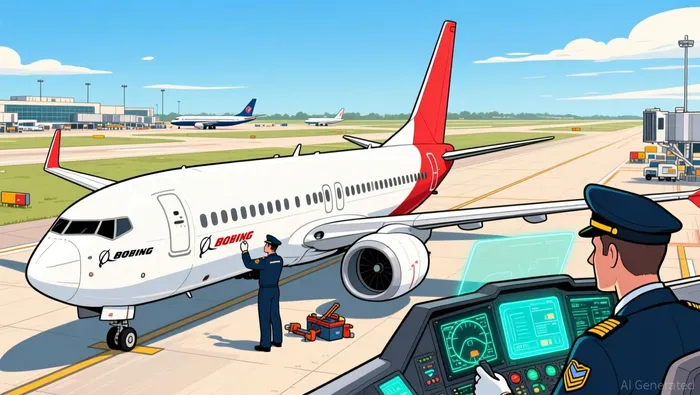 While the younger MAX 8 fleet reduces operating costs, the regulatory uncertainty surrounding the MAX 10 creates tangible execution risk, potentially overrelying on existing narrowbody capacity growth. Investors should note this tension between proven efficiency gains and unproven future capacity expansion, requiring a wait-and-see approach on the certification timeline. The broader financial context, including a reported Q3 2025 loss of $114 million and revised 2025 earnings guidance, underscores the pressure on cost management and the importance of successfully scaling capacity as demand improves.
Risk Assessment: Execution & Competitive Headwinds
American Airlines' recent Q3 financial results underscore significant headwinds against its growth trajectory, reporting a $114 million net loss despite $13.7 billion in revenue. Rising operational costs, specifically measured as CASM, are eroding margins. This pressure is amplified by intense pricing competition from major carriers Delta and United, squeezing profitability even as premium and loyalty revenue streams show improvement. The airline's strategic shift back to a traditional distribution model aims to recapture valuable business travel revenue lost during previous direct sales efforts, directly targeting the competitive gap with Delta and United.
However, near-term earnings faces a critical external risk: potential delays in the certification process for the MAX 10 aircraft. While the MAX 10 promises long-term fleet efficiency gains, any setbacks would disrupt planned capacity expansion schedules and cost savings, directly conflicting with the raised 2025 earnings outlook of 65-95 cents per share. This certification uncertainty introduces significant friction, threatening the realization of near-term profitability targets despite the underlying demand and strategic improvements.
The combination of persistent cost inflation, fierce competition hindering pricing power, and the looming MAX 10 certification risk creates substantial execution challenges. These unresolved frictions highlight the gap between the company's growth fundamentals and its ability to consistently convert operational efficiency and demand into robust quarterly profits. Investors must weigh the strategic direction against these concrete, ongoing execution hurdles and potential delays.





Comentarios
Aún no hay comentarios