
AMD's Strategic Position in the Reopening China AI Market
The U.S.-China tech rivalry has long shaped global semiconductor dynamics, but 2025 marks a pivotal inflection point for Advanced Micro DevicesAMD-- (AMD) as export policy shifts and surging AI infrastructure demand in China create a unique investment catalyst. With the Trump administration's recent recalibration of export controls, AMDAMD-- is poised to reclaim a foothold in the Chinese AI market-a sector where U.S. firms previously faced near-total exclusion. This analysis evaluates how policy changes, competitive positioning, and strategic partnerships position AMD to capitalize on China's AI infrastructure boom.
Policy Shifts: From Barriers to Conditional Access
The Biden-era AI Diffusion Rule, rescinded in May 2025, had sought to restrict U.S. AI chip exports to China via a global licensing framework. Its removal, coupled with the Trump administration's August 2025 closure of loopholes, initially signaled a hardening of export controls. However, a pragmatic reversal followed: in July 2025, the U.S. government approved AMD to resume shipments of its MI308 AI accelerators to China under a novel revenue-sharing agreement. This arrangement requires AMD to pay a 15% fee to the U.S. government on approved sales, a compromise balancing national security concerns with the need to preserve U.S. semiconductor competitiveness.
This policy shift reflects a broader recalibration of U.S. strategy. While the government banned foreign AI chips in state-funded Chinese data centers, it now allows compliant U.S. chips like the MI308 to enter the market. This creates a paradoxical scenario: China's AI industry is increasingly reliant on domestic alternatives like Huawei's Ascend 910C, yet U.S. firms retain a niche advantage in performance and ecosystem maturity. For AMD, the MI308's compliance with U.S. export rules-designed with reduced interconnect bandwidth to meet "Total Processing Performance" thresholds-opens a critical revenue stream in a market where demand for advanced AI chips remains insatiable.
China's AI Infrastructure Demand: A Tale of Two Realities
China's AI infrastructure is undergoing a dual transformation. On one hand, the government's push for self-sufficiency has accelerated domestic chip production, with Huawei and Cambricon capturing an estimated 40% of the domestic AI server market by late 2025. On the other, the performance gap between Chinese and U.S. chips remains stark. Huawei's Ascend 910C, for instance, delivers only 60% of the inference performance of NVIDIA's H100, while its reliance on SMIC's 7nm process (without EUV lithography) limits scalability and yield.
This gap is compounded by China's strategic focus on rare earth elements, which it now controls 80% of global production. While this gives Beijing leverage over supply chains critical to AI and defense technologies, it also underscores the U.S. advantage in advanced manufacturing-TSMC's CoWoS packaging and leading-edge processes remain unmatched. For AMD, the MI308's ability to leverage these U.S. manufacturing strengths positions it as a superior alternative to Chinese alternatives, even as Beijing prioritizes domestic solutions.
AMD's Competitive Positioning: Partnerships as Catalysts
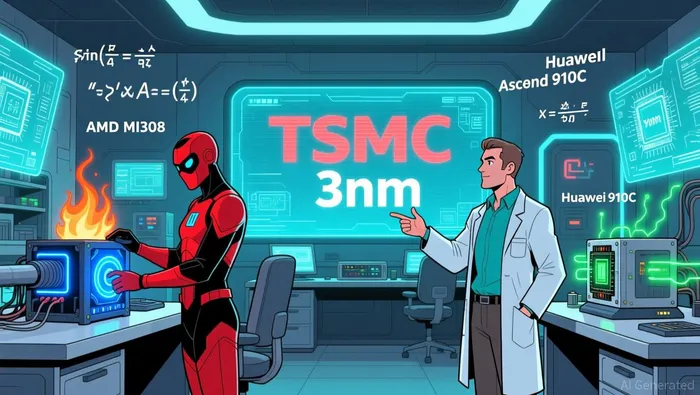 NVIDIA's dominance in the AI chip market remains formidable, but AMD's strategic partnerships are creating new avenues for growth. The most significant is its rumored $800 million–valued deal with Alibaba for 40,000–50,000 MI308 AI accelerators. If finalized, this order would not only offset earlier losses from export restrictions reported in Q2 2025 but also validate the MI308 as a viable competitor to NVIDIA's H20 in China's hyperscale data centers.
Equally impactful is AMD's October 2025 partnership with OpenAI to deploy 6 gigawatts of MI450 GPUs. This multi-year agreement includes warrants for OpenAI to purchase up to 160 million AMD shares, contingent on deployment milestones. Such high-profile partnerships signal AMD's growing credibility in the AI ecosystem, particularly as it redirects resources to North American hyperscalers like Microsoft and Oracle.
Risks and Opportunities
The 15% revenue-sharing agreement with the U.S. government introduces a financial drag but is offset by the sheer scale of China's AI market. Alibaba's potential order alone could generate hundreds of millions in revenue reported by TechNode, while the OpenAI deal ensures long-term demand for AMD's next-gen AI chips. Additionally, AMD's Q3 2025 financial results-$9.2 billion in revenue, driven by 22% year-over-year growth in its Data Center segment as reported-highlight its ability to scale amid geopolitical headwinds.
However, risks persist. The Chinese government's preference for domestic chips could limit AMD's market share, and geopolitical tensions may yet disrupt the current policy environment. Yet, given the performance and production gaps between Chinese and U.S. alternatives as reported, AMD's compliant chips remain indispensable for high-stakes applications like large-scale AI model training.
Conclusion: A Strategic Inflection Point
AMD's strategic position in the reopening China AI market is defined by three pillars: policy flexibility, technological differentiation, and strategic partnerships. The Trump administration's conditional access to the Chinese market, combined with the MI308's compliance with U.S. export rules, creates a unique window for AMD to capture revenue in a sector where demand is outpacing supply. Meanwhile, partnerships with Alibaba and OpenAI underscore AMD's ability to scale its AI offerings in both China and the global market.
For investors, this represents a compelling catalyst. While NVIDIA's dominance is unlikely to wane, AMD's agility in navigating policy shifts and leveraging its manufacturing ecosystem positions it as a key beneficiary of the U.S.-China tech rivalry. As the global AI chip market is projected to reach $846.8 billion by 2035, AMD's ability to secure a foothold in China-despite its challenges-could drive outsized returns for those willing to bet on its strategic execution.







Comentarios
Aún no hay comentarios