
AMD's Strategic Position in the AI Infrastructure Ecosystem and Why It's a Must-Have in 2025
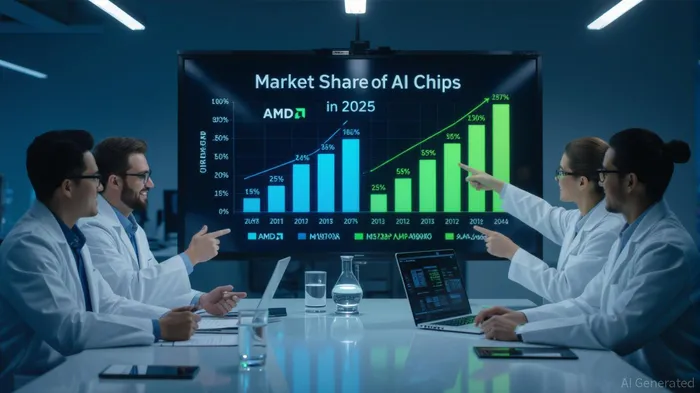
The AI chip market in 2025 is a battleground between two titans: NVIDIANVDA--, the undisputed leader, and AMDAMD--, the relentless challenger. While NVIDIA's dominance in both gaming and AI data centers remains unshakable—its data center revenue hit $115.2 billion in FY2025, accounting for 88% of total revenue—AMD is carving out a niche with a blend of hardware innovation, strategic partnerships, and a growing software ecosystem. For investors, AMD's progress in the AI infrastructure space is not just a story of catching up; it's a blueprint for long-term growth in a market projected to exceed $827 billion by 2030 [1].
Hardware Innovations: Closing the Gap in Performance and Efficiency
AMD's Instinct MI300X has emerged as a critical differentiator in the AI inference market. With 192GB of HBM3 memory and 5.3 TB/s bandwidth, the MI300X offers superior performance-per-watt efficiency, making it a cost-optimized solution for hyperscalers. Meta's deployment of 173,000 MI300X units—nearly 77% of its AI accelerator fleet—highlights its appeal in high-density workloads [2]. Meanwhile, Microsoft's adoption of 16% AMD GPUs underscores the chipmaker's growing influence in cloud and enterprise AI [3].
Looking ahead, AMD's MI400 series, slated for 2026, promises to further disrupt the market. With up to 432GB of HBM4 memory and 19.6 TB/s bandwidth, the MI400 will target memory-intensive tasks like large language model training, directly challenging NVIDIA's Blackwell architecture [4]. Analysts project that AMD's AI accelerator revenue could scale from $5 billion in 2024 to tens of billions by 2027, driven by these product advancements [5].
Software Ecosystem: ROCm's Open-Source Gambit
NVIDIA's CUDA ecosystem remains the gold standard for AI development, but AMD's ROCm platform is gaining traction. By prioritizing open-source collaboration, AMD is addressing a critical pain point for developers: vendor lock-in. As stated by AMD's VP of AI Software, Anush Elangovan, ROCm's integration of tools like VLLM and SGLANG—unavailable in proprietary stacks—positions it as a flexible alternative for open-source and cost-sensitive environments [6].
Data from Q2 2025 indicates that ROCm's GitHub activity has surged, with AMD aiming for feature parity with CUDA in PyTorch, TensorFlow, and JAX by Q3 2025 [7]. The company's goal to expand its developer community to 100,000+ active users by 2026 further signals confidence in the platform's scalability. While adoption remains a hurdle, ROCm's growth trajectory aligns with the broader industry shift toward open-source AI frameworks.
Strategic Partnerships and R&D: Fueling Long-Term Growth
AMD's partnerships with TSMCTSM-- and hyperscalers like MicrosoftMSFT-- and MetaMETA-- are pivotal to its AI strategy. By securing additional manufacturing capacity and refining yields for the MI300 series, AMD is addressing supply constraints that have historically limited its market penetration [8]. Additionally, the company's R&D investments—reaching $6.46 billion in 2024, or 24% of trailing revenue—underscore its commitment to innovation [9].
A key differentiator is AMD's vertical-specific AI accelerators. The upcoming MI350 and MI400 series will target healthcare, financial services, and automotive markets, diversifying AMD's revenue streams beyond generic AI workloads. This strategy mirrors NVIDIA's full-stack approach but leverages AMD's strengths in cost optimization and open-source adoption.
Market Projections and Risks
Despite NVIDIA's 80–85% market share in Q3 2025, AMD's growth is accelerating. Analysts predict the company could capture 13% of the AI accelerator market by 2030, driven by its product roadmap and ecosystem improvements [10]. However, risks remain: NVIDIA's CUDA dominance, Blackwell's impending launch, and the steep learning curve for ROCm adoption could slow AMD's ascent.
Conclusion: A Must-Have for the AI Era
AMD's strategic focus on hardware innovation, open-source software, and vertical-specific solutions positions it as a compelling long-term investment. While NVIDIA's dominance in premium AI training remains unchallenged, AMD's cost-optimized inference chips and ROCm ecosystem are reshaping the competitive landscape. For investors, the company's ability to capitalize on the $827 billion AI chip market by 2030—while mitigating risks through diversified partnerships and R&D—makes it a must-have in 2025.





Comentarios
Aún no hay comentarios