
AMD's Strategic Position in AI-Driven Growth: Navigating the Post-Peak AI Landscape for Long-Term Value
The global AI hardware market is on a trajectory of explosive growth, projected to expand from $66.8 billion in 2025 to $296.3 billion by 2034 at a 18% compound annual growth rate (CAGR). Amid this surge, Advanced Micro DevicesAMD-- (AMD) has positioned itself as a formidable challenger to NVIDIA's dominance, leveraging a combination of product innovation, open-source software ecosystems, and strategic partnerships to capture a growing share of the AI infrastructure market. For investors, the question is whether AMD's long-term strategy can translate into sustainable value creation in a post-peak AI landscape.
Long-Term Financial Targets and Strategic Pillars
AMD's ambitions are anchored in aggressive financial targets. The company aims to achieve a compound annual growth rate (CAGR) of over 35% in revenue and non-GAAP earnings per share (EPS) exceeding $20 by 2030. These goals are underpinned by a strategic pivot toward data center and AI markets, where AMDAMD-- expects a CAGR of over 80%. This focus aligns with broader industry trends, as AI workloads increasingly demand specialized hardware capable of handling large-scale inference and training tasks.
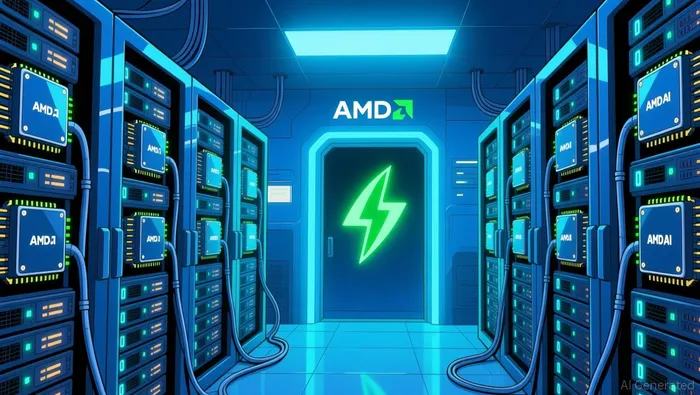 The company's confidence stems from its next-generation product roadmap, including the MI400 and MI500 GPU series, as well as the Helios Platform, which promises rack-scale performance and industry-leading memory capacity. These innovations are designed to close the performance gap with NVIDIA's Blackwell architecture, particularly in energy efficiency and cost-effectiveness-critical metrics for enterprises seeking to optimize total cost of ownership according to industry analysis.
Product Innovation and Competitive Positioning
AMD's competitive edge lies in its ability to innovate at both the hardware and software layers. The MI300X, for instance, features 192GB of HBM3 memory, surpassing NVIDIA's H100 in this metric and offering superior performance in specific workloads. Meanwhile, the MI350 series, built on a 3nm process and CDNA 4 architecture, has narrowed the performance gap with NVIDIA's offerings in large-scale inference tasks.
However, market share remains a challenge. AMD currently holds less than 10% of the AI GPU market, with NVIDIANVDA-- dominating at approximately 80%. To bridge this gap, AMD is emphasizing cost-effective solutions tailored for diverse customer segments, from startups to hyperscalers. Strategic partnerships, such as its collaboration with Oracle to build an AI supercluster using Helios racks and EPYC processors, further underscore its commitment to ecosystem-driven growth.
Software Ecosystem and Open-Source Strategy
A critical differentiator for AMD is its ROCm (Radeon Open Compute) platform, an open-source software stack that rivals NVIDIA's CUDA. ROCm has seen a 10x year-over-year increase in software downloads, reflecting growing adoption among developers and enterprises seeking vendor flexibility. This open ecosystem not only reduces dependency on proprietary tools but also fosters innovation through community-driven development.
AMD's emphasis on open standards aligns with industry shifts toward vendor-neutral solutions, as enterprises seek to avoid lock-in and optimize for interoperability. By positioning ROCm as a viable alternative to CUDA, AMD is addressing a key pain point in the AI hardware market while expanding its appeal to a broader range of users.
Edge Computing and Diversification
Beyond the data center, AMD is expanding into edge computing and industry-specific AI applications. Its adaptive and embedded portfolio, including FPGAs and semi-custom solutions, is being deployed in robotics, automotive, and industrial systems. This diversification strategy is crucial for mitigating risks associated with over-reliance on any single market segment and capitalizing on the growing demand for distributed AI workloads.
AMD's vision of a seamless compute environment-from the data center to the endpoint-positions it to benefit from the convergence of AI and edge technologies. This approach not only broadens its addressable market but also strengthens its value proposition in sectors such as autonomous vehicles and smart manufacturing.
Financial Resilience and Operational Discipline
Financially, AMD has demonstrated robust execution. In Q3 2025, the company reported record revenue of $9.2 billion, with a 46% year-over-year growth in its client segment driven by Ryzen processor demand. Despite export restrictions affecting shipments to China, AMD has maintained operational discipline, focusing on cost optimization and supply chain efficiency.
The company's energy efficiency goals-aiming for a 20x improvement by 2030-also align with investor priorities around sustainability and ESG (Environmental, Social, and Governance) criteria. By reducing the energy consumption of AI model training, AMD is addressing a key concern for enterprises seeking to balance performance with environmental impact.
Challenges and Risks
While AMD's strategy is compelling, risks remain. NVIDIA's entrenched dominance in AI server sales and its first-mover advantage in software ecosystems present significant hurdles. Additionally, the rapid pace of technological innovation requires sustained R&D investments, which could strain margins if not balanced with revenue growth.
Geopolitical factors, such as export controls and supply chain disruptions, also pose challenges. AMD's ability to navigate these risks while maintaining its competitive edge will be critical to its long-term success.
Conclusion: A High-Conviction Play in AI Infrastructure
For investors, AMD represents a high-conviction opportunity in the AI infrastructure boom. Its combination of product innovation, open-source software, and strategic diversification positions it to capture a growing share of a market expected to expand nearly fivefold by 2034. While the road to profitability is not without obstacles, AMD's long-term financial targets and operational resilience suggest a compelling value proposition for those willing to bet on the future of AI-driven computing.





Comentarios
Aún no hay comentarios