
AMD's Strategic Inflection Point: A Modern Oracle Analogy in the AI Semiconductor Era
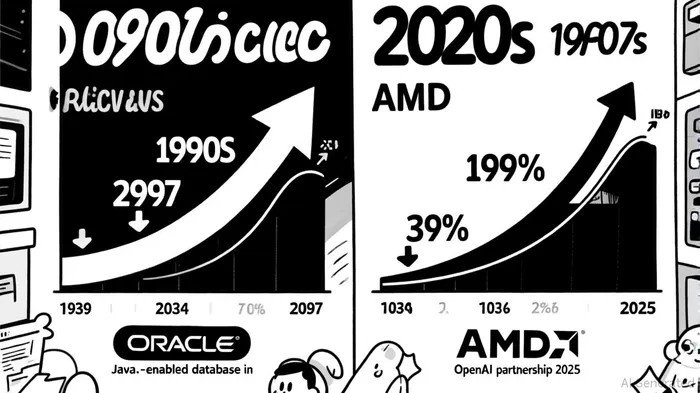
The semiconductor industry is no stranger to seismic shifts. In the 1990s, Oracle CorporationORCL-- transformed from a database specialist into a dominant force in enterprise software, leveraging strategic acquisitions, product innovation, and a bold vision for network computing. Today, Advanced Micro DevicesAMD-- (AMD) appears to be mirroring this trajectory, positioning itself at a pivotal inflection point in the AI semiconductor market. By examining Oracle's historical playbook and AMD's current moves, investors can discern a compelling narrative of disruption and growth.
Oracle's 1990s Transformation: A Blueprint for Disruption
Oracle's rise in the 1990s was driven by three pillars: product diversification, technological foresight, and strategic acquisitions. The company expanded beyond its relational database roots into enterprise software with OracleORCL-- Applications, offering integrated solutions for finance, supply chain, and customer relationship management. This move captured a broader customer base, including mid-sized and large enterprises, and solidified Oracle's dominance in the database market, according to Oracle revenue by year.
Simultaneously, Oracle adapted to the internet revolution. In 1997, it released Oracle Database 8, which added Java support-a forward-looking bet that aligned with the era's technological currents. By the late 1990s, Oracle's revenue had surged from $196 million in 1990 to over $10 billion by 2000, with a 41.3% share of the relational database market, a trend documented by DazeInfo. This growth was underpinned by a focus strategy targeting enterprise customers and a willingness to acquire complementary technologies, such as Cerner and NetSuite, to expand its ecosystem, as illustrated by Oracle acquisitions.
AMD's 2020s Inflection: A Parallel Play in AI
AMD's current strategic momentum echoes Oracle's 1990s playbook. The company has pivoted from a CPU-centric model to a diversified semiconductor leader, with AI at the core of its growth strategy. In 2025, AMDAMD-- announced a landmark partnership with OpenAI to deploy up to 6 gigawatts of Instinct MI450 Series GPUs, with the first phase of 1 gigawatt set for late 2026, according to an AMD press release. This collaboration, which includes a warrant for 160 million AMD shares tied to technical milestones, underscores AMD's role as a strategic compute partner for cutting-edge AI infrastructure, as reported by Markets FinancialContent.
Financially, AMD's growth has been nothing short of meteoric. In 2024, the company reported $25.8 billion in revenue, a 14% year-over-year increase, with its Data Center segment contributing $12.6 billion-a 94% jump from 2023, according to AMD 2024 financial results. The OpenAI deal alone is projected to generate tens of billions in revenue, accelerating AMD's ascent in the AI chip market. By 2025, AMD had captured 8% of the AI accelerator market, trailing NVIDIA's 90% dominance but gaining traction in cost-optimized inference workloads and open-source ecosystems, as noted by Business News Today.
Competitive Dynamics: NVIDIA's Fortress vs. AMD's Agility
NVIDIA's dominance in AI is underpinned by its CUDA ecosystem, full-stack software, and pricing power. In fiscal 2025, its data center revenue reached $115.2 billion, with gross margins of 74.2%-far outpacing AMD's 51% in the AI segment, figures reported by Business News Today. However, NVIDIA's strength lies in high-end training, while AMD's focus on open-source tools like ROCm and MI300X has carved a niche in inference and academic AI environments. This bifurcation mirrors Oracle's 1990s strategy of targeting specific customer segments with tailored solutions.
AMD's agility is further amplified by its open-architecture approach. Unlike NVIDIA's proprietary CUDA, ROCm fosters a more open ecosystem, attracting developers and institutions seeking flexibility. This mirrors Oracle's 1990s shift to Java, which positioned it as a web-enabling platform. As AI adoption accelerates, AMD's cost-optimized solutions are likely to gain traction in industries prioritizing scalability over peak performance.
Industry Trends and the Path Forward
The AI semiconductor market is projected to grow at a 35% CAGR, driven by demand for both training and inference workloads, according to WhatInsights. AMD's strategic alignment with OpenAI and its focus on open-source infrastructure position it to capitalize on this growth. Meanwhile, Oracle's 1990s experience offers a cautionary tale: while innovation and customer focus drive short-term gains, long-term success requires continuous adaptation. AMD must navigate challenges such as NVIDIA's entrenched ecosystem and the rising influence of cloud-native chip designs.
Conclusion: A New Era of Disruption
AMD's current trajectory mirrors Oracle's 1990s transformation in both strategy and scale. By diversifying its product portfolio, embracing open-source ecosystems, and securing high-profile partnerships, AMD is positioning itself as a formidable challenger in the AI semiconductor race. While NVIDIA's dominance remains formidable, AMD's agility and focus on cost-optimized solutions create a compelling narrative for long-term growth. For investors, the parallels to Oracle's historical inflection point suggest that AMD is not merely catching up-it is redefining the rules of the game.





Comentarios
Aún no hay comentarios