
AMD's Strategic Gambit in the AI Semiconductor Supercycle: A $100 Billion Bet on Long-Term Dominance
The semiconductor industry is witnessing a seismic shift as AI-driven demand reshapes the competitive landscape. At the center of this transformation is Advanced Micro DevicesAMD-- (AMD), whose recent $100 billion partnership with OpenAI has redefined its strategic positioning. This deal, coupled with aggressive R&D investments and a forward-looking product roadmap, positions AMDAMD-- as a formidable challenger to NVIDIA's AI dominance. For investors, the question is no longer whether AMD can compete in the AI era-it's how quickly it can scale to parity and beyond.
The OpenAI Partnership: A Strategic Masterstroke
AMD's collaboration with OpenAI is more than a revenue windfall; it's a structural repositioning. By securing a multi-year, multi-generation agreement to supply up to 6 gigawatts of Instinct MI450 GPUs, AMD has locked in a client that represents the cutting edge of AI innovation. The initial 1 gigawatt deployment, set for late 2026, will generate tens of billions in annual revenue, with total proceeds potentially exceeding $100 billion over four years, according to AMD's announcement.
What makes this deal unique is its equity component. OpenAI received a warrant for 160 million AMD shares, exercisable at 1 cent per share, with vesting tied to both AMD's stock performance and OpenAI's deployment milestones, as detailed in AMD's announcement. This structure creates a symbiotic relationship: AMD's success in scaling its AI hardware directly increases OpenAI's ownership stake, aligning incentives in a way that traditional vendor-client agreements rarely achieve.
For OpenAI, the partnership is a strategic hedge against NVIDIANVDA--. While the two companies also have a $100 billion equity and data partnership, as noted in Forbes, diversifying suppliers reduces supply chain risks and fosters competitive pricing. For AMD, it's validation of its ability to deliver high-performance, scalable solutions to the most demanding AI workloads.
R&D and Roadmap: Closing the Gap with NVIDIA
AMD's ascent in the AI semiconductor market is underpinned by relentless R&D investment. In 2024, the company allocated $6.46 billion-25% of its revenue-to AI semiconductor development, according to Migovi, a figure that underscores its commitment to innovation. This spending has fueled a product roadmap that directly challenges NVIDIA's dominance.
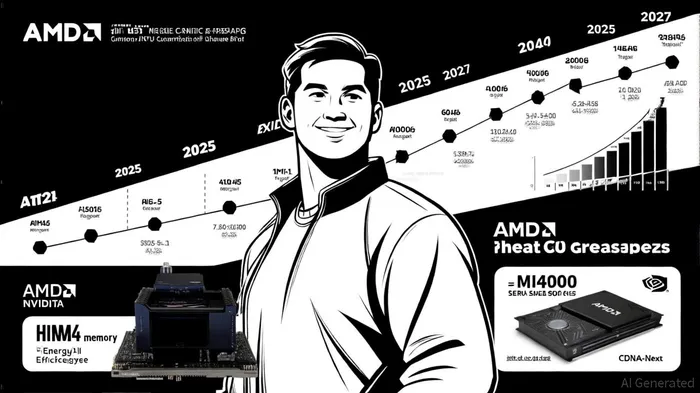
The MI400 series, launching in 2026, will feature the CDNA-Next architecture, HBM4 memory (up to 432 GB), and 19.6 TB/s bandwidth. These advancements are critical for handling large-scale AI models, particularly Mixture of Experts (MoE) architectures, where memory bandwidth and parallelism are bottlenecks. By 2027, the MI500X series will integrate with Zen 7-based EPYC "Verano" CPUs and Pensando "Vulcano" NICs, enabling rack-scale systems with unprecedented performance density.
AMD's focus on energy efficiency further differentiates it. The company aims to achieve a 20x improvement in rack-scale energy efficiency by 2030, reducing total cost of ownership (TCO) for data centers. In an industry where power consumption is a major constraint, this could become a decisive competitive edge.
Competitive Advantages: Open Ecosystems and Pricing Power
While NVIDIA commands 94% of the AI GPU market, according to a MarketMinute article, AMD's open-source ROCm platform and cost-effective solutions are eroding its lead. The MI300X and MI350X series have already attracted hyperscalers like Microsoft, Meta, and Oracle, proving that AMD's hardware can meet enterprise-grade demands. The OpenAI deal now adds another high-profile client, reinforcing AMD's credibility.
AMD's high core-count EPYC processors and energy-efficient designs also position it to capture workloads in hybrid AI-HPC environments. Unlike NVIDIA's closed ecosystem, AMD's open approach fosters interoperability, appealing to organizations wary of vendor lock-in. This is particularly relevant as AI developers increasingly influence hardware design-a trend the OpenAI partnership exemplifies.
Long-Term Implications: A New Era of AI Infrastructure
The AMD-OpenAI deal signals a broader industry shift. As AI developers become active stakeholders in hardware development, the traditional vendor-client dynamic is evolving into a collaborative ecosystem. This trend could accelerate AMD's market share growth, which stood at 8% in AI data centers in 2025, to 15% by 2027.
For investors, the key risks lie in execution. Can AMD scale production to meet OpenAI's 6 gigawatt demand? Will the MI400 and MI500 series deliver on their performance promises? And can the company sustain R&D spending amid potential margin pressures? Yet, the upside is equally compelling: a $100 billion revenue tailwind, a validated roadmap, and a market capitalization that has already surged past $300 billion post-announcement.
Conclusion: A High-Stakes Bet with High Rewards
AMD's strategic positioning in the AI semiconductor market is no longer speculative-it's a reality. The OpenAI partnership, combined with a robust product roadmap and open ecosystem strategy, creates a compelling case for long-term growth. While NVIDIA's dominance remains formidable, AMD's ability to innovate, scale, and align with industry leaders like OpenAI suggests it is no longer a challenger but a co-leader in the AI supercycle.
For investors willing to bet on the next phase of the AI revolution, AMD offers a rare combination of near-term revenue visibility and long-term disruptive potential.





Comentarios
Aún no hay comentarios