
AMD's Strategic Gambit in AI Infrastructure: A New Era of Semiconductor Rivalry
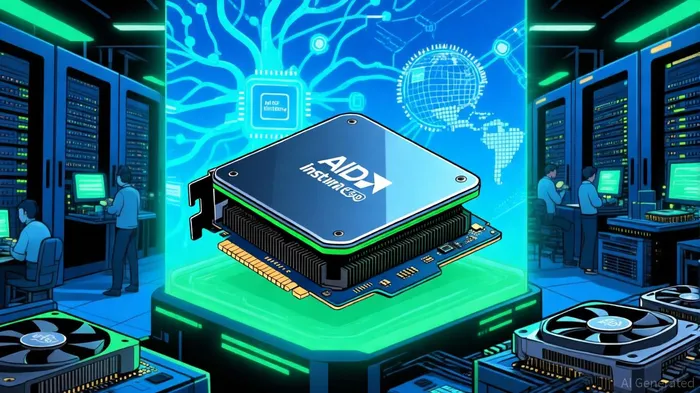
The semiconductor industry is at a pivotal inflection point, driven by the exponential growth of artificial intelligence (AI). At the heart of this transformation lies a fierce competition between chipmakers to dominate the AI infrastructure landscape. Advanced Micro DevicesAMD-- (AMD) has emerged as a formidable challenger to Nvidia's long-standing hegemony, with its recent multi-year partnership with OpenAI signaling a strategic pivot that could reshape the sector. This analysis examines AMD's positioning in the AI era, the implications of its collaboration with OpenAI, and the broader dynamics of semiconductor demand.
The OpenAI Partnership: A Strategic Masterstroke
AMD's agreement with OpenAI represents a landmark shift in the AI chip market. By securing a multi-generation supply deal to provide 6 gigawatts of AI computing power-powered by its Instinct MI450 GPUs, as AMD's press release explains-AMD is not only securing a critical client but also aligning itself with one of the most influential players in AI innovation. The partnership, which includes a warrant for OpenAI to acquire up to 160 million AMDAMD-- shares contingent on performance milestones, underscores the mutual ambition to scale AI infrastructure rapidly, according to a Daily Breeze analysis. For AMD, this deal is a validation of its technical capabilities and a direct challenge to NvidiaNVDA--, which has dominated AI training and inference with its CUDA ecosystem and H100/H200 GPUs, as reported in a Bloomberg report.
The financial stakes are enormous. Bloomberg estimates the partnership could generate tens of billions of dollars in revenue for AMD, accelerating its transition from a niche player in data center GPUs to a core supplier for next-generation AI models. OpenAI CEO Sam Altman has emphasized the deal's role in enabling "large-scale AI deployments," a necessity as models grow in complexity and data demands soar. This alignment with OpenAI positions AMD to benefit from the latter's expanding infrastructure needs, including its rumored "Azure Next" cloud initiative, as detailed in AMD's press release.
Semiconductor Demand in the AI Era: A $154 Billion Opportunity
The AI semiconductor market is surging, driven by insatiable demand for high-performance chips in data centers, cloud computing, and edge applications. By 2030, the market is projected to reach $154 billion, expanding at a 20% compound annual growth rate (CAGR), according to a GlobeNewswire report. In 2025 alone, the global semiconductor industry is on track to exceed $700 billion in sales, with AI and data center segments accounting for the lion's share of growth, per the Daily Breeze analysis. This demand is reshaping supply chains, with wafer demand expected to grow 4% annually through 2027 and AI server volumes expanding at 40–50% CAGR, according to Design News.
Nvidia remains the undisputed leader, with its Data Center segment driving record revenue of $35.1 billion in Q3 2025-a 94% year-over-year increase, as noted in the Daily Breeze analysis. However, AMD's aggressive R&D investments and competitive pricing are narrowing the gap. The company's Data Center segment contributed $3.2 billion to its Q2 2025 revenue, with AI-related revenue projected to hit $9.5 billion for the year, according to the same analysis. Intel, meanwhile, is regaining traction through a $5 billion partnership with Nvidia and a 40% stake in next-generation AI infrastructure, though manufacturing delays and ecosystem fragmentation persist.
Technical Capabilities: MI450X vs. Nvidia's Blackwell
AMD's Instinct MI450X GPU is a cornerstone of its AI strategy. Built on TSMC's 3nm node and CoWoS-L packaging, the MI450X boasts 288 GB of HBM4 memory, 18 TB/s bandwidth, and 50 PetaFLOPS of FP4 compute per GPU, details highlighted in AMD's press release. In a rack-scale IF128 configuration, it could deliver 6,400 PetaFLOPS of FP4 performance-surpassing Nvidia's NVL144 system, which offers 3,600 PetaFLOPS. The MI450X's Infinity Fabric interconnect and 800GbE NICs also promise reduced bottlenecks in distributed training, a critical advantage for large models.
However, Nvidia's upcoming Blackwell architecture-featuring the B300 and Rubin GPUs-threatens to close this gap. The B300 is expected to deliver 15 PetaFLOPS of FP4 performance per GPU, while the Rubin platform (launching in late 2026) could offer 50 PetaFLOPS. Nvidia's dominance in FP16 performance (1979 TFLOPS for the H100) and Tensor Core technology further solidify its lead in training efficiency, as discussed in a sanj.dev analysis. AMD's ROCm software ecosystem, though improving, still lags behind CUDA in developer adoption and framework integration, according to the GlobeNewswire report.
Strategic Implications and Risks
AMD's partnership with OpenAI and its technical advancements position it to capture a significant share of the AI chip market. However, success hinges on overcoming software limitations and scaling production to meet surging demand. The company's "developer-first" approach to ROCm and collaborations with PyTorch and Kubernetes communities are promising, per the Daily Breeze analysis, but Nvidia's ecosystem moat remains formidable.
Geopolitical risks also loom large. U.S. export controls on advanced chips to China-a market critical for semiconductor demand-could constrain growth for all players, as AMD's press release notes. Additionally, supply chain bottlenecks, including wafer shortages and fab capacity constraints, may delay deployments, according to Design News.
Conclusion: A Definitive Challenge to the Status Quo
AMD's partnership with OpenAI is more than a commercial win-it is a strategic declaration of intent to disrupt Nvidia's dominance in AI infrastructure. With a robust roadmap, competitive hardware, and a growing software ecosystem, AMD is well-positioned to capitalize on the $154 billion AI semiconductor opportunity. Yet, the road ahead is fraught with technical, geopolitical, and competitive challenges. For investors, the key question is whether AMD can translate its hardware advantages into sustained market share gains while navigating the complexities of AI's next frontier.







Comentarios
Aún no hay comentarios