
AMD's Path to Sustained Growth and New Price Lows: Navigating AI and HPC Momentum
Advanced Micro Devices (AMD) has emerged as a formidable player in the artificial intelligence (AI) and high-performance computing (HPC) markets, driven by a combination of technological innovation and strategic partnerships. However, the company's stock price has experienced volatility in 2025, raising questions about the sustainability of its growth trajectory. This analysis examines AMD's technological leadership, market momentum, and the factors that could lead to new price lows despite its progress.
Technological Leadership: A Foundation for Growth
AMD's recent product launches underscore its commitment to competing in the AI and HPC space. The Instinct MI350 GPU, built on the CDNA 4 architecture, is designed to rival Nvidia's offerings in AI accelerator performance while emphasizing energy efficiency, according to a Monexa analysis. This GPU is a cornerstone of AMD's strategy to capture market share in data centers and hyperscale environments. Complementing this, the Ryzen AI processors integrate AI functionalities into consumer-grade hardware, enabling enhanced performance for edge computing applications, as the Monexa analysis also notes.
The company's EPYC CPUs have also driven growth, with a 24.2% server market share in 2025-up from 23.3% in 2024. This growth is supported by a 14.4% year-over-year increase in EPYC shipments, reflecting strong demand for high-core-count, energy-efficient processors in cloud and enterprise environments. A strategic partnership with OpenAI further solidifies AMD's position: OpenAI plans to deploy 6 gigawatts of AMD's MI450 Series GPUs, with the first 1 gigawatt expected in late 2026, according to an AMD press release. This collaboration is projected to generate tens of billions in revenue for AMDAMD--, aligning with its vision to scale AI infrastructure.
Market Momentum and Financial Projections
Analysts remain cautiously optimistic about AMD's financial prospects. The stock price is forecasted to range between $140 and $210 in 2025, with a consensus 12-month price target of $180.88, based on an Investing.com analysis. Northland analyst Gus Richard projects AI revenue of $9.5 billion and server revenue of $8.5 billion for 2025, driven by the MI325X GPU and EPYC adoption. Long-term forecasts suggest AMD's stock could reach $300–$427 by 2030, assuming continued success in AI and HPC markets, according to a MarketBeat forecast.
Q3 2025 results highlight AMD's momentum: revenue reached $6.8 billion, with the Data Center segment contributing $3.5 billion-more than double the prior year's figure, as reported in a Creative Strategies report. The company raised its Data Center GPU revenue guidance to $5 billion+ and announced the MI325X GPU, which offers 20% better inference performance than Nvidia's H200. Strategic acquisitions, such as ZT Systems, and the upcoming MI350 series (targeting Nvidia's Blackwell) further position AMD for growth.
Risks and Headwinds: A Balancing Act
Despite these positives, AMD faces significant challenges. The stock has corrected sharply by 20% from its July 2025 highs, creating a support zone around $150–$160, a development highlighted in the Investing.com analysis. This pullback is attributed to U.S. export restrictions, which excluded the MI308 GPU from the Chinese market and led to an $800 million charge in 2025, with an estimated $1.5 billion in lost revenue. Additionally, aggressive discounting to gain AI market share has raised concerns about margin compression, a point raised by Monexa.
Competition from NvidiaNVDA--, Broadcom, and Alibaba remains intense. AMD's reliance on heavy discounting to secure contracts has drawn comparisons to the "race to the bottom" in pricing, potentially undermining profitability. Furthermore, supply chain disruptions and geopolitical tensions could hinder AMD's ability to scale production and serve international markets.
Historical backtesting of the $150–$160 support zone reveals mixed signals for investors. Since 2022, AMD has touched this price range 93 times, with short-term (1–10 trading-day) performance showing a modest positive drift: the best average excess return of +2.23% occurs after 7 days, with a win rate above 65%. However, from day 24 onward, the pattern reverses, with cumulative excess returns turning significantly negative (-4% to -4.3%). This suggests the zone acts more as a temporary trading floor than a long-term accumulation level.
The Path Forward: Innovation vs. Execution
AMD's ability to sustain growth hinges on its execution of the next-gen MI350 and MI400 GPU roadmaps and its capacity to navigate regulatory and competitive pressures. The company's dual focus on CPUs and AI accelerators positions it to compete with Intel and Nvidia, but success will depend on maintaining strong enterprise adoption and expanding AI infrastructure partnerships, according to a Techi outlook.
Analysts remain divided: while some project a 40% upside to $230, others caution that overreliance on AI growth could lead to volatility. The recent Q3 results, which included a 22% year-over-year revenue increase and 54% gross margins, suggest AMD can deliver on its promises, as noted by Creative Strategies. However, the stock's susceptibility to macroeconomic shifts and sector-specific risks means investors must remain vigilant.
Conclusion
AMD's technological advancements and strategic partnerships have positioned it as a key player in the AI and HPC markets. However, the company's stock price volatility underscores the risks of overpaying for growth in a highly competitive sector. While the long-term outlook remains bullish, short-term headwinds-including export restrictions, margin pressures, and intense competition-could lead to new price lows. Investors should monitor AMD's ability to balance innovation with profitability as it navigates this complex landscape.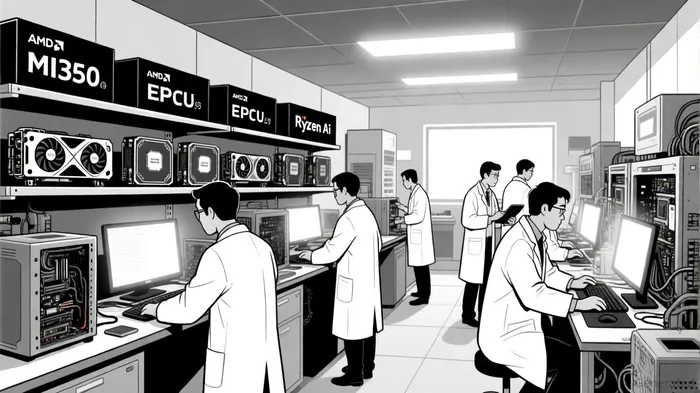







Comentarios
Aún no hay comentarios