
AMD vs. Intel: Which Semiconductor Stock Offers a Stronger Growth Catalyst for 2026?
The semiconductor industry in 2026 is poised for a pivotal year, with Advanced Micro DevicesAMD-- (AMD) and IntelINTC-- emerging as two of the most scrutinized players. As artificial intelligence (AI) and high-performance computing (HPC) reshape global demand, investors are increasingly focused on which company offers a more compelling growth trajectory. This analysis evaluates AMDAMD-- and Intel through three critical lenses: top-line momentum, margin expansion, and valuation dynamics, drawing on Q3 2025 financial results and forward-looking guidance.
Top-Line Momentum: AMD's Explosive Growth vs. Intel's Stagnation
AMD's third-quarter 2025 performance underscored its dominance in the compute revolution. The company reported revenue of $9.2 billion, a 36% year-over-year (YoY) increase, with its Data Center segment contributing $4.3 billion-up 22% YoY-driven by strong adoption of 5th Gen EPYC processors and Instinct MI350 Series GPUs. This segment's growth was further bolstered by over 160 EPYC-powered instances launched by hyperscalers like Google, Microsoft Azure, and Alibaba. Meanwhile, the Client and Gaming segment surged 73% YoY, with gaming revenue alone rising 181%.
In contrast, Intel's Q3 2025 revenue of $13.7 billion reflected a modest 3% YoY increase. While its Client Computing Group grew 5% YoY to $8.5 billion, the Data Center and AI segment declined 1% YoY to $4.1 billion according to Intel's financial results. This divergence highlights AMD's ability to capitalize on AI-driven demand, whereas Intel's top-line growth remains constrained by a shrinking data center market and slower adoption of its newer products.
Margin Expansion: AMD's Profitability Surge vs. Intel's Cost-Driven Turnaround
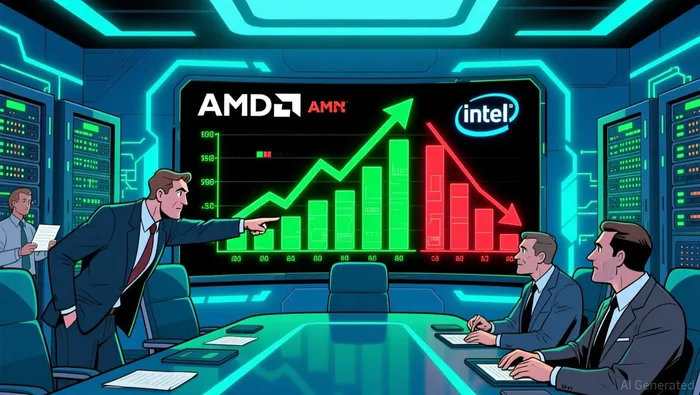 AMD's gross margin expansion in Q3 2025 was nothing short of remarkable. The company achieved a non-GAAP gross margin of 54%, up 11 percentage points quarter-over-quarter and 12 points year-over-year. This reflects efficient cost management and pricing power in high-margin segments like data center and gaming. For Q4 2025, AMD projects a non-GAAP gross margin of 54.5%, signaling continued margin resilience.
Intel, meanwhile, has seen gross margins improve from 15% (GAAP) and 18% (non-GAAP) in Q3 2024 to 38.2% (GAAP) and 40% (non-GAAP) in Q3 2025 according to Intel's financial results. While this represents progress, it remains significantly below AMD's levels. Intel's margin gains are largely cost-driven, stemming from restructuring efforts and foundry optimization, rather than organic pricing power. Analysts caution that without meaningful top-line growth, Intel's margins may struggle to sustain this trajectory.
Valuation Dynamics: AMD's Attractive Premium vs. Intel's Elevated Risk
As of Q3 2025, AMD's forward P/E ratio for 2026 is projected at approximately 40x, reflecting investor confidence in its 35%+ revenue CAGR and expanding AI/HPC leadership. This compares favorably to Intel's forward P/E of nearly 70x, which some analysts argue is stretched given its uncertain revenue outlook and reliance on cost-cutting to drive earnings growth according to investing.com analysis.
AMD's valuation is also supported by its earnings potential. Analysts project a 62% spike in earnings for 2026, driven by robust demand for its data center and gaming products. Wall Street's consensus price target implies 42.34% upside potential over the next 12 months according to Yahoo Finance. Intel, while expected to see a 76% earnings boost in 2026, faces headwinds from a stagnant data center market and slower revenue growth, raising questions about the sustainability of its valuation premium.
Conclusion: AMD as the Clear Growth Catalyst
For investors seeking exposure to the compute-driven economy, AMD emerges as the stronger growth catalyst for 2026. Its explosive top-line momentum, driven by AI and gaming, is matched by margin expansion and a valuation that, while elevated, is justified by its market-leading position. Intel, despite cost-driven improvements, remains constrained by a declining data center segment and a forward P/E that reflects higher risk. As the semiconductor industry pivots toward AI and HPC, AMD's strategic execution and financial performance position it as the more compelling long-term bet.







Comentarios
Aún no hay comentarios