
AMD's Geopolitical Gambit: Turning Export Curbs into AI Dominance
The semiconductor industry is entering a new era of geopolitical chess, where trade restrictions and technological arms races are reshaping market dynamics. AMDAMD--, long known for its x86 rivalry with IntelINTC--, now faces a steeper challenge: navigating U.S. export curbs on China while capitalizing on the $100 billion AI infrastructure boom. Far from being a casualty of these policies, AMD has positioned itself to turn the $1.5 billion annual revenue hit from export restrictions into a springboard for long-term market share gains against rivals like NVIDIANVDA-- and Chinese competitors. Its Q2 2025 guidance and strategic pivots reveal a company leveraging adversity to accelerate its AI ambitions.
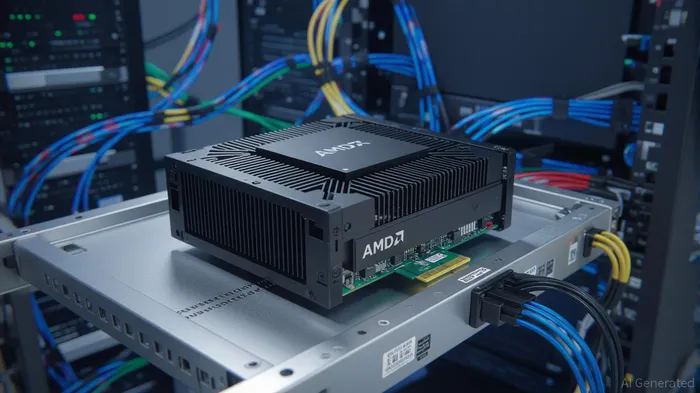
The Cost of Compliance, the Prize of Innovation
AMD's Q2 revenue guidance of $7.4 billion (+27% YoY) masks a seismic shift in its strategy. The $700 million Q2 revenue reduction (and $1.5 billion annualized impact) stems from halted shipments of its MI300X AI accelerators to China, a market that once accounted for 10% of its sales. To offset this, AMD has booked $800 million in inventory write-downs and charges related to unsellable MI300X units in Q2, with an additional $700 million expected in Q3. While these charges slashed its non-GAAP gross margin to 43% (from a projected 54%), they are one-time in nature and largely reflected in consensus estimates.
But here's the critical twist: AMD is using these constraints as a catalyst to accelerate its product roadmap. The banned MI300X and MI308X models, designed for Chinese hyperscalers, are being replaced by the MI350 series and upcoming MI400 accelerators, which avoid export restrictions by adhering to U.S. Bureau of Industry and Security (BIS) guidelines. These newer chips not only sidestep regulatory hurdles but also outperform their predecessors in AI training efficiency. For instance, the MI350X boasts 1.5 times the compute density of the MI300X and integrates advanced power management to reduce data center cooling costs—a direct hit at NVIDIA's H100/H800 dominance.
Geopolitical Tailwinds: A Double-Edged Sword Becomes a Lever
The U.S. export controls, while painful in the near term, have inadvertently created two tailwinds for AMD:
1. Market Diversification: By shifting focus from China to markets like Japan, Taiwan, and the EU—regions where U.S. allies are accelerating AI adoption—AMD is securing contracts with companies less exposed to regulatory risks. For example, Japanese cloud provider GMO Click has selected AMD's MI350 for its new AI supercomputing cluster, a deal that would have gone to NVIDIA in an unrestricted environment.
2. Product Leadership Reinforcement: The forced migration to newer architectures has accelerated AMD's AI software ecosystem. Its ROCm 6.0 platform now supports the MI350/MI400 series natively, reducing the need for Chinese customers to rely on NVIDIA's CUDA. This creates a flywheel effect: more customers using ROCm mean more developers optimize workloads for AMD's chips, deepening its competitive moat.
Meanwhile, Chinese competitors like Baidu's Kunlun and Alibaba's Hanguang are struggling to scale beyond domestic markets due to U.S. restrictions on advanced chip manufacturing tools. This leaves AMD and NVIDIA as the only viable global suppliers for high-performance AI accelerators—a duopoly AMD is now challenging with aggressive pricing.
The TAM Opportunity: AI Infrastructure's Next Phase
The total addressable market (TAM) for AI semiconductors is projected to grow from $30 billion in 2023 to $120 billion by 2027, driven by enterprise adoption of large language models and generative AI. AMD's pivot aligns perfectly with this trend:
- Data Center Momentum: AMD's EPYC “Turin” CPUs, paired with MI350 accelerators, offer a complete AI stack that undercuts NVIDIA's CPU+GPU bundles. Microsoft's Azure has already certified Turin-based servers for AI workloads, signaling a shift in cloud provider allegiances.
- Margin Resilience: Despite the write-downs, AMD's Q1 2025 data center revenue surged 50% YoY, and its free cash flow remains robust at $1.2 billion. Excluding one-time charges, its margins would have been industry-leading.
Investment Thesis: High Risk, High Reward
AMD's stock has underperformed NVIDIA by 20% year-to-date, partly due to the export curbs' immediate impact. However, the company's strategic moves suggest it is playing a long game:
- Short-Term Pain: Analysts have lowered Q2 EPS estimates to $0.57, but this reflects the one-time charges. Excluding them, EPS would have been ~$1.30, a 40% YoY increase.
- Long-Term Gain: If AMD captures 20% of the $120B AI TAM by 2027 (up from ~5% today), its AI revenue could exceed $24 billion—a growth vector that dwarfs its legacy PC and gaming businesses.
The risks are clear: further export restrictions, China's retaliatory tech policies, and NVIDIA's potential countermeasures (e.g., faster chip releases). But for investors with a 3–5 year horizon, AMD's blend of geopolitical agility and product innovation makes it a compelling contrarian play.
Conclusion: Betting on AMD's Resilience
AMD is proving that in the AI era, compliance with geopolitical realities can be a competitive advantage. By redirecting resources to next-gen products and global markets, it has turned a $1.5 billion headwind into a catalyst for market share gains. While the near-term earnings hit is undeniable, the company's focus on ROCm ecosystem lock-in, data center leadership, and BIS-compliant architectures positions it to outpace both U.S. and Chinese rivals in the years ahead. For investors willing to stomach volatility, AMD's stock—currently trading at 12x forward non-GAAP EPS excluding charges—offers a rare chance to bet on a company turning crisis into command.
Investment recommendation: Consider a staged entry into AMD, with a 6–12 month target price of $150 (20x adjusted 2025E EPS), assuming AI revenue growth meets expectations. Avoid if near-term liquidity needs require stability.





Comentarios
Aún no hay comentarios