
AMD's Bold Bet on Silicon Photonics: A Strategic Play to Dominate AI's Future
The race to dominate artificial intelligence (AI) infrastructure is no longer just about raw computing power—it's about how efficiently data moves between chips. AMD's recent acquisition of Enosemi, a Silicon Valley startup specializing in silicon photonics, marks a bold strategic shift to address this critical bottleneck. By integrating photonic technology into its AI systems, AMDAMD-- is positioning itself to leapfrog rivals like NVIDIA and capture a larger slice of the burgeoning $100 billion AI semiconductor market. This move isn't just about keeping up—it's about rewriting the rules of the game.
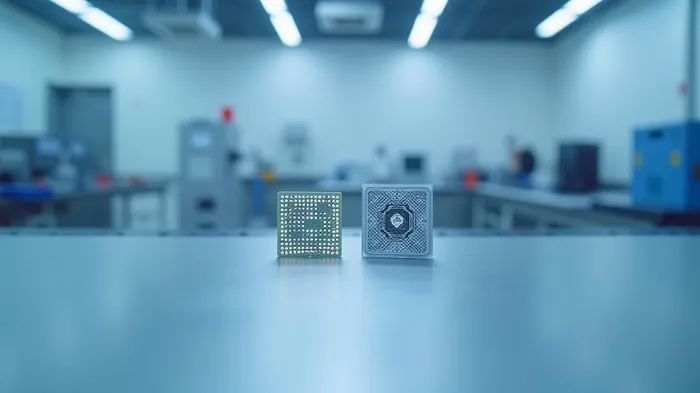
The Silicon Photonics Revolution: Why Light Matters
Silicon photonics replaces electrical signals with light to transmit data, enabling faster speeds and lower power consumption—a game-changer for AI systems. Enosemi's expertise lies in photonic integrated circuits (PICs), which can be co-packaged with CPUs or GPUs to eliminate latency and bandwidth constraints. This technology is pivotal for exascale computing, where data must move at light-speed to keep pace with ever-larger AI models. AMD's acquisition isn't merely an add-on; it's a foundational step toward solving the “memory wall” problem that limits current AI hardware.
Consider NVIDIA's lead in data center photonics, embedded in its BlueField DPU and DOCA software stack. AMD's move now puts it on equal footing, but with a unique edge: integration into its full-stack AI portfolio. Enosemi's PICs will complement AMD's Xilinx FPGAs, Pensando networking chips, and software tools (Silo AI, Mipsology), creating a cohesive ecosystem that rivals can't easily replicate.
A Strategic Reversal and Focused Bet
AMD's decision to divest ZT Systems' server manufacturing business to Sanmina in 2024—while retaining its AI-focused assets—highlighted a critical pivot: prioritize high-margin, high-impact technologies over commodity hardware. The Enosemi acquisition amplifies this strategy. By doubling down on silicon photonics, AMD is betting that data movement will be as critical as data computation in the AI era.
This focus is already paying off. AMD's AI-related revenue grew by 67% in 2024, driven by its Instinct GPU and software stack. With Enosemi's photonics, this trajectory could accelerate further.
The $100 Billion Prize: Why This Acquisition Wins
The AI semiconductor market is projected to hit $120 billion by 2027, fueled by hyperscalers, cloud providers, and enterprises racing to deploy large language models and generative AI. Silicon photonics isn't just a niche play—it's the backbone of next-gen data centers. AMD's integration of PICs into its co-packaged optics architecture allows it to offer a 30–40% improvement in bandwidth density compared to traditional interconnects. This translates to lower costs for customers and higher margins for AMD.
Moreover, Enosemi's founders—Ari Novack and Matthew Streshinsky—are no strangers to scaling breakthrough technologies. Novack's new role at AMD signals a commitment to long-term photonics R&D, far beyond what a small startup could achieve alone. This synergy could push AMD ahead in the critical race to exascale, where photonics is a non-negotiable component.
Risks and the Case for Immediate Investment
Critics may argue that photonics remains unproven at scale, but AMD's strategic patience and portfolio depth mitigate this risk. The company has already invested $4.9 billion in ZT Systems to master system design, and its sale of non-core assets freed capital for high-impact bets like Enosemi.
For investors, the calculus is clear: AMD is building a full-stack AI platform that rivals cannot match. NVIDIA's dominance is undeniable, but AMD's integration of photonics into its ecosystem creates a compelling “third way” to compete. With AI infrastructure spending set to balloon and photonics adoption accelerating, AMD stands to capture disproportionate value.
Final Analysis: Buy AMD Now
The Enosemi acquisition is more than a tactical move—it's AMD's masterstroke to dominate AI's next frontier. With silicon photonics as its secret weapon, AMD is poised to capitalize on a $100 billion market while NVIDIA struggles to defend its turf.
Investors should act now: AMD's stock trades at a P/E ratio of just 18x, far below NVIDIA's 35x, despite its accelerating AI growth. This valuation gap is unsustainable if AMD continues to outperform.
In the AI arms race, the next battlefield isn't just about who computes fastest—it's about who moves data best. AMD has just fired its first shot across the bow. Don't miss the boat.







Comentarios
Aún no hay comentarios