
AMD in 2026: The Systems-Led Challenger in the AI Super-Cycle
AMD's transformation from a chipmaker to a systems-led architect of AI infrastructure is accelerating, positioning the company as a formidable challenger in the AI-driven semiconductor sector. By integrating hardware, software, and systems into cohesive solutions, AMDAMD-- is not only addressing the technical demands of the AI supercycle but also reshaping its competitive positioning against rivals like NvidiaNVDA--. With a 2026 roadmap anchored by next-generation GPUs, open-source software ecosystems, and strategic partnerships, AMD is poised to capture a significant share of the $1 trillion AI compute market by 2030.
Data Center Dominance: The Helios Era
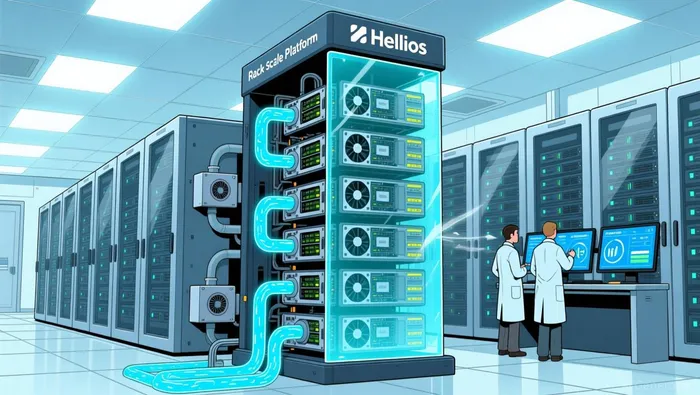
At the heart of AMD's systems integration strategy is the Helios rack-scale platform, a blueprint for yotta-scale AI infrastructure. Built on the Instinct MI455X GPU and EPYC "Venice" CPUs, Helios delivers up to 3 AI exaflops of performance in a single rack-enough to train trillion-parameter models while maintaining energy efficiency according to AMD. This modular, liquid-cooled design is already attracting hyperscalers and cloud providers, with Oracle announcing a 50,000-GPU AI supercluster based on Helios starting in Q3 2026.
The MI455X itself represents a generational leap, leveraging 2nm process technology and HBM4E memory to deliver a projected 1,000x performance increase over the MI300X series. Complementing this hardware is ROCm 7, AMD's open-source software stack, which has seen a 10-fold surge in downloads, signaling growing developer adoption. Analysts at Melius Research argue that ROCm's open ecosystem reduces vendor lock-in, making AMD an attractive partner for enterprises seeking flexibility in AI deployment.
Expanding the AI Ecosystem: From Edge to Enterprise
Beyond the data center, AMD is extending its systems integration strategy to the edge and client markets. The Ryzen AI 400 Series and Ryzen AI PRO 400 Series processors, featuring up to 60 TOPS of NPU AI compute, are enabling AI PCs and embedded systems to handle 128-billion-parameter models with 128GB unified memory. These chips are particularly appealing to enterprises requiring modern security and manageability, with early adopters including OEMs targeting premium notebooks and SFF desktops.
To accelerate development, AMD introduced the Ryzen AI Halo Developer Platform, a compact SFF PC that brings high-performance Ryzen AI Max+ Series processors to developers. Meanwhile, the AMD Developer Cloud-a fully managed cloud environment-further lowers barriers to entry for AI development, ensuring rapid deployment of next-gen compute resources.
Strategic Alliances and Market Projections
AMD's systems-led approach is bolstered by strategic partnerships and ambitious market projections. A $150 million commitment to bring AI into classrooms and communities underscores its long-term vision for democratizing AI, while the Genesis Mission-a public-private initiative-aims to secure U.S. leadership in AI technologies according to AMD. These efforts align with broader industry trends, as data center AI revenues are projected to grow at over 80% CAGR through 2030.
Financial analysts are equally bullish. At its 2025 Financial Analyst Day, AMD outlined a target of 35%+ compound annual revenue growth over the next five years, with data center AI expected to outpace even these figures. The company's recent $1 billion order from OpenAI for 6 gigawatts of Instinct GPUs-starting with 1 gigawatt of MI450s in late 2026- validates its ability to secure large-scale contracts. Wall Street has responded with elevated price targets, including Melius Research's $380/share, driven by AMD's potential to capture 10% of the AI market.
Challenges and the Road Ahead
Despite its momentum, AMD faces headwinds. Nvidia's dominance in the AI chip market remains a hurdle, and production delays for the MI450 and Helios systems could disrupt timelines. However, AMD's focus on open ecosystems and full-stack solutions-such as the upcoming MI500 Series GPUs, which promise a 1,000x performance boost over the MI300X- positions it to differentiate in a crowded landscape.
Conclusion: A Systems-First Investment Thesis
AMD's shift to systems integration is more than a technical pivot-it's a strategic repositioning to lead the AI supercycle. By combining cutting-edge hardware, open-source software, and scalable infrastructure, AMD is addressing the full spectrum of AI workloads, from data centers to edge devices. With a product roadmap that outpaces competitors and a growing ecosystem of partners, the company is well-positioned to outperform in the long term. For investors, the question is no longer whether AMD can compete in AI-it's how quickly it can capitalize on its systems-led advantage.







Comentarios
Aún no hay comentarios