
AMC's Stock Disconnect: A Historical Lens on the Box Office Recovery Trade
The market's verdict on AMCAMC-- is stark. On January 9, 2026, shares hit a new all-time low of $1.48. That plunge occurred just as the company reported its strongest pre-Christmas weekend since 2021, drawing over 4 million guests and generating $88 million domestically. This is the central anomaly: a clear operational rebound met with persistent investor skepticism.
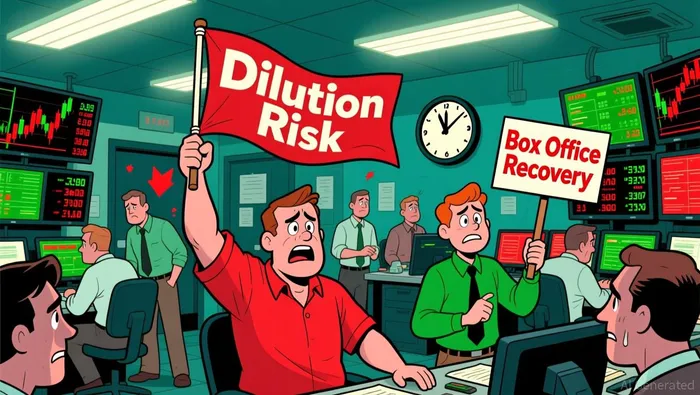
This pattern is not new. Historically, when the box office recovers, the market often looks past the immediate ticket sales to the long-term balance sheet. For AMC, that focus is now fixed on a specific future risk. An amended note agreement, part of a broader creditor deal, allows for up to $150 million in stock offerings beginning in February 2026. That looming dilution is the overhang that current performance cannot yet dispel.
The setup mirrors past cycles where operational strength was overshadowed by financial restructuring fears. The company has taken steps to improve its position, like the recent $40 million cancellation of exchangeable notes without issuing new shares. Yet, the market's technical picture underscores deep skepticism. Shares trade far below key moving averages, with the RSI at 18.83, considered oversold, signaling extreme pessimism. The bottom line is that for now, the future dilution risk is priced in more heavily than the present recovery.
Historical Precedents: When Box Office Recovery Didn't Translate to Stock Prices
The current disconnect at AMC echoes a familiar pattern in financial markets: operational strength often fails to support equity valuations when the future capital structure is in doubt. History shows the market tends to price in a worst-case outcome, not today's box office numbers.
Consider the pre-bankruptcy period of Regal Cinemas, a direct peer in the theater industry. Even as it reported strong box office results, investor focus was fixed on its insolvency risk and the potential for massive dilution through a distressed restructuring. The market's verdict was clear: the fear of a broken balance sheet overshadowed the revenue from sold tickets. This is a structural parallel to AMC's situation today, where the looming $150 million in potential stock offerings is the overhang that current performance cannot yet dispel.
The dynamic also finds a broader analogy in the dot-com bubble. High-growth tech stocks saw valuations collapse despite robust revenue growth, punished for the uncertainty of future cash flows and the risk of dilution from perpetual equity raises to fund operations. The market was not discounting today's sales; it was discounting the sustainability of the business model and the dilution that would be required to keep it alive. In both cases, the market priced in a worst-case capital structure outcome.
The bottom line is that for investors, the path to a higher stock price at AMC likely requires more than just a strong box office. It demands tangible progress in reducing the very dilution risk that the market is currently pricing in. As the company has shown with the recent $40 million cancellation of exchangeable notes without issuing new shares, steps to strengthen the balance sheet are necessary. But the market's historical lens suggests these actions must be seen as part of a credible, long-term plan to resolve the capital structure, not just isolated fixes. Until then, operational metrics may continue to be secondary to the fear of future equity issuance.
The Balance Sheet: A Legacy of Restructuring
The company's recent financial moves are a direct response to that legacy. The cornerstone is the comprehensive refinancing completed in July 2025. That transaction was designed to be a multi-pronged fix, providing new liquidity while directly attacking the debt pile. It immediately equitized at least $143 million of existing debt, with the potential to convert up to a total of $337 million. This was a critical step in reducing near-term maturities and altering the capital structure.
The durability of this effort is being tested by follow-through. Just weeks ago, AMC executed another piece of the puzzle, cancelling an additional $40 million of exchangeable notes without issuing a single new share. This brought the total reduction in that specific debt class from the July deal to $183 million. The mechanism-debt elimination tied to share price performance without dilution-was built into the original agreement. Its execution is a positive signal of creditor cooperation and a tangible reduction in future obligations.
Beyond the debt work, the company is also pruning non-core assets to focus capital. The recent sale of its stake in Hycroft Mining for $24.1 million to reinvest in its core exhibition business is a clear example of this strategic refocus. It demonstrates a shift away from speculative holdings toward strengthening the operational engine.
Yet, the market's fears persist. The July deal, while substantial, did not eliminate the risk of future dilution. The amended note agreement still allows for up to $150 million in stock offerings starting in February. This creates a tension: the company is successfully reducing debt and strengthening its balance sheet, but the path forward still involves potential equity issuance. The market is pricing in that future risk, viewing the recent restructuring as a necessary but incomplete solution. The bottom line is that AMC is actively cleaning up its balance sheet, but the historical lens shows that for investors, the fear of future dilution often outweighs the credit of past fixes.
Operational Momentum and Valuation
The operational picture is clear. The release of 'Avatar: Fire and Ash' has provided a significant near-term boost, grossing $483 million worldwide. This is the kind of blockbuster that drives box office recovery, and AMC is positioned to capture it. The company's global footprint of 860 theatres and 9,600 screens is a key asset in this cycle, giving it scale to benefit from any sustained rebound in moviegoing.
Yet, the market's valuation tells a different story. At its recent low, the company's market capitalization implies a value that discounts both this asset base and the recent operational wins. This setup is reminiscent of distressed valuations seen in past industry cycles, where the fear of a broken capital structure outweighs the revenue from sold tickets. The recent stock price action-trading far below key moving averages and with the RSI at oversold levels-reflects this deep skepticism.
The bottom line is a stark contrast. On one side, there is tangible momentum from a major film release and a global exhibition network ready to capitalize. On the other, the valuation is pricing in a worst-case capital structure outcome, likely the future dilution risk from the amended note agreement. For the stock to re-rate, the market would need to see that operational momentum translate into a credible path to resolving that balance sheet uncertainty. Until then, the valuation remains a function of risk, not revenue.
Catalysts and Risks: What to Watch
The path forward for AMC hinges on a few near-term events that will either validate or break the current thesis. The market's fear is not of today's box office, but of tomorrow's capital structure. The first and most immediate test is the amended note agreement allowing for up to $150 million in stock offerings beginning in February 2026. The mere possibility is the overhang; the market will watch to see if any actual issuance occurs. The absence of such a move would be a positive signal that the company and its creditors are managing the risk, while any dilution would likely reignite the skepticism that has kept the stock depressed.
On the operational side, the sustainability of the recent recovery is key. The performance of 'Avatar: Fire and Ash', which has grossed $483 million worldwide, will be a critical benchmark. The company's global footprint of 860 theatres and 9,600 screens is positioned to benefit, but investors need to see that this blockbuster momentum translates into a steady stream of strong releases through the first quarter. Any stumble in the film slate could quickly undermine the optimism that has driven the box office rebound.
Finally, watch for further balance sheet progress. The company has already canceled an additional $40 million of exchangeable notes without issuing shares, bringing the total reduction in that debt class to $183 million. More announcements of this nature-debt eliminated without dilution-would build credibility in the restructuring plan. Conversely, any hint of a need for additional equity raises would directly contradict the narrative of a strengthening capital structure.
The bottom line is that the setup is binary. For the stock to re-rate, the market needs to see the operational momentum from films like 'Avatar' meet a credible, tangible reduction in the dilution risk. The February earnings report on the 24th will provide a key data point, with estimates calling for a smaller loss and higher revenue. But the real catalysts will be the capital structure decisions and the box office results that follow.





Comentarios
Aún no hay comentarios