
Ambipar's Debt Restructuring Strategy and Its Implications for Shareholder Value
Ambipar Participações e Empreendimentos SA, a Brazilian waste-management company, has embarked on an aggressive debt restructuring strategy to stabilize its balance sheet and restore investor confidence. Central to this effort is the engagement of external legal counsel, including Cleary Gottlieb Steen & Hamilton and Carey Olsen, to navigate complex negotiations with creditors and optimize capital structure. This analysis evaluates the strategic and financial impact of these advisory engagements, their alignment with Ambipar's deleveraging goals, and the broader implications for shareholder value.
Strategic Rationale for External Advisers
Ambipar's decision to hire external legal expertise reflects the complexity of its debt landscape. The company, which has faced a “BB-” credit rating from both Fitch and S&P Global with fluctuating outlooks, is leveraging the experience of firms like Cleary Gottlieb, a global leader in out-of-court restructuring solutions [2]. Bloomberg Law reports that AmbiparAMBI-- is in advanced discussions to formalize Cleary Gottlieb's role in its debt negotiations, signaling a shift toward structured, stakeholder-focused strategies to avoid insolvency [1].
Carey Olsen, meanwhile, has already played a pivotal role in Ambipar's recent $400 million green bond issuance in February 2025, which included a 10.875% coupon and extended maturities to 2033. This transaction, advised by Carey Olsen's Cayman Islands team, was part of a broader effort to refinance short-term obligations and fund sustainability projects [5]. The firm also supported an earlier $750 million green bond offering in 2024 with a lower 9.875% coupon, highlighting its expertise in structuring debt to align with Ambipar's environmental mission while managing liquidity risks [4].
Financial Terms and Cost-Benefit Analysis
The financial terms negotiated by Ambipar's advisers underscore a disciplined approach to debt management. The 2025 green bond issuance, for instance, includes call options exercisable after 2029, providing flexibility to refinance at favorable rates in the future [5]. These terms contrast with the 2024 offering, where the 9.875% coupon reflected lower market volatility and investor demand. By securing extended maturities and favorable covenants, Ambipar has reduced refinancing risks and improved its debt maturity profile.
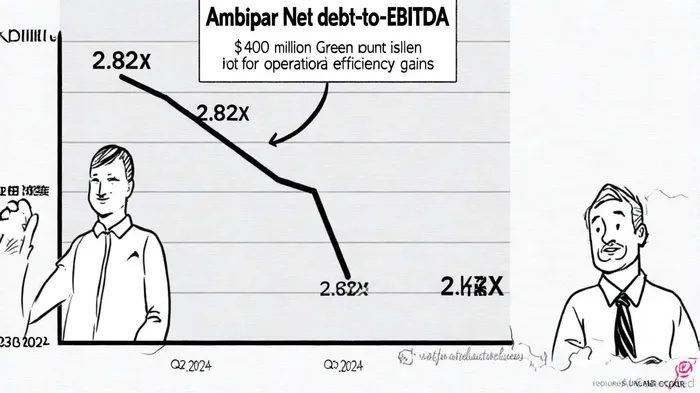
While specific adviser fees for Cleary Gottlieb and Carey Olsen are not disclosed, industry benchmarks suggest that such engagements typically involve retainer fees and success-based components. For example, M&A advisory fees for companies with similar EBITDA ranges often include retainer fees between $56–80k and success fees of 6–9% [6]. Assuming comparable structures, Ambipar's advisers could command significant compensation, though the value proposition lies in their ability to secure favorable debt terms and mitigate governance risks. Fitch has noted that Ambipar's deleveraging plan—targeting a 4.5x gross leverage ratio by 2025—has already driven operational efficiency gains, including a 0.2x reduction in net debt-to-EBITDA from Q2 to Q3 2024 [4].
Equity Performance and Valuation Metrics
The engagement of external advisers has coincided with mixed signals for Ambipar's equity performance. In 2024, Fitch upgraded the company's outlook to “Positive” following a $485.4 million debt reduction and improved operational metrics [3]. This catalyzed a temporary boost in investor sentiment, with Ambipar's market capitalization rising to $92.57 million and an enterprise value of $557.84 million by mid-2025 [7]. However, Fitch revised its outlook to “Negative” in September 2025, citing governance concerns and transparency issues [1]. This duality reflects the dual-edged nature of restructuring: while financial engineering can stabilize balance sheets, unresolved corporate governance risks may undermine long-term value creation.
Notably, Ambipar's 2023 financial results—revenue of R$5.4 billion and EBITDA of R$1.4 billion—demonstrate underlying operational strength [7]. The company's focus on organic growth and sustainability projects, funded in part by green bonds, positions it to capitalize on ESG-driven capital flows. However, the high Debt/Equity ratio of 1.71 and a current ratio of 1.79 suggest continued vulnerability to interest rate fluctuations and liquidity shocks [7].
Conclusion: Balancing Short-Term Gains and Long-Term Risks
Ambipar's debt restructuring strategy, bolstered by external advisers, has achieved tangible progress in reducing leverage and extending debt maturities. The $400 million green bond issuance and operational efficiency initiatives have strengthened its capital structure, while Cleary Gottlieb's involvement signals a commitment to structured, stakeholder-aligned solutions. However, the negative credit outlook from Fitch underscores the need for sustained governance reforms to fully realize shareholder value.
For investors, the key takeaway is that Ambipar's success hinges on its ability to balance short-term financial engineering with long-term corporate governance improvements. While the engagement of top-tier advisers has mitigated immediate insolvency risks, the company must address transparency concerns and align its restructuring efforts with ESG objectives to sustain equity gains. In a market where ESG criteria increasingly dictate capital allocation, Ambipar's trajectory offers both opportunities and cautionary lessons for stakeholders.





Comentarios
Aún no hay comentarios