
Amazon's Zoox: Pioneering the Autonomous Mobility Revolution and Its Strategic Implications for Investors
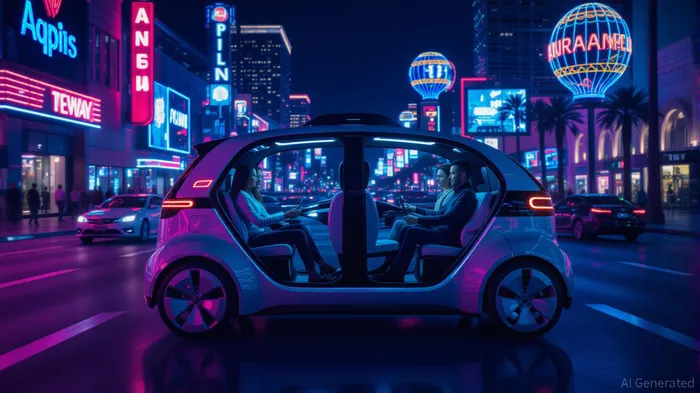
Amazon's Zoox has ignited a seismic shift in the autonomous mobility-as-a-service (MaaS) sector with its September 2025 launch of free robotaxi rides in Las Vegas. This move, backed by Amazon's $1.2 billion acquisition of Zoox in 2020 [2], positions the company as a disruptive force in a market projected to grow at a staggering 74.6% CAGR from 2025 to 2032, reaching $373.03 billion by 2032 [1]. By deploying a purpose-built, steering-wheel-free electric vehicle equipped with eight lidars, 10 radars, and 18 cameras [2], Zoox is redefining urban transportation while leveraging Amazon's vast infrastructure and financial muscle to scale rapidly.
Strategic Positioning: Zoox's Edge in the Autonomous Race
Zoox's Las Vegas launch is not merely a product rollout but a calculated strategic maneuver to outpace competitors like Waymo and TeslaTSLA--. Unlike Waymo's retrofitting approach, Zoox's vehicle was designed from the ground up for autonomy, enabling bidirectional movement and a 16-hour operational range on a single charge [2]. This design, coupled with a waiver from U.S. regulators allowing driverless operation without traditional controls [2], gives Zoox a regulatory and technological edge. Amazon's broader vision to integrate Zoox into its logistics and delivery networks further amplifies its potential. For instance, Zoox's autonomous platform could revolutionize urban Prime deliveries, micro-fulfillment centers, and even mobile retail experiences [1].
The competitive landscape is equally compelling. While Waymo dominates San Francisco with a 27% market share [2], Zoox's expansion into Las Vegas, San Francisco, and planned entries into Miami and Austin positions it to capture key urban hubs. Analysts at Bernstein predict 2025–2026 as pivotal years for transitioning from proof of concept to commercial viability [2], a timeline Zoox is accelerating with its free-ride strategy to build public trust and data sets.
Financial Implications: A High-Growth, Low-Cost Model
The financial case for Zoox is underpinned by favorable market dynamics and Amazon's ability to absorb high R&D costs. The U.S. robotaxi market, valued at $5,301.7 million in 2025, is expected to surge to $262,659.8 million by 2032 [1]. Zoox's cost structure, while initially steep ($44,000 per vehicle in 2025), is projected to decline to $32,000 by 2035 due to advancements in sensor technology and manufacturing efficiency [2]. This cost reduction, combined with Amazon's $1 billion venture fund for autonomous tech [2], ensures Zoox can scale profitably.
Revenue projections are equally robust. Goldman SachsGS-- estimates that Tesla's robo-taxi service could generate $150,000 in annual profit per vehicle [2], a benchmark Zoox could match by leveraging Amazon's pricing power and operational scale. With plans to manufacture 10,000 units annually in HaywardHAYW--, California [2], Zoox is poised to capture a significant share of the $45.28 billion U.S. autonomous vehicle market by 2030 [2].
Amazon's Ecosystem Integration: A Long-Term Play
Zoox's integration into Amazon's ecosystem is a masterstroke. By aligning with AWS's AI capabilities and Amazon's Climate Pledge (net-zero emissions by 2040), Zoox's all-electric vehicles align with both technological and environmental goals [2]. The company's machine learning models, which predict dynamic agent movements up to eight seconds in advance [2], could also enhance Amazon's logistics algorithms, optimizing delivery routes and reducing costs.
Moreover, Zoox's expansion into delivery services—such as using its robotaxis for urban Prime deliveries—creates a flywheel effect. Amazon's $155.7 billion Q1 2025 revenue [2] and AWS's 17% year-over-year growth [2] demonstrate the company's financial resilience, enabling it to subsidize Zoox's early losses while capturing long-term value.
Why Investors Should Act Now
The autonomous MaaS sector is at an inflection pointIPCX--. With Zoox's Las Vegas launch, AmazonAMZN-- has signaled its intent to dominate the next decade of urban mobility. For investors, the urgency lies in the sector's projected 74.6% CAGR [1] and Zoox's first-mover advantage in a market where early entrants capture disproportionate value. Regulatory tailwinds, such as the U.S. federal waiver for driverless operations [2], further reduce barriers to entry.
However, risks remain. Regulatory fragmentation across 29 U.S. states [2] and high initial costs could delay profitability. Yet, Amazon's balance sheet and strategic patience—evidenced by its $1.2 billion acquisition and ongoing R&D investments—position Zoox to navigate these challenges.
Conclusion
Amazon's Zoox is not just a robotaxi service; it is a catalyst for reimagining urban mobility. By combining purpose-built technology, Amazon's ecosystem, and a high-growth market, Zoox is set to disrupt traditional ride-hailing and logistics. For investors, the time to act is now—before the autonomous revolution accelerates beyond reach.





Comentarios
Aún no hay comentarios