
Amazon's Strategic AI Reorganization: A Catalyst for Catching Up in the AI Arms Race?
Amazon's recent reorganization of its AI leadership and operational structure has sparked intense debate about its ability to close the gap with AI leaders like Microsoft and Google. The company's 2025 moves-centered on executive realignments, workforce restructuring, and a renewed focus on hardware-software integration-signal a pivotal shift in its approach to artificial intelligence. But whether these changes will translate into sustained competitive advantage remains an open question, particularly as rivals double down on enterprise and consumer-facing AI innovations.
Executive Leadership: A New Guard for AI Ambition
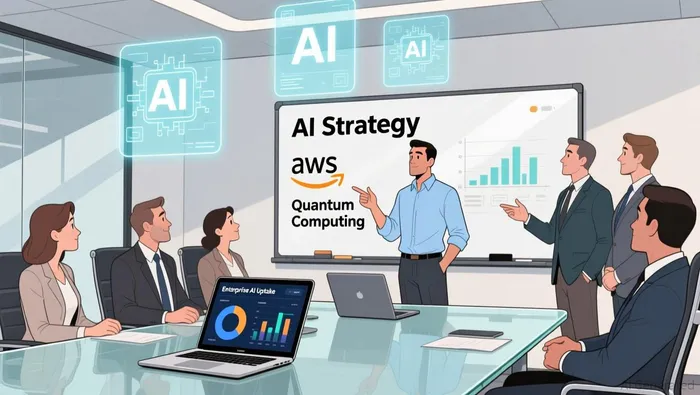
At the heart of Amazon's reorganization is the appointment of Peter DeSantis, a 27-year AWS veteran, to lead a newly consolidated unit overseeing AI, silicon development, and quantum computing according to company announcements. DeSantis, who previously oversaw AWS infrastructure and the launch of AmazonAMZN-- EC2, now reports directly to CEO Andy Jassy, underscoring the urgency of aligning AI strategy with broader corporate goals as reported by TechCrunch. This move reflects Amazon's recognition that AI is no longer a niche initiative but a core pillar of its cloud and retail ecosystems.
 However, the transition is not without turbulence. Rohit Prasad, the architect of Amazon's Nova AI models and AGI research, is departing the company by year-end according to industry reports. His exit marks the end of an era for Amazon's foundational AI work, though his contributions-such as Nova's enterprise adoption-have laid critical groundwork. To fill the void, Amazon has recruited Pieter Abbeel, a UC Berkeley professor and generative AI expert, to lead frontier model research as reported by Business Chief. Abbeel's dual focus on robotics and AGI suggests Amazon is pivoting toward more ambitious, long-term AI capabilities, even as it grapples with immediate operational challenges.
Organizational Realignment: Streamlining for Speed
Amazon's reorganization extends beyond leadership. The company announced the layoff of 14,000 corporate employees in 2025, a move Jassy framed as necessary to reduce bureaucracy and accelerate AI-driven innovation according to Investopedia. This restructuring aligns with broader industry trends, as companies like Microsoft and Google also prioritize leaner teams to outpace rivals. Yet Amazon's approach carries risks: while it aims to create a "leaner, more agile organization," critics warn that such cuts could stifle creativity or erode institutional knowledge according to a recent analysis.
The reorganization also emphasizes hardware-software convergence, with DeSantis overseeing custom silicon like Graviton and Trainium chips as reported by Pymnts. These chips are critical for optimizing AI workloads, particularly as AWS competes with Microsoft Azure and Google Cloud for enterprise AI contracts. Amazon's recent launch of the Nova 2 models at re:Invent 2025 further highlights its push to integrate AI into cloud infrastructure, offering customers scalable solutions for generative AI as reported by Investors.com.
Competitive Positioning: A B2B Play in a Consumer-Driven Race
Amazon's AI strategy diverges from its rivals. While Microsoft and Google are embedding AI into consumer-facing products (e.g., Microsoft 365 Copilot, Google Search), Amazon is doubling down on enterprise and developer customers through AWS according to a market analysis. By hosting models from Anthropic, Cohere, and Meta on its cloud platform, Amazon positions itself as the "go-to" infrastructure provider for businesses seeking AI capabilities without building their own models according to Bloomberg. This approach leverages AWS's existing dominance in cloud computing but risks underinvestment in consumer-facing AI tools, where Google and Microsoft are gaining traction.
The financial stakes are high. AWS's growth rate has lagged behind Microsoft Azure in recent years, with Amazon's cloud division losing market share from 50% in 2018 to 38% in 2025 according to market data. Bloomberg attributes this decline to AWS's "bloat" and slower AI adoption compared to competitors as reported by Bloomberg. Amazon's $4 billion investment in Anthropic and rumored $10 billion stake in OpenAI signal a belated but aggressive push to catch up according to QuiverQuant. However, these bets must contend with Microsoft's deep integration of OpenAI's GPT models into its productivity suite and Google's AI-first consumer products.
Market Reactions and Analyst Perspectives
The stock market has responded cautiously to Amazon's reorganization. While the company reported a 20.2% year-over-year growth in AWS revenue during Q3 2025 according to financial data, its stock dipped slightly after the re:Invent conference, reflecting investor skepticism about execution risks. Analysts remain divided: 30 firms issued "Buy" or "Outperform" ratings in late 2025, citing Amazon's AI infrastructure investments according to QuiverQuant, but others warn of regulatory hurdles and labor displacement challenges according to a recent analysis.
Conclusion: A Calculated Bet with Uncertain Payoffs
Amazon's AI reorganization represents a calculated bet to reclaim its position in the AI arms race. By centralizing leadership under DeSantis, streamlining operations, and emphasizing hardware-software integration, the company is addressing long-standing inefficiencies. However, its B2B-focused strategy may struggle to match the consumer-centric momentum of Microsoft and Google. For investors, the key question is whether Amazon can execute its vision without sacrificing innovation or alienating its workforce. If successful, the reorganization could position AWS as the backbone of enterprise AI. If not, Amazon risks falling further behind in a sector where speed and agility are paramount.







Comentarios
Aún no hay comentarios