
Amazon's Restructuring: A Leaner Path to AI Dominance?
Amazon's recent announcement of up to 14,000 managerial job cuts by March 2025 marks a pivotal moment in its evolution. The move, aimed at slashing costs by $3.5 billion annually, signals a strategic pivot toward leaner operations and aggressive investment in AI and automation. For investors, this raises critical questions: Will this restructuring bolster margins and competitiveness in the AI-driven tech landscape, or does it risk stifling innovation and alienating talent? Let's dissect the implications.
The Strategic Rationale: Efficiency Meets Innovation
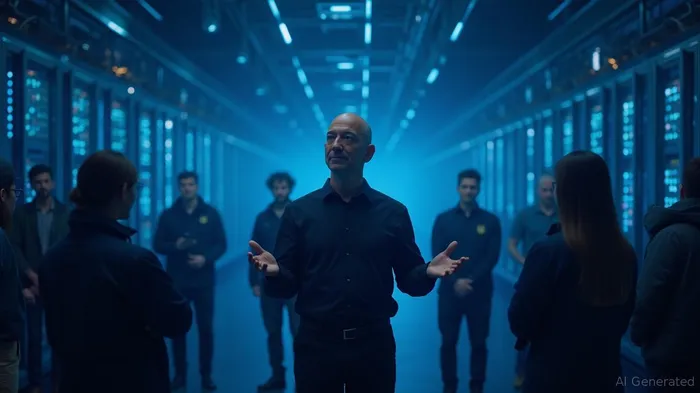
Amazon's restructuring is not merely a cost-cutting exercise. By flattening hierarchies and reducing the managerial overhead, CEO Andy Jassy aims to accelerate decision-making and free up capital for high-growth areas like AI. The $3.5 billion in annual savings will fuel advancements in tools such as AWS's Bedrock platform and Trainium2 chips, which offer 30–40% better price-performance than GPUs. These investments are critical to maintaining AWS's dominance in cloud computing, which generated $29.3 billion in Q1 2025 revenue—up 17% year-over-year.
Margin Gains: A Clear Financial Payoff
The financial upside is undeniable. Past restructurings have improved AWS's margins to a decade-high 39.5%, while North America's operating margin rose to 8.0% in Q4 2024. The 2025 capital expenditure surge—$100 billion focused on AI and logistics—aims to compound these gains. By trimming underperforming projects and focusing on scalable AI solutions, AmazonAMZN-- could replicate AWS's success in agentic AI (e.g., the 94%-accurate Nova Act model) to further differentiate itself.
The Risks: Innovation, Morale, and Competition
Yet, the risks are equally stark. Critics warn that cutting managerial roles could erode expertise and slow innovation. While AWS remains the cloud leader, competitors like Microsoft Azure (growing at 33% YoY) and Google Cloud (surging 28%) are outpacing it in AI-specific segments. Azure's integration with OpenAI and Google's Gemini 2.5 model highlight Amazon's need to move faster.
Employee morale is another concern. Amazon's “sink-or-swim” culture has already spurred exodus to rivals like Meta and Google. Flattened hierarchies may lead to burnout, particularly as remaining staff absorb extra workloads. The “bureaucracy tipline”—a tool to report inefficiencies—could backfire if perceived as punitive.
Market Perception and Near-Term Challenges
Investors remain divided. While AWS's AI investments and Prime's 200 million subscribers provide a solid foundation, Amazon's stock has lagged peers in 2025, down 12.9% year-to-date. Near-term risks loom large: unresolved tariffs on Chinese goods could force price hikes, squeezing retail margins, while supply chain bottlenecks may delay AI infrastructure scaling.
Investment Thesis: A Long Game with Execution Risks
For investors, the calculus hinges on whether Amazon can navigate these risks. The positives are compelling: AWS's cloud leadership, Prime's ecosystem dominance, and AI-driven tools like Vulcan robots (improving warehouse efficiency) position Amazon to capitalize on $117 billion in annualized cloud revenue. Long-term, the restructuring could prove a masterstroke if AWS retains its AI edge.
However, execution is key. Should Azure or Google overtake AWS in AI adoption, Amazon's margin gains could evaporate. Similarly, poor handling of workforce morale could erode its talent pipeline.
Final Verdict: Hold for Now, Watch for Catalysts
Amazon's restructuring is a bold move with high upside potential but significant execution risks. While AWS's financials remain robust, the stock's undervalued P/E ratio (33.6) suggests it's pricing in near-term headwinds. Investors should hold for now, monitoring AWS's AI revenue growth and margin trends. A turnaround in tariffs or a breakthrough in agentic AI adoption could shift sentiment to “buy.” Until then, Amazon's future hinges on balancing cost discipline with innovation—a tightrope walk that will define its next chapter.
Amazon's journey from retail giant to AI leader is far from over. For now, the stakes are high, and the rewards could be historic—if Amazon can keep its focus.





Comentarios
Aún no hay comentarios