
Amazon's Grocery Gambit: Strategic Market Penetration and Margin Potential in 2025
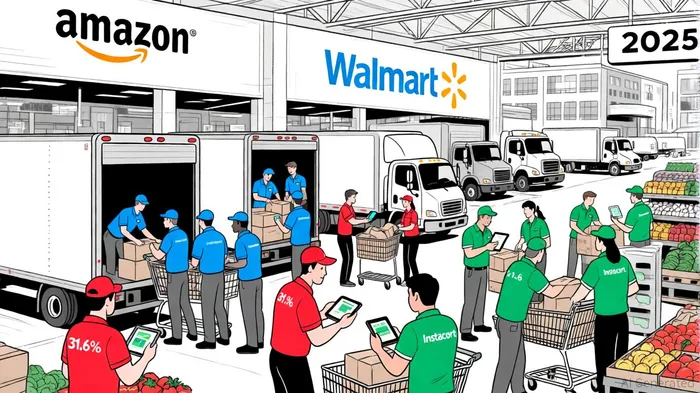
The grocery sector, long a cornerstone of retail, is undergoing a seismic shift as digital platforms redefine convenience, pricing, and logistics. AmazonAMZN--, the e-commerce juggernaut, has positioned itself as a formidable challenger to traditional grocers and delivery intermediaries. In 2025, its grocery business accounts for 22.6% of U.S. online sales, trailing Walmart's 31.6% but outpacing Instacart's 21.6% [1]. This growth, driven by aggressive delivery pricing, AI-driven personalization, and a sprawling logistics network, raises critical questions for investors: Can Amazon sustain its market penetration while improving margins? And how does its strategy stack up against entrenched competitors?
Strategic Market Penetration: Scaling Reach and Convenience
Amazon's grocery expansion hinges on three pillars: logistics, Prime integration, and price parity. By 2025, the company has extended its same-day delivery service to over 1,000 U.S. cities, with plans to reach 2,300 by year-end [2]. This expansion is underpinned by regional fulfillment centers, insulated packaging for perishables, and a fleet of electric delivery vans. For Prime members, free delivery on orders over $25 eliminates a key barrier to frequent online shopping, while non-Prime users pay a flat $12.99 fee—cheaper than Walmart+'s annual $98 subscription [5].
The company's acquisition of Whole Foods has also proven pivotal. Since 2017, Whole Foods has seen over 40% sales growth, leveraging Amazon's digital ecosystem to blend in-store and online experiences [2]. Meanwhile, Amazon Fresh and local delivery partnerships have enabled it to compete with Walmart's physical store network, which serves as both a retail outlet and fulfillment center [1].
Data from Capital OneCOF-- Shopping indicates that Amazon's online grocery sales are growing at an 8.23% annual rate, outpacing the sector's average [3]. This growth is fueled by Prime's 200 million global members, who now enjoy 1-hour delivery in select Whole Foods markets. By bundling groceries with electronics, apparel, and household goods, Amazon creates a “one-stop shop” that differentiates it from competitors like Instacart, which relies on third-party retailers [2].
Margin Potential: Logistics vs. Perishables
While Amazon's scale and automation reduce delivery costs, its grocery margins remain under scrutiny. Perishables—accounting for roughly 40% of grocery spending—pose a unique challenge. Traditional grocers like KrogerKR-- and WalmartWMT-- have long optimized supply chains for fresh produce, dairy, and meat, whereas Amazon's reliance on third-party suppliers and regional hubs introduces complexity [2].
Walmart's Walmart+ program, which offers free delivery and cash-back incentives, has proven more profitable in perishables due to its physical stores' proximity to customers [6]. Amazon, however, is investing in AI-driven inventory management and warehouse robots to mitigate waste and improve efficiency [2]. Its “Subscribe & Save” program further enhances margins by locking in recurring purchases for non-perishables [4].
Instacart's intermediary model, meanwhile, avoids inventory costs but faces rising delivery expenses. By pushing retailers to price at or above in-store levels, Instacart has boosted sales growth for partners but faces margin pressure from Amazon's undercutting [3].
Competitive Dynamics and Long-Term Risks
Walmart's dominance in the grocery sector is bolstered by its 21% overall market share (vs. Amazon's 22% online) and its ability to cross-sell household essentials [3]. Its physical stores act as anchors for online orders, reducing last-mile delivery costs. Amazon, by contrast, must continue scaling its logistics infrastructure to match this efficiency.
Instacart's 57.7% share of grocery delivery intermediary sales [3] highlights the importance of convenience, but its lack of inventory exposes it to margin volatility. Amazon's hybrid model—owning inventory for core products while leveraging third-party sellers—offers a middle ground, though it risks alienating suppliers if pricing becomes too aggressive.
For investors, the key question is whether Amazon can achieve grocery margins comparable to its core e-commerce business. While its 2025 gross margin for groceries remains undisclosed, analysts estimate it lags behind Walmart's 24% margin in the sector [1]. Amazon's focus on unit economics—prioritizing volume over immediate profitability—suggests a long-term play, but rising labor and fuel costs could strain margins if not offset by automation.
Conclusion: A Strategic Bet on Scale and Innovation
Amazon's grocery business is a high-stakes bet on digital transformation. Its ability to integrate AI, logistics, and Prime loyalty positions it to capture a larger share of the $43.8 billion U.S. online grocery market [3]. However, profitability hinges on overcoming perishable goods challenges and sustaining delivery cost advantages.
For investors, the path forward depends on two factors: execution and competition. If Amazon can replicate its e-commerce margin model in groceries—leveraging scale and data-driven pricing—it could cement its dominance. But Walmart's physical network and Instacart's delivery agility remain formidable threats.







Comentarios
Aún no hay comentarios