
Amazon's Alexa+ Ecosystem as the Next Big AI Infrastructure Play
The AI assistant landscape in 2025 is no longer defined by isolated tools but by ecosystems capable of seamless cross-platform integration. Amazon's Alexa+ represents a pivotal shift in this evolution, positioning itself as a universal intermediary for consumer AI interactions. By leveraging its dominance in smart speakers, expanding into web and wearable platforms, and forging strategic partnerships, Alexa+ is not just competing with generative AI chatbots like ChatGPT or Google Gemini-it is redefining the infrastructure layer of consumer AI.
The Cross-Platform Revolution: From Voice to Web to Wearables
Amazon's Alexa+ has transcended its origins as a voice-activated smart speaker assistant. At CES 2026, the company launched , a web-based interface that mirrors the functionality of AI chatbots while retaining Alexa's device-integrated capabilities. This move democratizes access to Alexa+, enabling users to interact with it via browsers, mobile apps, or wearable devices like the Bee wrist device. The result is an AI assistant that operates across multiple surfaces-home, web, and mobile-without requiring users to switch contexts.
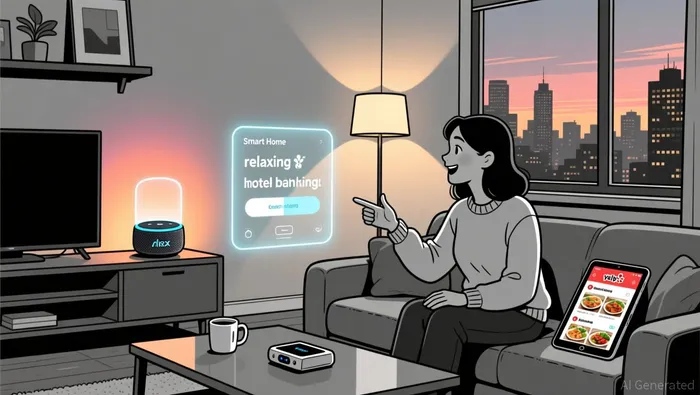
The platform's architecture has also evolved from passive response to active execution. For instance, Alexa+ can now orchestrate multi-step tasks such as booking a hotel via Expedia, generating a meal plan using Yelp, and adjusting smart home devices-all within a single conversation. This agentic capability is powered by deep API integrations with third-party services, including Angi, Square, and Sonos, creating a unified workflow that rivals the fragmented experiences of competing platforms.
Consumer Behavior Trends: Trust, Utility, and Ubiquity
Consumer adoption of AI assistants in 2025 is driven by three key factors: trust, utility, and ubiquity. According to a 2025 report, 72% of chatbot users report that AI assistance is as effective as human interaction. Alexa+ capitalizes on this trust by embedding itself into daily routines-parents use it for childcare support, while 76% of interactions involve tasks unique to Alexa+ compared to other AIs.
The platform's utility is further amplified by its role in voice commerce and smart home orchestration. By 2025, Alexa+ users engage in 2-3 times more conversations and triple their shopping activity compared to the original Alexa. This aligns with broader consumer behavior trends: generative AI users exhibit higher purchase intent, with increased conversion rates during high-spend periods like Black Friday. While Alexa+ data is not explicitly tied to these metrics, its integration into Amazon's retail ecosystem positions it as a direct conduit for AI-driven commerce.
Ubiquity, meanwhile, is achieved through Amazon's aggressive expansion into third-party hardware. Alexa+ now operates on devices from Sonos, Bose, LG, Samsung, and BMW, ensuring its presence in homes, cars, and public spaces. This cross-device accessibility mirrors the "ambient AI" vision of competitors like Apple and Google but with a critical edge: Alexa+'s ability to maintain context across sessions and execute actions without app switching.
Strategic Partnerships: Building an Agentic Ecosystem
Amazon's partnerships with Expedia, Yelp, and Square illustrate its ambition to become a universal intermediary for consumer transactions. For example, Alexa+ can now book a vacation by integrating Expedia's travel APIs, generate a personalized meal plan using Yelp's restaurant data, and process payments via Square-all through natural language queries. This eliminates the need for users to navigate multiple apps, creating a frictionless experience that aligns with 2025's demand for real-time, personalized service.
The platform's pricing strategy further reinforces its ecosystem dominance. Alexa+ is free for Prime members, leveraging Amazon's 200+ million Prime subscribers as a distribution channel, while non-Prime users pay $19.99/month-a model that balances customer acquisition with monetization. This dual-tier approach ensures Alexa+ remains accessible to core users while generating recurring revenue from premium features.
Market Dynamics: A $30 Billion Opportunity
The smart speaker market, currently valued at $13.91 billion in 2024, is projected to reach $30.1 billion by 2032, with Alexa leading the charge. Amazon's 69.9 million Alexa+ users by 2025 and 130 million Echo device sales underscore its dominance in North America, where the smart home speaker market is expected to grow at a 23.2% CAGR through 2029.
Beyond hardware, Alexa+'s web and wearable expansions open new revenue streams. The Bee wrist device, for instance, targets the $6.41 billion U.S. smart home speaker market by 2029, while Alexa.com's browser-based interface competes directly with AI chatbots in the $80+ billion customer service sector. With 95% of customer interactions expected to be AI-powered by 2025, Alexa+'s ability to reduce costs (from $6.00 to $0.50 per interaction) and improve resolution times by 87% positions it as a scalable infrastructure play.
Conclusion: The Infrastructure Play of the Decade
Amazon's Alexa+ is not merely an AI assistant-it is the backbone of a cross-platform ecosystem designed to dominate consumer AI interactions. By integrating voice, web, and wearable interfaces; forging agentic partnerships; and aligning with consumer behavior trends, Alexa+ is positioned to capture a significant share of the $30 billion smart speaker market and beyond. For investors, the platform's strategic expansion, pricing model, and infrastructure capabilities make it a compelling bet in the AI arms race.





Comentarios
Aún no hay comentarios