
Altria and KT&G's Strategic Alliance: Pioneering Growth in Smoke-Free and Wellness Markets
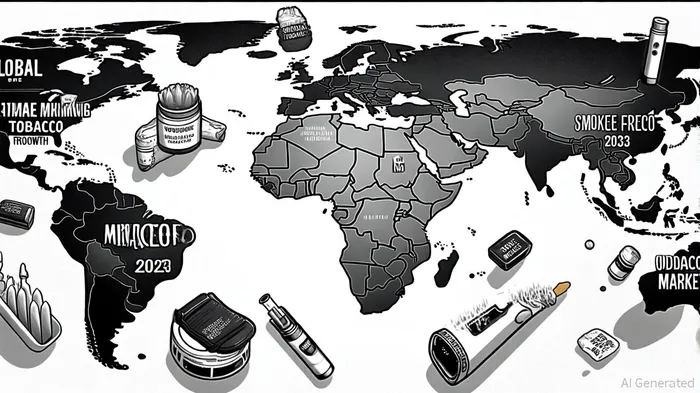
The global tobacco industry is undergoing a seismic shift, driven by health-conscious consumers, regulatory pressures, and technological innovation. At the forefront of this transformation is AltriaMO-- Group's strategic partnership with KT&G, a South Korean tobacco giant, to expand smoke-free and wellness product portfolios. This collaboration, anchored by a non-binding Global Collaboration Memorandum of Understanding (MOU), represents a bold bet on the future of nicotine consumption and wellness innovation, positioning both firms to capitalize on a market projected to grow from $29.64 billion in 2024 to $44.01 billion by 2033 at a 4.49% compound annual growth rate [1].
Strategic Synergies: From Nicotine Pouches to Wellness Innovation
Altria and KT&G's partnership is built on complementary strengths. Altria, a leader in U.S. smoke-free products through brands like on! and Skoal, is expanding its global footprint by acquiring Another Snus Factory Stockholm AB (ASF), a Nordic-based nicotine pouch company that owns the LOOP brand [3]. This move accelerates Altria's access to European markets, where nicotine pouches are gaining traction as alternatives to traditional cigarettes. Concurrently, KT&G's subsidiary, Korea Ginseng Corporation (KGC), is partnering with Altria to explore U.S. wellness and energy segments, leveraging KGC's expertise in herbal and functional foods [4]. This dual focus—on nicotine delivery systems and wellness—reflects a broader industry trend toward harm reduction and holistic consumer engagement.
The partnership's initial steps are already yielding momentum. Altria's on! nicotine pouch shipments grew 26.5% quarter-over-quarter in Q2 2025 [5], underscoring strong demand for smokeless products. By integrating KT&G's distribution networks and R&D capabilities, the alliance aims to scale nicotine pouches in select international markets while mitigating operational costs in traditional tobacco manufacturing [6].
Market Dynamics: A $44 Billion Opportunity by 2033
The smoke-free tobacco market's growth is fueled by three key drivers: product innovation, urbanization, and digital commerce. Flavored and pouch-based products now account for 45% of new demand, with the U.S. market alone attributing 61% of its growth to these categories [1]. Meanwhile, online sales channels are surging, contributing 53.9% of market share in 2025 due to convenience and targeted marketing [7].
Geographically, the Asia-Pacific region dominates with a 49.6% market share, driven by cultural acceptance in countries like India and Bangladesh [8]. Latin America is also emerging as a growth hub, with Brazil and Mexico showing increased adoption of smokeless products [9]. For Altria and KT&G, these trends present opportunities to diversify revenue streams beyond their traditional markets.
Navigating Regulatory Uncertainty
The regulatory landscape remains a double-edged sword. While the U.S. Food and Drug Administration (FDA) has streamlined premarket tobacco product applications (PMTAs) for nicotine pouches [10], it has also proposed capping nicotine levels in combusted products at 0.7 mg/g to reduce addiction [11]. This policy, if enacted, could accelerate the shift to smoke-free alternatives but may also face legal and political challenges.
Internationally, the picture is fragmented. Australia's 2024 ban on smokeless tobacco eliminated a key market [12], while New Zealand's debates over nicotine pouch liberalization highlight regulatory ambiguity [13]. In Europe, a 60% tax hike on white snus products in July 2025 threatens price-sensitive consumers [14]. For Altria and KT&G, agility in navigating these divergent policies will be critical to sustaining growth.
Risks and Resilience
Despite the optimism, challenges persist. Public health concerns about smokeless tobacco—such as risks of gum disease and oral cancer—remain unresolved [15]. Additionally, the market's high concentration, dominated by firms like Philip Morris International and British American Tobacco, means competition for market share will intensify [16]. Altria's foray into cannabis via Cronos Group also faces regulatory headwinds, complicating its diversification strategy [17].
However, the partnership's focus on wellness—through KGC's ginseng and herbal expertise—offers a unique differentiator. By framing nicotine pouches as part of a broader wellness ecosystem, Altria and KT&G can tap into consumer trends prioritizing health and sustainability.
Conclusion: A Transformative Bet on the Future
Altria and KT&G's collaboration is more than a strategic alliance; it is a transformative play on the future of nicotine consumption and wellness. By combining Altria's U.S. market dominance with KT&G's global innovation and KGC's wellness credentials, the partnership is well-positioned to lead the smoke-free transition. As the market evolves, investors should monitor regulatory developments, product innovation cycles, and the competitive responses of industry giants. For now, the data suggests that this alliance is not just adapting to change—it is actively shaping it.







Comentarios
Aún no hay comentarios