
Is Alten's 16% Share Price Correction in 2025 a Mispriced Opportunity?
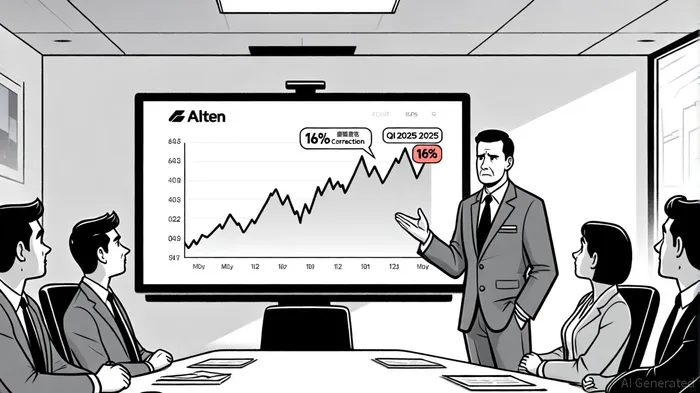
The recent 16% correction in Alten's share price has sparked debate among investors about whether the stock is a mispriced opportunity or a warning sign of deeper challenges. From a value investing perspective, the company's fundamentals and strategic positioning in a rapidly evolving IT sector suggest a nuanced answer. While Alten's valuation appears attractive on certain metrics, its operational headwinds and sector-specific risks demand careful scrutiny.
Valuation Metrics: A Tale of Contradictions
Alten's stock currently trades at a trailing P/E ratio of 12.4x, significantly below both its peer group average of 11.5x and the broader IT industry's 22.4x [1]. A discounted cash flow analysis further suggests an intrinsic value of €64.92 per share, with the current market price of €66.25 implying a modest 2.0% premium [1]. These metrics hint at a potential undervaluation, particularly when compared to the industry's lofty multiples.
However, the company's earnings performance has been volatile. Net income for 2024 fell 20.06% year-over-year to €186.42 million, driven by a 0.2% organic decline in revenue and a sharper 2.7% like-for-like drop in Q4 [5]. While Alten's debt-to-equity ratio of 4.5% and free cash flow of €333.2 million in 2024 underscore its financial health [2], the forward P/E ratio of 9.61x for 2025—despite a projected 4% revenue decline—raises questions about the sustainability of its earnings [2].
Sector Positioning: Navigating the AI Gold Rush
The IT sector is on a growth trajectory fueled by AI and digital transformation. Global IT spending is expected to rise 9.3% in 2025, with AI adoption accelerating at a 29% CAGR through 2028 [1]. Alten's strategic pivot toward AI—training 500 consultants and developing AI-powered solutions—positions it to capitalize on this trend [3]. The company's recent acquisitions, including Wordgrid Solutions and East Japan Institute of Technology, further bolster its expertise in high-growth areas like Energy and Utilities [4].
Yet, Alten's geographic diversification is a double-edged sword. While its international presence spans 30+ countries, recent Q1 results revealed sharp declines in key European markets: -10.7% in Germany, -6% in the UK, and -22.5% in Scandinavia [3]. These setbacks highlight the risks of overreliance on volatile regions and underscore the need for Alten to accelerate its expansion into emerging markets, where AI adoption is rising rapidly [2].
Strategic Risks and Operational Challenges
Alten's long-term success hinges on its ability to address two critical issues. First, attrition remains a persistent challenge. With 88% of its 57,700-strong workforce comprising engineers, retaining talent is paramount in a sector where skills shortages are acute [1]. Second, integrating recent acquisitions—particularly in Asia and Poland—could strain resources and dilute margins if not executed smoothly [4].
The company's forward-looking metrics also warrant caution. A projected 4% revenue decline in 2025, coupled with a forward P/E of 9.61x, suggests that the market is pricing in limited near-term growth [2]. While Alten's EV/EBITDA of 5.31x appears attractive, declining multiples over the past few years indicate waning investor confidence [2].
Conclusion: A Calculated Bet for Patient Investors
Alten's 16% correction offers a compelling entry point for value investors who can tolerate short-term volatility. The company's undervalued multiples, strong cash flow, and strategic alignment with AI-driven growth make it a candidate for long-term appreciation. However, the risks of operational headwinds and sector-specific challenges cannot be ignored. For those willing to adopt a patient, contrarian approach, Alten's current valuation may represent a mispriced opportunity—provided the company can execute its AI and emerging market strategies effectively.







Comentarios
Aún no hay comentarios