
Why Altcoins Outperformed Bitcoin in 2025: A Strategic Shift in Crypto Fund Flows
In 2025, the cryptocurrency market witnessed a seismic shift in fund flows and investor sentiment, with altcoins like EtherETH-- (ETH), XRPXRP--, and SolanaSOL-- (SOL) outperforming BitcoinBTC-- (BTC) in weekly returns and attracting significant capital inflows. This divergence marked a strategic reallocation of portfolios toward high-growth altcoins, driven by a confluence of technological innovation, regulatory clarity, and macroeconomic dynamics.
The Fund Flow Divergence: Altcoins vs. Bitcoin
Data from 2025 reveals a stark contrast in fund flows between Bitcoin and select altcoins. While Bitcoin and EthereumETH-- ETFs faced outflows-$782 million and $102.34 million, respectively-Solana and XRP ETFs saw net inflows of $13.14 million and $64 million in a single trading session. XRP ETFs alone reached $1.14 billion in assets under management by late 2025, with $423.27 million in inflows since mid-November. This trend underscores a growing appetite for altcoins, despite their heightened volatility (80% for XRP, 87% for SOLSOL--, compared to Bitcoin's 43%) according to market analysis. The disconnect between ETF inflows and XRP's flat price of $1.88 highlights the maturation of crypto markets, where institutional flows and macroeconomic conditions increasingly dictate price action over retail speculation as experts observed.
Technological and Regulatory Catalysts
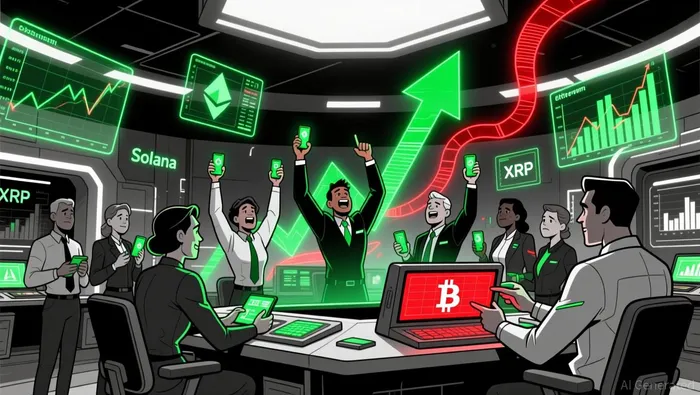 The rebalancing toward altcoins was fueled by their unique value propositions. Ethereum remains the backbone of decentralized finance (DeFi) and programmable finance, with its ETFs delivering 18.23% returns over six months. Solana, meanwhile, leveraged its high-throughput network (processing thousands of transactions per second) and regulatory milestones, such as the launch of the first U.S. spot Solana staking ETF and CME options expansion according to industry reports. XRP's focus on cross-border payments and regulatory clarity-bolstered by its institutional partnerships-positioned it as a utility-driven asset, with arguments that its $120 billion market cap (vs. Bitcoin's $2 trillion) allows for asymmetric upside from modest institutional allocations according to financial analysis.
Regulatory developments further amplified this shift. The approval of spot Bitcoin ETFs in the U.S. and the EU's Markets in Crypto-Assets (MiCA) framework legitimized crypto as an asset class, but investors sought diversification beyond Bitcoin's "store of value" narrative according to industry analysis. As one expert noted, "Altcoins are no longer just speculative bets-they're tools for real-world utility and innovation" as highlighted in industry insights.
Macroeconomic Drivers and Portfolio Strategies
The 2025 macroeconomic environment played a pivotal role in this reallocation. While Bitcoin's peak at $126,000 in October was driven by ETF inflows, two sharp corrections in April and November eroded confidence. In contrast, altcoins like Solana and XRP benefited from their utility in cross-border transactions and staking, which provided yield in a low-interest-rate environment. Investors also prioritized assets with real-world adoption, such as Layer-1 blockchains and tokenized real-world assets (RWAs), while smaller-cap altcoins underperformed due to liquidity constraints according to market analysis.
Portfolio strategies evolved to balance stability and growth. A common approach involved allocating 70% to Bitcoin as a foundational asset and 30% to altcoins like ETHETH--, XRP, and SOL according to portfolio experts. This diversification allowed investors to hedge against Bitcoin's volatility while capturing the asymmetric returns of high-growth altcoins during market rotations. As CoinShares observed, "The 2025 market rewarded those who embraced both Bitcoin's defensive qualities and altcoins' innovation-driven upside" as noted in industry reports.
Global Trends and the Future Outlook
Globally, institutional adoption and fintech innovation accelerated altcoin adoption. In the Asia-Pacific region, blockchain-based payroll systems and stablecoins bridged the gap between fiat and crypto, enabling SMEs to adopt altcoins for low-cost, transparent transactions according to regional reports. Meanwhile, Mastercard's data revealed that 58% of consumers were either holding or curious about crypto, signaling a shift from speculative trading to utility-driven adoption as reported in global research.
Looking ahead, the 2026 market may hinge on whether investors prioritize growth (favoring XRP and SOL) or stability (favoring Bitcoin) as market analysts predict. For now, the 2025 rebalancing toward altcoins reflects a broader maturation of the crypto ecosystem-one where utility, governance, and scarcity increasingly outweigh speculative fervor.







Comentarios
Aún no hay comentarios