
Altcoins at a Crossroads: Top 5 High-Momentum Cryptos Poised for 80%+ Gains in 2026
The crypto market in 2026 is at a pivotal inflection point. After years of speculative frenzy and regulatory uncertainty, the industry is maturing into a space defined by real-world utility, institutional-grade infrastructure, and compliance-driven innovation. Decentralized finance (DeFi) is no longer a buzzword but a foundational layerLAYER-- of global finance, while regulatory frameworks like the EU's MiCA and the U.S. GENIUS Act are reshaping the playing field. For investors, this convergence of trends creates a unique opportunity to identify altcoins that align with the future of crypto. Below, we analyze five high-momentum projects-Flare (FLR), Hyperliquid (HYPE), Monero (XMR), LAYER, and VIRTUAL-that are positioned to deliver 80%+ gains in 2026.
1. Flare (FLR): Bridging DeFi and Real-World Assets
Flare (FLR) is a protocol that enables cross-chain interoperability and tokenization of real-world assets (RWAs). Its technical roadmap for 2026 includes expanding its Flare Network to support tokenized securities and stablecoins with programmable yields. A bullish price projection for FLR ranges from $0.017048 to $0.026433 in 2026, driven by its role in DeFi's shift toward institutional-grade use cases. However, bearish scenarios caution that regulatory headwinds or weak adoption could push the price as low as $0.007381.
FLR's alignment with DeFi's tokenization wave is critical. As Moody's notes, tokenized assets like U.S. Treasuries and commodities are expected to grow exponentially in 2026, with FLR's infrastructure enabling seamless cross-chain liquidity. For traders, this positions FLR as a "bridge" asset between legacy finance and decentralized ecosystems.
2. Hyperliquid (HYPE): The DeFi Derivatives Powerhouse
Hyperliquid (HYPE) is a high-performance derivatives exchange built on EthereumETH--, leveraging zero-knowledge proofs (ZKPs) to balance privacy and transparency. In 2025, HYPE's TVL surged as it became a hub for institutional-grade perpetual trading, with its native token used for governance and staking.
For 2026, HYPE's growth hinges on its ability to integrate with DePIN and AI-driven yield strategies. A report by The Block highlights that HYPE's TVL is projected to grow alongside the broader DeFi TVL, which is expected to reach $200 billion by early 2026. This growth is fueled by liquid staking and restaking protocols, which HYPE's infrastructure supports.
Regulatory clarity under the GENIUS Act will further bolster HYPE's appeal, as it allows traditional institutions to engage with DeFi without compromising compliance.
3. Monero (XMR): Privacy as Core Infrastructure
Monero (XMR) has emerged as a privacy-centric asset with a clear use case in a world increasingly focused on data protection. In 2025, XMR outperformed Bitcoin and Ethereum by 130%, driven by demand for confidential transactions in both DeFi and traditional finance.
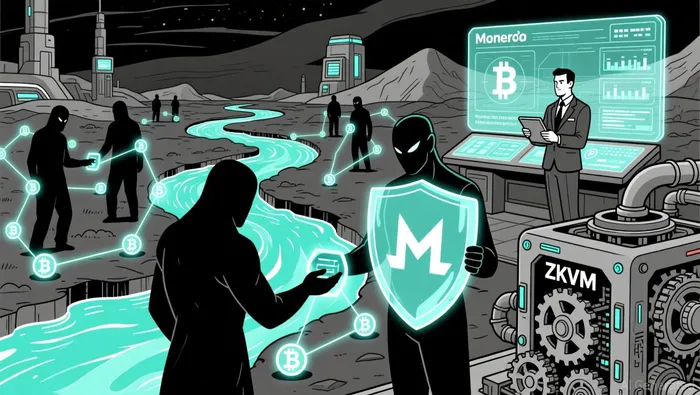
The 2026 outlook for XMRXMR-- is tied to the rise of privacy-plus-compliance models, where zero-knowledge proofs (ZKPs) and selective disclosure mechanisms satisfy regulatory requirements while preserving user anonymity. For example, XMR's integration with zkVMs allows developers to build privacy-preserving applications without sacrificing scalability.
Regulators in the U.S. and EU are softening their stance on privacy coins, provided they incorporate AML/KYC verification layers. This shift positions XMR as a "regulated privacy" asset, with institutional adoption likely to accelerate in 2026.
4. LAYER: DeFi's Regulatory Compliance Layer
LAYER is a protocol designed to address the regulatory challenges of DeFi by embedding compliance into its architecture. Its technical framework includes modular smart contracts that adapt to conflicting regulatory regimes, such as the EU's MiCA and U.S. AML laws.
In 2026, LAYER's value proposition will be amplified by the rise of AI-driven AML frameworks, which enable real-time monitoring of on-chain activity. This is critical as DeFi's TVL grows and institutions demand auditability. LAYER's ability to act as a "compliance middleware" for DeFi protocols makes it a strategic play for investors seeking exposure to the DeFi-institutionalization trend.
5. VIRTUAL: The Tech-Backed DeFi Catalyst
VIRTUAL, while less defined in the data, is linked to the broader U.S. tech sector's performance, which saw a market cap of $22.6 trillion as of January 2026. Its growth potential is tied to the tokenization of tech assets and the integration of AI-driven DeFi automation.
For example, VIRTUALVIRTUAL-- could represent a tokenized version of tech sector indices or a platform leveraging AI for yield optimization. Its alignment with the $16.7 billion growth in public-market RWA tokenization in 2025 suggests strong institutional interest. As AI and DeFi converge, VIRTUAL's role in enabling programmable financial products will be key to its 2026 trajectory.
Conclusion: Strategic Altcoin Opportunities in 2026
The five altcoins above-FLR, HYPE, XMR, LAYER, and VIRTUAL-represent the intersection of DeFi utility, regulatory adaptability, and institutional adoption. While risks like macroeconomic volatility and regulatory shifts remain, the 2026 landscape is uniquely positioned for altcoins that solve real-world problems.
For investors, the key is to prioritize projects with clear use cases, technical readiness, and regulatory alignment. These five assets not only meet those criteria but also stand to benefit from the broader integration of crypto into global finance-a trend that is now irreversible.






Comentarios
Aún no hay comentarios