
Altcoin Season 2025: Evaluating High-Potential Movers in a Shifting Crypto Cycle
The crypto market is entering a pivotal phase. After years of Bitcoin-centric narratives, 2025 is shaping up to be a defining altcoin season. On-chain data and liquidity shifts tell a compelling story: capital is migrating from BitcoinBTC-- to a diverse array of altcoins, driven by macroeconomic tailwinds, institutional adoption, and blockchain innovation. But which projects are best positioned to capitalize on this momentum?
On-Chain Metrics Signal a Structural Shift
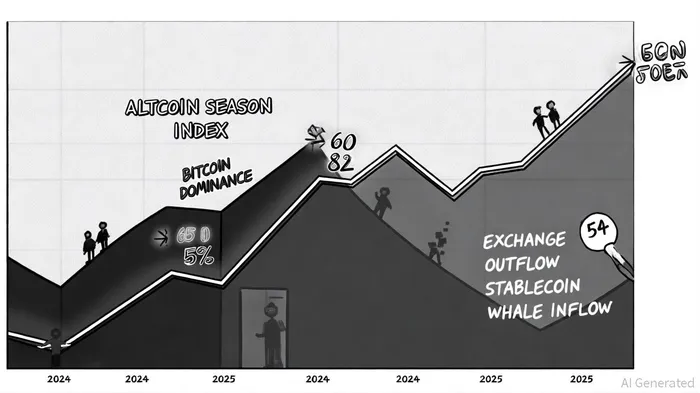
The Altcoin Season Index, a composite metric tracking the performance of top 50 altcoins relative to Bitcoin, has surged to 76–82 points—a level historically associated with active altseasons[1]. This aligns with Bitcoin dominance dropping to 54%, its lowest since 2021[1]. The decline in Bitcoin's market share reflects a broader redistribution of capital into altcoins, supported by a 15% increase in altcoin market capitalization (excluding Bitcoin and stablecoins) to $1.7 trillion, nearing the 2021 peak[3].
On-chain behavior reinforces this trend. Exchange outflows for Bitcoin and major altcoins like EthereumETH-- have accelerated since late 2024, indicating reduced selling pressure[5]. Meanwhile, holder counts for XRPXRP-- and DogecoinDOGE-- (DOGE) have grown by 20% and 18%, respectively, suggesting increased retail and institutional accumulation[5]. Stablecoin liquidity is also shifting: whale accounts now hold over 5% more stablecoins than a month ago, signaling heightened demand for leveraged trading and cross-chain activity[5].
Liquidity Migration: Where Capital Is Flowing
Liquidity distribution reveals critical insights. XRP, for instance, is heavily concentrated on centralized exchanges like Bitget, Binance, and CoinbaseCOIN--, controlling 67% of its market depth at the +/- $0.02 range[1]. SolanaSOL-- (SOL)'s orderbooks, meanwhile, hold 60% of Ethereum's liquidity at the +/- 2% depth range, reflecting strong institutional confidence in its high-performance blockchain[1]. Even meme coins like DOGEDOGE-- show surprising resilience, with liquidity tightly clustered around the market price—a sign of consistent speculative activity[1].
Cross-chain migrations are equally telling. Large value transfers from Ethereum to Solana and Layer 2 solutions like ArbitrumARB-- have spiked, driven by developers and investors seeking faster, cheaper transactions[3]. This mirrors the 2020 DeFi boom, where Ethereum's congestion pushed capital into alternative ecosystems.
High-Potential Altcoins in 2025
Ethereum (ETH): Despite being a “blue-chip,” Ethereum remains a cornerstone of altcoin season. Upgrades like the Shanghai hard fork and dank sharding are set to reduce gas fees by 40%, making it more attractive for DeFi and NFTs[2]. Institutional inflows into U.S. Bitcoin ETFs (exceeding $900 million in early 2025) also indirectly benefit ETH, as investors rotate into altcoins after securing Bitcoin exposure[5].
Solana (SOL): Solana's 65,000 TPS and sub-second finality position it as the go-to chain for high-frequency trading and decentralized apps. Its orderbook liquidity and developer activity have grown 30% year-over-year[2], outpacing even Ethereum.
Aptos (APT): A newer entrant, AptosAPT-- is gaining traction with its modular blockchain design and focus on enterprise-grade scalability. Community-driven growth and a 50% increase in validator nodes since 2024 suggest strong long-term potential[4].
Chainlink (LINK): As the backbone of DeFi's oracle infrastructure, ChainlinkLINK-- benefits from Ethereum's resurgence and the rise of hybrid smart contracts. Its TVL (Total Value Locked) has surged to $12 billion, up from $7 billion in early 2024[2].
Cardano (ADA): Cardano's research-driven approach and energy-efficient proof-of-stake model are attracting institutional investors. Recent partnerships with governments for identity verification and supply chain solutions could drive mass adoption[4].
Risks and Considerations
While the data is bullish, risks persist. Unlike past altseasons (e.g., DeFi in 2020 or NFTs in 2021), 2025 lacks a unifying narrative to sustain broad-based growth[1]. Additionally, altcoins are historically more volatile—2024's “Trump Rally” saw sharp corrections after brief surges[3]. A repeat is possible if macroeconomic conditions deteriorate or the Federal Reserve delays rate cuts[3].
Conclusion
Altcoin Season 2025 is not just a speculative frenzy—it's a structural shift driven by on-chain fundamentals and liquidity dynamics. Ethereum, Solana, and emerging projects like Aptos and Chainlink are best positioned to capitalize on this cycle. However, investors must remain cautious: while the metrics are compelling, the absence of a clear narrative and inherent volatility could lead to sharp corrections. For those willing to navigate the risks, the rewards could be substantial.





Comentarios
Aún no hay comentarios