
Altcoin Momentum in a Post-Bitcoin Rally: Diversification and Risk-Adjusted Returns
The 2025 BitcoinBTC-- rally has catalyzed a seismic shift in crypto market dynamics, with capital rapidly rotating into altcoins. Bitcoin dominance-a metric measuring Bitcoin's share of total crypto market capitalization-has fallen below 59%, signaling the dawn of a new altcoin season, a Coinpedia report notes. This trend is driven by institutional adoption, regulatory clarity, and technological innovation, with SolanaSOL-- (SOL), CardanoADA-- (ADA), and EthereumETH-- (ETH) leading the charge, according to a Markets report. However, as investors capitalize on altcoin momentum, the critical question remains: How can one balance the high-growth potential of altcoins with the risk mitigation benefits of Bitcoin in a diversified portfolio?
Altcoin Momentum: Drivers and Opportunities
The post-2025 Bitcoin rally has created a "liquidity overhang," with capital seeking higher-yield opportunities in altcoins. Solana, for instance, surged 35% in a month following the approval of the first U.S.-listed Solana ETF in July 2025, as the Markets report noted. Similarly, Cardano (ADA) and Ethereum (ETH) have posted year-over-year gains of 103.1% and 59.56%, respectively, per the Markets report. Regulatory tailwinds, such as the SEC's dropped appeal against Ripple, have further fueled XRP's bullish trajectory, according to a Currency Analytics piece.
Beyond blue-chip altcoins, niche projects like PayDax Protocol (PDP) are attracting attention for their institutional-grade security and high-yield incentives, as highlighted in an allocation study. Meanwhile, India's burgeoning crypto ecosystem-driven by youth engagement and infrastructure development-is emerging as a global growth engine, according to an Analytics Insight analysis. These developments suggest that altcoins are no longer mere speculative assets but are increasingly becoming vehicles for innovation and capital efficiency.
Correlation, Volatility, and Risk-Adjusted Returns
While altcoins offer explosive growth potential, their risk profiles differ sharply from Bitcoin's. Bitcoin has decoupled from traditional macro correlations (e.g., real interest rates) and now functions as a "liquidity anchor" during market stress, with a 30-day Sortino Ratio of 1.23-outperforming Ethereum and major stock indices, the Analytics Insight analysis found. In contrast, altcoins face liquidity stress, as evidenced by Q2 2025's 2% depth maximum drawdown, where altcoins fell -31.3% versus Bitcoin's -18.05%, a trend reported by Coinpedia.
The declining correlation between Bitcoin and altcoins-now at historic lows-has also introduced volatility risks, the Markets report observed. When Bitcoin consolidates, altcoins often outperform, but this independence can trigger sharp corrections if market sentiment shifts. For example, Solana's 35% rally in October 2025 was accompanied by a 22% volatility spike, underscoring the trade-off between beta and stability, as detailed in the Markets report.
Portfolio Diversification: Balancing Bitcoin and Altcoins
Optimal portfolio allocation hinges on risk tolerance and investment horizon. Conservative strategies recommend a 1–5% allocation to Bitcoin, leveraging its low correlation with traditional assets to enhance Sharpe ratios, according to a Crypto Valley study. For instance, a 5% Bitcoin allocation in a 60/40 portfolio (60% equities, 40% bonds) historically improved annualized returns by 3–5% and Sharpe ratios from 0.69 to 0.98, the Crypto Valley study notes.
Moderate to aggressive investors may allocate 5–25% to crypto, with altcoins forming a smaller portion. ARK Invest's 2023 research suggests a 19.4% Bitcoin allocation for maximizing risk-adjusted returns, while altcoins like Ethereum and Solana could occupy 3–5% of the portfolio, as the allocation study suggests. Rebalancing strategies-quarterly adjustments being most effective-help manage volatility, reducing drawdowns and maintaining target allocations, the Crypto Valley study found.
Diversified crypto portfolios (e.g., Bitcoin + Ethereum + Cardano) have outperformed single-asset holdings, achieving annualized returns of 102.91% versus Bitcoin's 65.25% in Q3 2025, according to the allocation study. However, altcoin-heavy portfolios remain vulnerable to liquidity shocks, emphasizing the need for a "blue-chip core" (Bitcoin, Ethereum) and "satellite" exposure to high-growth altcoins, as reported by Coinpedia.
Conclusion: Navigating the Altcoin Renaissance
The post-2025 Bitcoin rally has unlocked a new era of altcoin momentum, but success requires a disciplined approach to diversification. While altcoins offer asymmetric upside-driven by innovation and regulatory progress-they also demand careful risk management. Bitcoin's role as a liquidity anchor and its superior risk-adjusted returns make it an essential portfolio component, while strategic altcoin allocations can enhance growth potential.
As the market evolves, investors must remain agile, leveraging rebalancing strategies and macroeconomic signals to optimize exposure. The key lies in balancing Bitcoin's stability with altcoins' innovation, ensuring that the pursuit of higher returns does not come at the cost of portfolio resilience. 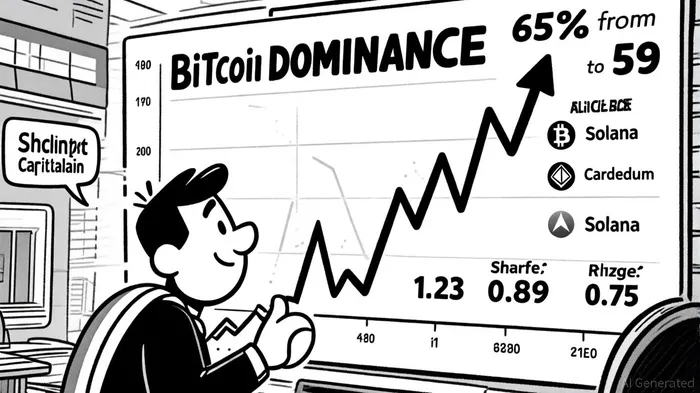







Comentarios
Aún no hay comentarios