
Altcoin Momentum Amid Bitcoin Consolidation: Strategic Entry Points in High-Growth Layer-1 and Gaming Tokens
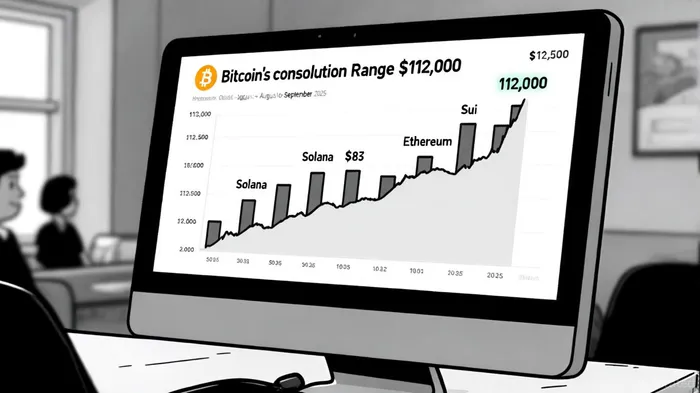
Bitcoin's consolidation phase between $112,500 and $118,000 has created a unique inflection point for the crypto market. While the spot price remains range-bound, on-chain metrics and derivatives data reveal a critical divergence in altcoin momentum, particularly among high-growth layer-1 protocols and gaming tokens. Here's how to strategically position for the next wave of innovation.
Layer-1 Altcoins: The Infrastructure Play
The layer-1 sector is experiencing a renaissance driven by scalability, institutional adoption, and on-chain utility. Solana (SOL) continues to dominate with 40 million daily transactions and 4.59 million active addresses[3], outpacing Ethereum's 1.1 million transactions and 300,000 active addresses[3]. Post-Dencun, Ethereum's gas fees dropped 60%, but Solana's $0.00025 average transaction cost remains a killer app for DeFi and NFTs[3].
Ethereum (ETH), while still the DeFi leader with $306 billion TVL[3], faces competition from modular chains like SuiSUI-- and AptosAPT--. Sui's TVL surged 100% YoY[3], and Aptos' 5.6 million active addresses[3] signal strong developer traction. Crucially, whale accumulation on these chains is accelerating: a SolanaSOL-- whale added $2.75 million in SOLSOL-- in a single transaction[4], while Ethereum's 900 ETH dormant wallet reactivated[1].
Gaming Tokens: The New Gold Rush
The gaming sector is a microcosm of crypto's speculative and utility-driven dynamics. Metacade (MCADE), despite a 34.88% monthly decline[5], retains 72% of its supply illiquid for over a year[5], suggesting long-term holder conviction. Conversely, FLOKI and MAGIC show bullish on-chain signals: FLOKI's exchange reserves fell 4.52%[3], and MAGIC's 57.4% weekly gain[3] reflects whale accumulation and rising buyer participation.
However, the sector is fragmented. While EthereumETH-- and Solana attract institutional capital, smaller tokens like MAGACOIN FINANCE are seeing inflows as whales diversify into niche use cases[5]. The key differentiator? Projects with rising active addresses and transaction volumes—like Sui's 5.6 million daily transactions[3]—indicate genuine adoption, notNOT-- just speculation.
On-Chain Divergence: A Bullish Signal
Bitcoin's consolidation has not stifled altcoin activity. Active addresses for layer-1 chains like Solana and Sui are up 20–30% QoQ[3], while Bitcoin's active addresses dipped to 692,000 in late August[4]. This divergence suggests capital is flowing into high-utility protocols as BitcoinBTC-- waits for a catalyst. The NVT golden cross at 1.51[4] further validates Bitcoin's fundamental strength, but altcoins are leveraging this stability to build momentum.
Strategic Entry Points
Solana (SOL): Consolidating near $150, SOL's inverse head-and-shoulders pattern[4] and 7.99% weekly gain[2] make it a prime candidate for breakout.
Sui (SUI): With TVL at $1.13 billion[3] and whale accumulation, SUI's 115.23% surge in trading volume[2] signals undervaluation.
- MAGIC: A 57.4% weekly gain[3] and declining exchange reserves[3] indicate short-term liquidity risk but long-term potential.
Macro Tailwinds
The Fed's September rate cut reduced Bitcoin's opportunity cost[3], but layer-1 and gaming tokens benefit from a different dynamic: institutional capital seeking yield. MicroStrategy's Bitcoin accumulation[1] and Ethereum's 75% institutional inflows[3] highlight a shift toward crypto as a strategic asset. For altcoins, this means leveraging Bitcoin's consolidation to capture market share.
Conclusion
Bitcoin's consolidation is not a bearish signal—it's a setup for altcoin season 2.0. Layer-1 protocols with robust on-chain metrics and gaming tokens showing whale accumulation are the keys to unlocking alphaALPHA--. As the Fed's dovish pivot and institutional adoption converge, now is the time to allocate to innovation, not just speculation.






Comentarios
Aún no hay comentarios