
Altcoin Liquidity Crunch Amid Bitcoin ETF Surge: Capital Reallocation and Investor Implications
The Bitcoin ETF Boom and Its Ripple Effect
Bitcoin's ETF inflows have notNOT-- only driven its price to all-time highs above $126,000, according to a CCN report, but also outpaced gold ETFs by over $4 billion in net inflows, per Bit2Me data. This institutional stamp of approval has made Bitcoin a cornerstone of diversified portfolios, particularly as macroeconomic uncertainty and the "debasement trade" favor assets like Bitcoin, as detailed in a CoinDesk piece. However, this focus on Bitcoin has come at a cost for altcoins.
For instance, while SolanaSOL-- (SOL) and XRPXRP-- have attracted $2.7 billion and $1.9 billion in inflows this year, according to a Coin-Views report, they've also faced short-term dips amid Bitcoin's dominance. The altcoin market capitalization, at $1.2 trillion (39.3% of the total crypto market cap), is increasingly concentrated in high-utility tokens like EthereumETH-- (ETH) and AI-related projects, while lower-cap altcoins struggle with thin liquidity.
Liquidity Metrics: A Tale of Two Markets
Altcoin liquidity metrics reveal a stark divide. High-utility tokens like ETHETH-- and SOLSOL-- maintain robust order book depth, with ETH showing $15–16 million in liquidity within the 0.1% price range, based on a Techopedia analysis. In contrast, memeMEME-- coins and low-cap altcoins exhibit fragile liquidity, with PepePEPE-- (PEPE) and Trump (TRUMP) experiencing volatile retail-driven volume spikes but low liquidity-to-volume ratios.
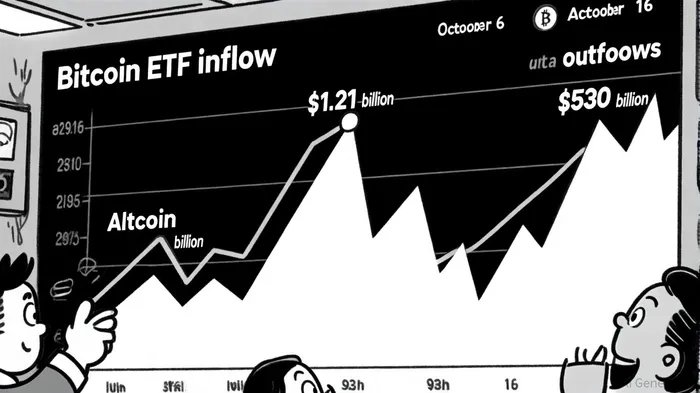
Decentralized exchanges (DEXs) hold $23 billion in altcoin liquidity, but centralized exchanges (CEXs) dominate, with Binance controlling 40% of CEX liquidity. This concentration amplifies risks during market stress, as seen in October when Bitcoin ETF outflows ($530 million on October 16, per an Analytics Insight report) coincided with altcoin price dips.
Implications for Altcoin Investors
The liquidity crunch presents both risks and opportunities. For investors in high-utility altcoins, the shift toward institutional-grade projects (e.g., Sui, Aptos) offers long-term potential as ETF approvals for Solana and XRP loom, according to a CryptoImpactHub analysis. However, those holding speculative assets face heightened volatility and slippage risks.
Whale and institutional activity further complicates the landscape. Accumulation in AI tokens like Fetch.ai (FET) and Real-World Assets (RWA) projects like ONDOONDO-- suggests a strategic rotation toward utility-driven assets, while meme coins remain vulnerable to pump-and-dump cycles and leave retail investors exposed to liquidity shocks.
The Road Ahead: Balancing Optimism and Caution
While Bitcoin ETF inflows are projected to surpass $36 billion in Q4 (as previously reported by CoinDesk), the altcoin market's future hinges on regulatory clarity and infrastructure development. The SEC's October 2025 decisions on altcoin ETFs could unlock $8 billion in institutional inflows for XRP alone, according to CryptoImpactHub, potentially stabilizing liquidity. However, until then, investors must navigate a fragmented market where capital reallocation is both a tailwind and a headwind.
For now, the message is clear: liquidity is king. Altcoin investors should prioritize projects with strong fundamentals and institutional backing while hedging against the volatility of a market still dominated by Bitcoin's gravitational pull.






Comentarios
Aún no hay comentarios