
The Altcoin Liquidity Crisis: Can DATs and ETFs Save the Sector?
The cryptocurrency market in 2025 is at a crossroads. A liquidity crisis has gripped the altcoin sector, with order-book depths collapsing, trading volumes fluctuating wildly, and price volatility eroding confidence. As institutional capital retreats and retail traders flee, the survival of many altcoins hinges on innovative liquidity solutions. Two emerging instruments-Digital Asset Treasuries (DATs) and Exchange-Traded Funds (ETFs)-are being positioned as potential saviors. But can they truly stabilize a market teetering on the edge?
The Altcoin Liquidity Crisis: A Systemic Breakdown
The crisis is not merely a function of declining trading volumes but a structural failure in market depth and capital availability. According to a report by Alaric Securities, the drying up of real liquidity in crypto and Asian equities has created chaotic price swings and a reevaluation of investment strategies. In the altcoin space, fragmented infrastructure, concentrated ownership, and a lack of hedging tools have exacerbated the problem. For example, the October 2025 bear market revealed the pro-cyclical nature of crypto liquidity: during downturns, few are willing to take the opposite side of trades, amplifying slippage and price drops.
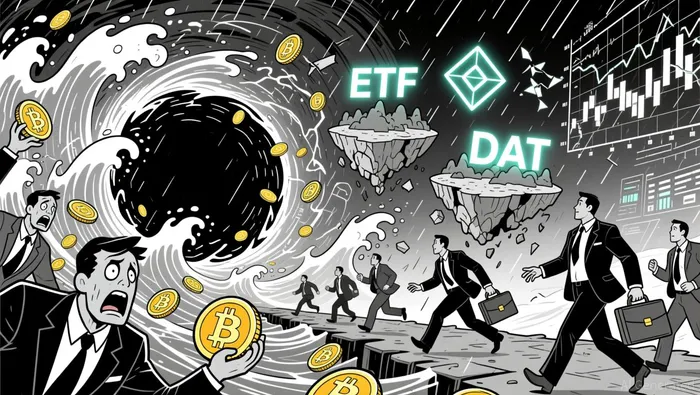
The November 2025 market reset further underscored the fragility of altcoin liquidity. The total market cap fell by 25%, with BitcoinBTC-- plummeting from $126,000 to $80,000. Record outflows from spot Bitcoin and Ethereum ETFs, a $120M Balancer exploit, and a sharp reduction in derivatives leverage highlighted the sector's vulnerability. As one analyst noted, "The market is clearing excess leverage like a mature system under stress-but the absence of a central bank to provide emergency liquidity leaves altcoins exposed."
ETFs: A Double-Edged Sword for Altcoin Liquidity
Spot ETFs for major altcoins like EthereumETH--, SolanaSOL--, and XRPXRP-- have emerged as a lifeline. Bloomberg Intelligence estimates that over 100 altcoin ETFs could launch within six months, with five set to debut in early December 2025. These products have created a "liquidity buffer", absorbing selling pressure and stabilizing prices during volatile periods. For instance, the Franklin XRP and Grayscale Dogecoin Trusts have navigated a regulatory landscape that once delayed ETF approvals for years.
However, ETFs have also fragmented liquidity. Capital is shifting away from direct spot market participation, creating a two-tier system where ETF-backed assets enjoy deeper order books compared to unbacked counterparts. This dynamic has ripple effects: miners now face execution slippage and order-book depth as critical profitability factors. While ETFs offer institutional-grade liquidity, they cannot fully address the broader altcoin market's challenges. As the CryptoQuant CEO warned, "Altcoin liquidity is drying up. Only tokens with DATs or ETFs will survive deeper corrections."
DATs: Corporate Treasuries as a New Paradigm
Digital Asset Treasuries (DATs) represent a corporate strategy where companies hold cryptocurrencies on their balance sheets, offering investors equity exposure to digital assets. Unlike ETFs, DATs can leverage financing, staking yields, and corporate strategy to manage holdings. For example, MicroStrategy's accumulation of 632,000 BTC through convertible debt and equity financing has increased its BTC per share while rewarding shareholders. Similarly, Bitmine Immersion has generated free cash flow from staking Ethereum, a privilege ETFs often lack due to regulatory constraints.
DATs also offer a speed-of-accumulation advantage. Bitmine's ETH per share surged 130% in one month through strategic equity issuance. However, this model carries risks. DATs often trade at premiums to their market net asset value (mNAV), creating fragility. If the premium narrows during a bear market, DATs may be forced to sell holdings to stabilize stock prices, triggering a downward spiral. Smaller DATs reliant on leverage are particularly vulnerable.
DATs vs. ETFs: A Tale of Two Instruments
The key differences between DATs and ETFs lie in return potential, risk exposure, and liquidity. DATs can generate higher returns through staking and leverage but introduce corporate risk and operational complexity. ETFs, by contrast, are passive instruments with strict regulatory oversight, limiting their upside but also their downside. For example, Bitwise's BSOL ETF leverages Solana staking yields to enhance returns, while DATs like SharpLink Gaming face penalties for staking risks.
Regulatory clarity is another critical factor. The EU's MiCA and the U.S. CLARITY Act have favored well-capitalized DATs with robust compliance frameworks. Meanwhile, ETFs benefit from universal listing standards and the 8(a) clause, enabling rapid regulatory acceptance. However, both instruments are vulnerable to geopolitical events and ESG regulations, which can disrupt liquidity.
The Path Forward: A Liquidity-Driven Survival Strategy
The altcoin sector's survival depends on a hybrid approach. ETFs provide immediate liquidity and institutional access, while DATs offer long-term capital efficiency and innovation. However, neither solution is a panacea. As the Skynet DAT report notes, DATs must balance volatility management, transparency, and regulatory adaptability to thrive. Similarly, ETFs must address liquidity fragmentation and ensure secondary market depth.
For miners and developers, the priority is to leverage ETF outflows and DAT strategies to stabilize ROI. As one miner observed, "Market depth is now as critical as hashrate efficiency. Strategic liquidity timing and exchange selection are non-negotiable." For investors, the lesson is clear: diversification across ETFs and DATs, while hedging against regulatory and market risks, is essential in this volatile environment.
Conclusion
The altcoin liquidity crisis of 2025 is a test of the sector's resilience. While DATs and ETFs offer promising solutions, their success hinges on execution, regulation, and market structure. As the industry evolves, the ability to adapt to liquidity-driven survival strategies will determine which projects endure-and which fade into irrelevance.







Comentarios
Aún no hay comentarios