
Altcoin ETFs: Strategic Entry Points and Market Impact in a Post-Launch Era
Market Impact: Altcoin ETFs as Catalysts for Institutional Liquidity
The SolanaSOL-- ETF's success has ignited speculation about a potential XRPXRP-- ETF. With XRP's 27.2% price surge in Q3 2025 and a 215% jump in real-world asset (RWA) market capitalization on the XRP Ledger to $364.2 million, fueling XRP ETF optimism, experts like Nate Geraci predict XRP ETF inflows could surpass Solana's. This optimism is rooted in XRP's utility as a cross-border payments solution, a sector where institutional investors increasingly seek exposure to scalable, enterprise-adopted protocols, as analysts have noted.
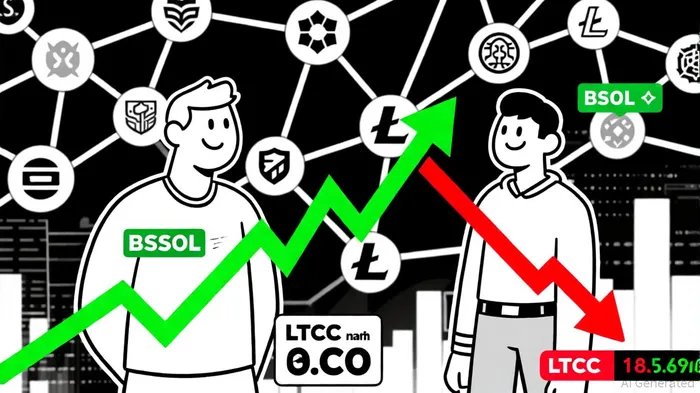
However, not all altcoin ETFs have fared equally. Litecoin's $LTCC ETF, for example, attracted only $1 million in volume and saw a 3.3% price decline, a point highlighted in the same coverage of early altcoin ETF debuts, underscoring the limited appeal of legacy cryptocurrencies in a market prioritizing innovation and utility. This divergence underscores a critical lesson for institutional investors: market capitalization and use-case differentiation are paramount in selecting altcoin ETFs.
Strategic Entry Points: Yield, Liquidity, and Sector-Specific Opportunities
Institutional investors are adopting tailored strategies to capitalize on altcoin ETFs. The Solana Staking ETF (BSOL), which stakes 100% of investor assets and offers a 7% annual yield, was highlighted in early coverage of the BSOL debut and exemplifies the appeal of yield-generating tokens. This model contrasts with the 21Shares Hyperliquid ETF (tracking HYPE), which targets the 16th-largest digital asset by market cap and leverages Coinbase and BitGo custodianship to attract U.S. investors, according to the 21Shares HYPE proposal.
A pivotal catalyst for institutional entry has been liquidity supply. In 2025, a long-term Solana whale transferred 200,000 SOL ($40 million) to Coinbase Prime, as reported in the Solana whale transfer, coinciding with the $BSOL ETF's debut. This movement, after years of inactivity, suggests institutional liquidity providers are preparing to capitalize on staking and ETF-driven demand. Such whale activity often precedes broader market participation, making it a critical signal for strategic entry.
Risk Management: Navigating Volatility and Regulatory Uncertainty
Despite growing optimism, institutions are deploying sophisticated risk frameworks. According to 2025 data, 72% of institutional investors use equal weighting and quarterly rebalancing to mitigate concentration risk, as seen in the CoinShares ETF launch. Additionally, 82% employ derivatives like options and futures to hedge volatility, and 60% integrate AI-driven tools for real-time risk assessment, as reported in Institutional risk statistics. These strategies are bolstered by $16 billion in crypto custodial spending in 2025, reflecting a maturing infrastructure for institutional-grade security, according to the same data.
However, liquidity challenges persist. Traditional volatility metrics fail to capture tail risks in crypto markets, where 24/7 trading of underlying assets creates overnight pricing dislocations, a point made in ETF liquidity guidance. For example, EthereumETH-- ETFs faced $168.7 million in outflows last week, according to crypto fund flows, partly due to sluggish on-chain activity and a wait-and-see attitude among investors. This underscores the need for updated liquidity frameworks that account for crypto's unique 24/7 nature, as VettaFi's guidance details.
The Road Ahead: Altcoin Season or Cautionary Pause?
Bitcoin's recent $931 million in ETF inflows and stabilization above key support levels have sparked debates about an impending "altcoin season." While Ethereum's outflows suggest caution, tokens with real-world utility-like payments platforms (XRP) or decentralized exchanges (HYPE)-are gaining traction. Institutions are advised to prioritize liquidity-rich, fundamentals-driven altcoins while maintaining hedging strategies to buffer against volatility.
As the SEC reviews over 90 altcoin ETF filings, the next 12 months will likely determine whether altcoin ETFs become a cornerstone of institutional portfolios or remain a niche experiment. For now, the data is clear: strategic entry requires a blend of yield-seeking, liquidity monitoring, and risk-aware frameworks.






Comentarios
Aún no hay comentarios