
Altcoin ETFs and Their Role in a Post-FOMC Crypto Market Surge
ETF-Driven Institutional Flow: A New Paradigm
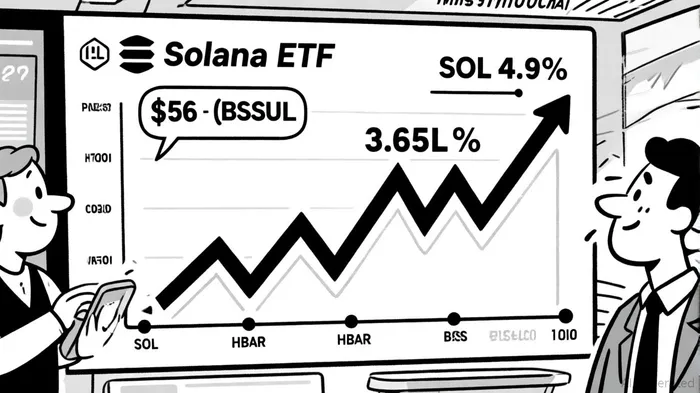
The Solana ETF, managed by Bitwise, stands out for its full staking integration, offering investors a projected 7% annual yield, Coinotag reported. Despite its strong volume, SOL's 3.65% post-launch price dip underscores the "buy-the-rumor, sell-the-news" dynamic common in speculative markets, the Coinotag report noted. However, the broader trend is clear: institutional investors are leveraging ETFs to gain exposure to altcoins with robust utility, such as Hedera's HBARHBAR-- (up 4.9% post-ETF launch) and staking-enabled networks like Solana, the Coinotag report adds.
The absence of major players like BlackRockBLK-- in altcoin ETFs, however, raises questions about scalability. While BlackRock's BitcoinBTC-- ETF (IBIT) dominated 2025 with $28.1 billion in inflows, a Coinotag analysis found that altcoin ETFs face an uphill battle to replicate this success. Analysts project that without institutional giants, Solana and XRPXRP-- ETFs may attract $3–8 billion in initial capital, depending on regulatory clarity and market conditions, the analysis projected.
Fed Easing and Altcoin ETFs: A Strategic Entry Point
The Federal Reserve's easing cycle is a critical catalyst for altcoin ETFs. Lower interest rates typically reduce the cost of capital, incentivizing institutional investors to allocate to higher-yielding assets like staking-enabled ETFs. For example, the Grayscale Solana Trust ETF (GSOL), which began staking in October 2025, distributes 77% of net staking rewards to holders, according to a Benzinga report. This model aligns with the Fed's dovish stance, as it offers both yield and exposure to a network with enterprise-grade use cases.
Historical parallels suggest that Fed easing amplifies ETF-driven inflows. During the 2023 Bitcoin ETF frenzy, BlackRock's dominance skewed capital toward Bitcoin, leaving altcoins underperforming, the Coinotag analysis noted. However, 2025's altcoin ETF landscape is more diversified, with 155 pending applications tracking 35 cryptocurrencies, according to a Panewslab report. This fragmentation could mitigate the "BlackRock effect," allowing niche altcoins to capture institutional attention.
Challenges and Opportunities in a BTC-Driven Bull Market
While altcoin ETFs offer a gateway to diversification, they face headwinds. The CoinDesk 20 index remains heavily weighted toward Bitcoin and EthereumETH--, limiting altcoin price momentum, the Panewslab report found. Additionally, capital shifts from Digital Asset Treasuries (DATs) to altcoin ETFs could depress DAT MNAV ratios, triggering asset sales and downward pressure, the report warned.
Yet, the potential for a BTC-driven bull market to spill over into altcoins is significant. JPMorgan and Bitget project that a Solana ETF could attract $3–6 billion in its first year, according to a CoinMarketCap article, while Grayscale's entry into the U.S. Solana ETP market signals growing institutional conviction, the Benzinga report observed. These developments suggest that altcoin ETFs are notNOT-- just speculative tools but strategic assets in a post-FOMC world.
Conclusion: Positioning for the Next Wave
The $65 million debut of altcoin ETFs in October 2025 reflects a maturing market where institutional investors are balancing yield, utility, and regulatory compliance. As the Fed's easing cycle unfolds, altcoin ETFs-particularly those with staking integration and enterprise use cases-could serve as high-conviction entry points for capital seeking diversification beyond Bitcoin. However, success hinges on overcoming BlackRock's dominance and navigating macroeconomic risks. For investors, the key takeaway is clear: altcoin ETFs are no longer fringe instruments but integral components of a crypto bull market strategy.





Comentarios
Aún no hay comentarios