
Alphabet's Strategic Position in the AI-Driven Economy: The Universal Edge Platform for the Next Decade
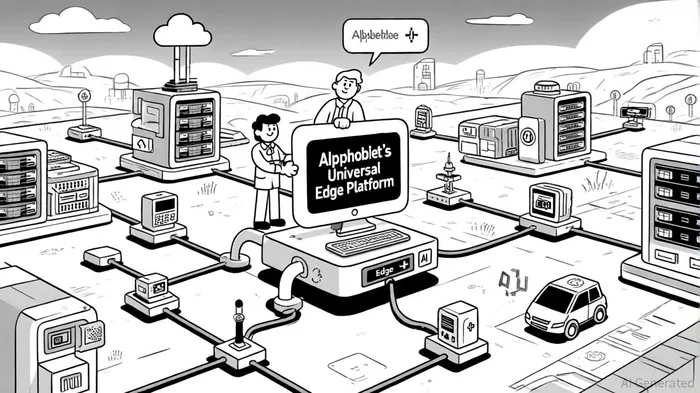
In the rapidly evolving AI-driven economy of 2025, Alphabet Inc. (GOOGL) has emerged as a formidable contender, positioning itself as the Universal Edge Platform for the next decade of technological disruption. By integrating AI, edge computing, and cloud infrastructure, Alphabet is not only redefining its core business but also reshaping industries ranging from healthcare to manufacturing. This analysis explores Alphabet's strategic initiatives, competitive advantages, and real-world implementations, underscoring its potential to dominate the AI landscape.
A $75 Billion Bet on AI and Edge Infrastructure
Alphabet's 2025 capital expenditure plan—a staggering $75 billion investment—signals its aggressive commitment to AI and edge computing. This funding targets data center expansions, AI hardware acquisitions (including NVIDIA's Blackwell GPUs and custom Tensor Processing Units, or TPUs), and network infrastructure upgrades[1]. The company's appointment of Koray Kavukcuoglu as Chief AI Architect further emphasizes its focus on embedding cutting-edge models like Gemini into core products, from GoogleGOOGL-- Search to Android XR[3].
This infrastructure spending is not merely defensive but transformative. By leveraging TPUs and partnerships with NVIDIANVDA--, Alphabet is optimizing low-latency, high-throughput AI tasks, enabling real-time processing for applications such as autonomous vehicles and smart factories[5]. For instance, Google Cloud's adoption of NVIDIA's GB300 NVL72 rack-scale solutions underscores its ambition to lead in AI production and research[4].
The Universal Edge Ecosystem: From Platforms to Partnerships
Alphabet's strength lies in its ecosystem-first strategy, integrating AI across 15+ billion-user platforms, including YouTube, Android, and Google Workspace. This vast user base provides a fertile ground for edge computing, where data is processed closer to the source, reducing latency and enhancing user experiences[1].
Key to this strategy is Alphabet's collaboration with enterprise partners. Google Cloud's Vertex AI and Agent Development Kit are empowering companies like Anyscale and KPMG to build AI-driven automation tools[1]. In healthcare, Verily's Lightpath platform—a chronic care management solution powered by AI—demonstrates Alphabet's ability to translate edge computing into personalized medicine for conditions like diabetes and obesity[6]. Similarly, in manufacturing, edge AI enables predictive maintenance and real-time quality control, reducing downtime by up to 40%[2].
Alphabet's edge computing ecosystem is further reinforced by its $150 billion R&D investment over five years, which has yielded proprietary assets like Gemini 2.0. This multimodal AI model, capable of processing text, images, and code, is already enhancing Google Search, YouTube, and Google Workspace[5]. Such vertical integration—from chip design to application layers—creates a durable competitive advantage.
Financial Resilience and Market Positioning
Alphabet's financials in 2025 reflect both growth and maturity. Q1 2025 operating income surged 33.34% to $112.39 billion, supported by a 32.11% operating margin and 58.20% gross margin[5]. These metrics highlight its ability to balance aggressive AI investments with profitability. The company's $70 billion share buyback program and first-ever quarterly dividend further signal confidence in its long-term value proposition[5].
In the cloud market, Google Cloud's revenue grew 32% YoY in Q2 2025, driven by AI adoption among enterprise clients[5]. While AWS and Microsoft Azure maintain larger market shares (31% and 29%, respectively), Alphabet's AI-first approach is closing the gap. Google Cloud's 7th-generation TPUs, which deliver 10x the performance of prior models, and its focus on sustainability (e.g., carbon-free computing) are attracting AI-focused enterprises[2].
Competitive Landscape: Alphabet vs. AWS vs. Azure
The cloud wars of 2025 are defined by three titans: Amazon Web Services (AWS), Microsoft Azure, and Alphabet. AWS retains the largest market share (31%) but faces slowing growth (17.5% YoY in Q3 2025), partly due to challenges in optimizing AI accelerators[5]. Azure, meanwhile, leverages its 49% stake in OpenAI and deep enterprise integration to outperform Alphabet in AI revenue growth (35% YoY in Q3 2025)[2].
Alphabet's unique value proposition lies in its open ecosystem approach. Unlike Microsoft's exclusive partnerships or AWS's cost-efficiency focus, Google Cloud prioritizes innovation and sustainability. Its acquisition of Wiz for cloud security and aggressive AI accelerator programs further differentiate it[1]. While AWS and Azure dominate infrastructure, Alphabet's edge computing and AI leadership make it a compelling choice for forward-thinking enterprises.
Regulatory Risks and Long-Term Outlook
Despite its strengths, Alphabet faces regulatory headwinds. Ongoing antitrust investigations and the EU's Digital Services Act impose compliance costs, particularly for platforms like YouTube[5]. However, a favorable U.S. federal antitrust ruling in September 2025 allowed Alphabet to retain control over Chrome and Android, stabilizing its ecosystem[5].
Looking ahead, Alphabet's Universal Edge Platform is poised to drive innovation in AI-driven sectors. With $35 billion in Google Cloud revenue in 2024 and a $3 trillion market cap milestone achieved in September 2025[5], the company is well-positioned to capitalize on the AI arms race.
Conclusion
Alphabet's strategic investments in AI, edge computing, and cloud infrastructure position it as the Universal Edge Platform for the next decade. By integrating cutting-edge hardware, fostering ecosystem partnerships, and leveraging its vast user base, Alphabet is not only addressing current market demands but also future-proofing its dominance in the AI-driven economy. For investors, the company's financial resilience, innovative R&D pipeline, and regulatory adaptability make it a compelling long-term bet.





Comentarios
Aún no hay comentarios