
Alphabet's Resilience in the Digital Search Era: Sustained Demand and AI-Driven Competitive Moats
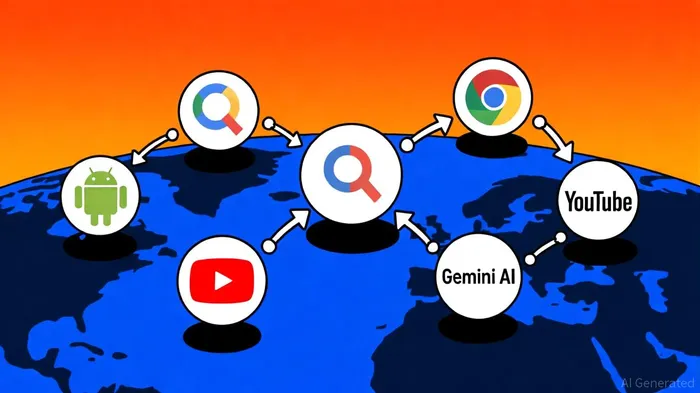
Alphabet Inc. (GOOGL) continues to dominate the digital search landscape, maintaining a staggering 92% global market share in Q3 2025[2]. This resilience is underpinned by its AI-driven innovations and a robust ecosystem of products, which together create formidable competitive moats. As the digital advertising industry evolves, Alphabet's ability to adapt and leverage artificial intelligence (AI) ensures its leadership remains unchallenged—despite regulatory headwinds and intensifying competition.
Sustained Demand in Digital Search and Advertising
Alphabet's dominance in digital search is not merely a function of scale but a reflection of sustained demand for its services. GoogleGOOGL-- Search alone generated $144 billion in revenue during the first nine months of 2024[5], a testament to its entrenched role in global internet usage. The company's ecosystem—anchored by Chrome (68.34% global web traffic in December 2024[2]) and Android (73.49% mobile web traffic[2])—creates a flywheel effect, where user engagement across devices and platforms reinforces search and advertising revenue.
Competitors like Meta PlatformsMETA-- Inc. (29.55% market share in the Internet Services & Social Media sector[1]) and MicrosoftMSFT-- (17.71% in the broader Technology Sector[1]) struggle to replicate this synergy. While Meta's social networking platforms and Microsoft's AI-powered Bing have gained traction, Alphabet's ability to integrate AI across its services—such as real-time search enhancements and personalized ad targeting—keeps it ahead.
AI as a Strategic Moat
Alphabet's investment in AI has been a cornerstone of its competitive advantage. The company holds over 7,800 AI-related patents[1], a testament to its long-term R&D focus. Its Gemini AI platform, a multimodal large language model capable of processing text, images, audio, and video, has become a linchpin of its strategy. By March 2025, Gemini had achieved 400 million monthly visits and 35 million daily active users[2], outpacing Microsoft Copilot in key European markets.
The financial implications of these innovations are clear. Alphabet's Q1 2025 earnings showed a 12% revenue increase, driven by AI integration across Google Search, YouTube, and Google Cloud[2]. CEO Sundar Pichai's announcement of a $75 billion capital expenditure plan for 2025—surpassing the $59.73 billion consensus estimate—further underscores the company's commitment to scaling AI infrastructure[3]. This includes expanding data centers and servers to handle the computational demands of advanced models like Gemini 2.5 Pro, which recently topped chatbot rankings[4].
Challenges and Regulatory Risks
Despite its strengths, Alphabet faces significant challenges. Antitrust rulings, such as the recent decision labeling Google's search engine an illegal monopoly[2], could force the company to share critical search data with competitors. Additionally, regulatory scrutiny from the EU and U.S. over data privacy and antitrust concerns may constrain its ability to collect and utilize user data for AI training[4]. These risks highlight the fragility of Alphabet's moats in a rapidly evolving regulatory environment.
However, Alphabet's vast data resources and first-mover advantage in AI adoption provide a buffer. Its ability to refine models using real-time web access and user interactions—features absent in many competitors—ensures its AI edge remains difficult to replicate[2].
Investment Outlook
Alphabet's resilience in the digital search era hinges on its ability to sustain AI-driven innovation while navigating regulatory challenges. The company's ecosystem of products, coupled with its leadership in AI patents and user engagement, creates a durable competitive moat. While short-term risks exist, the long-term trajectory of digital advertising—projected to grow at a 12% CAGR through 2030[5]—positions Alphabet to capitalize on emerging opportunities in AI-powered commerce, cloud services, and personalized content.
For investors, Alphabet represents a compelling case study in leveraging technological innovation to maintain dominance in a dynamic market. Its strategic investments in infrastructure and AI, combined with a robust revenue base, suggest that the company is well-positioned to weather near-term headwinds and continue delivering value. Historically, a simple buy-and-hold strategy following Alphabet's earnings beats has shown mixed but gradually improving performance: over 14 instances from 2022 to 2025, the stock outperformed the benchmark by ~3.4% over 30 days, with win rates rising from 43% (Day 1) to 71% (Day 30) [5]. While short-term effects are negligible, the delayed outperformance suggests patience may be rewarded for investors aligned with Alphabet's long-term AI vision.





Comentarios
Aún no hay comentarios