
Is Alphabet's Recent Legal and Market Momentum a Signal of Long-Term Growth, or a Warning of Overbought Conditions?
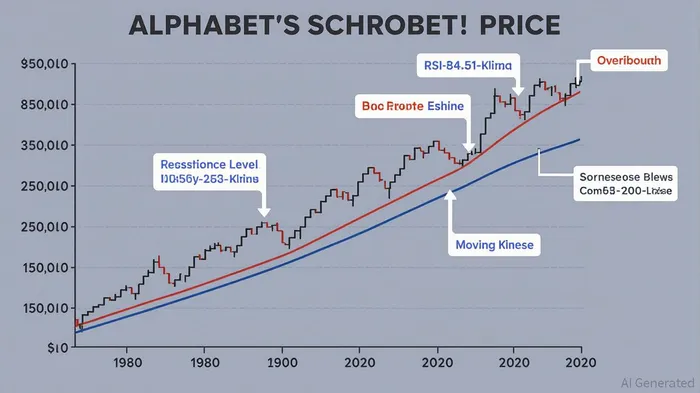
Alphabet's recent surge to a $226.43 all-time high and a $2.56 trillion market cap has ignited a debate among investors: Is this a contrarian opportunity to buy the dip, or a warning of imminent overbought correction? The tension between its technical indicators and regulatory developments reveals a nuanced picture.
Technical Overbought Signals: A Cautionary Flag
Alphabet's 14-day RSI of 84.51—well above the 70 overbought threshold—suggests short-term exhaustion. This metric, corroborated by RSI readings of 82.43 and 83.14, signals a high probability of near-term consolidation or pullback. Historically, such levels often precede profit-taking, particularly when price stalls at key resistance zones like 227–229. However, bullish momentum persists: the MACD remains positive, and the stock trades above both its 50-day and 200-day moving averages. This duality—overbought technicals versus sustained upward momentum—reflects a market betting on Alphabet's resilience despite short-term risks.
Antitrust Rulings: A Mixed Blessing for Long-Term Growth
Recent antitrust rulings have reshaped Alphabet's regulatory landscape. While courts avoided drastic measures like breaking up Chrome or Android, they imposed restrictions on exclusive distribution agreements and mandated data-sharing with competitors. These rulings, though limiting Alphabet's dominance in search and adtech, were interpreted as favorable by investors, lifting the stock 9.14% and adding $234 billion to its market cap. The decision also acknowledged the disruptive potential of generative AI, with competitors like MicrosoftMSFT-- and OpenAI poised to challenge Alphabet's AI ecosystem.
Yet, regulatory risks remain. The DOJ and FTC continue to prioritize antitrust enforcement against Big Tech, and Alphabet's $96.4 billion Q2 revenue—driven by AI growth (e.g., Gemini's 450 million monthly active users)—may attract further scrutiny. For contrarian investors, the key question is whether these regulatory headwinds will erode Alphabet's ecosystem advantages or merely force adaptation.
Fundamental Strength vs. Technical Weakness: A Contrarian Lens
Alphabet's fundamentals remain robust. Its cloud business grew 32% year-over-year, and its AI initiatives, including Gemini and autonomous vehicles, position it for long-term innovation. A discounted cash flow (DCF) analysis suggests an intrinsic value significantly higher than its current price, implying undervaluation. However, the overbought RSI and regulatory uncertainties create a paradox: while the stock appears fundamentally attractive, technical indicators warn of near-term volatility.
For contrarians, this divergence presents an opportunity. If Alphabet's RSI corrects to the 60–70 range—a typical retracement for overbought assets—the stock could rebound on renewed buying interest. The recent antitrust ruling, by removing the threat of forced divestitures, has already reduced a major overhang. Investors willing to tolerate short-term volatility might find value in dips, particularly if Alphabet's AI and cloud growth accelerates.
Conclusion: Balancing the Scales
Alphabet's trajectory embodies the classic tension between momentum and fundamentals. While its overbought RSI signals caution, its regulatory resilience and AI-driven growth justify long-term optimism. For contrarian investors, the optimal strategy may lie in selectively buying dips—provided they avoid overexposure during a potential near-term pullback. As always, the key is to align risk tolerance with the conviction that Alphabet's ecosystem advantages, if preserved, will outpace short-term technical corrections.







Comentarios
Aún no hay comentarios