
Is Alphabet (GOOG) Vulnerable to AI-Driven Search Disruption?
The digital search landscape is undergoing a seismic shift as AI-driven platforms redefine how users interact with information. Alphabet Inc. (GOOG), the parent company of GoogleGOOGL--, has long dominated the search market, but emerging competitors like ChatGPT, Perplexity, and Gemini are challenging its supremacy. This article evaluates Alphabet's strategic resilience in the face of AI-driven disruption, drawing on recent market data, product innovations, and competitive dynamics.
The Rise of AI-Driven Search: A New Paradigm
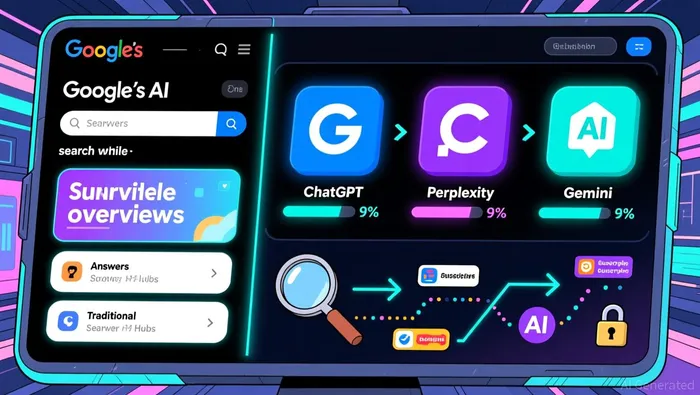
AI-powered search engines are reshaping user behavior and monetization models. According to a report by BrightEdge, AI-driven search traffic converts at 4–5 times the rate of traditional search, with 50% of consumers now using AI tools for queries. Platforms like Perplexity AI, which offers citation-rich responses and research-focused capabilities, have seen nearly fivefold growth in website visits from 2023 to 2024. Meanwhile, ChatGPT retains a commanding 60.7% share of the generative AI market, while Google's Gemini holds 13.5% and Perplexity secures 6.6%.
This shift is not merely technological but economic. McKinsey estimates that AI search could generate as much revenue as traditional search by 2028, impacting $750 billion in global markets. For Alphabet, the challenge lies in adapting its ad-driven business model to a world where users receive direct answers without clicking through to websites.
Alphabet's Strategic Countermeasures: Innovation and Monetization
Alphabet has responded with a dual strategy: integrating AI into its core search ecosystem and diversifying revenue streams. The launch of AI Overviews-concise, AI-generated summaries atop traditional search results-aims to retain user engagement while maintaining ad relevance. By mid-2025, these overviews appeared in 13.14% of queries, a figure expected to grow rapidly.
To monetize this shift, Alphabet introduced AI Ultra, a premium subscription tier priced at $249.99/month. This service offers advanced features like Gemini and DeepThink mode, targeting power users and businesses willing to pay for enhanced AI capabilities. The move mirrors Microsoft's success with its AI-powered Bing integration, which has driven ad revenue growth by capturing a slice of the generative AI market.
Alphabet has also invested heavily in AI infrastructure. A $2.4 billion deal with coding startup Windsurf and a $150 million partnership with Warby Parker for AI-enabled smart glasses underscore its commitment to hardware-software synergy. These investments position Alphabet to lead in next-generation AI applications, from voice-activated search to immersive commerce.
Navigating Risks: Regulatory and Market Challenges
Despite its proactive stance, Alphabet faces significant risks. Regulatory scrutiny over AI overviews has intensified, with independent publishers reporting a 56% drop in desktop clickthrough rates when AI summaries are displayed. This has triggered investigations into potential antitrust violations, threatening Alphabet's ability to leverage publisher content for AI training.
Moreover, Perplexity's 85% user retention rate and 29% share of academic/research queries highlight its appeal to specialized audiences. For Alphabet, this signals the need to refine its AI offerings to compete in verticals where precision and citation quality are paramount.
Strategic Resilience: A Balanced Outlook
Alphabet's resilience hinges on its ability to balance innovation with monetization. While competitors like Perplexity and ChatGPT excel in niche areas, Google's scale and ecosystem dominance remain formidable. The company's $49.33 billion R&D spend in 2024 supports continuous iteration of models like Gemini and Bard, ensuring it stays ahead of the curve.
- Adaptation to Generative Engine Optimization (GEO): As 80% of B2B buyers now prioritize AI tools over traditional search for vendor discovery, Alphabet must refine its AI algorithms to align with GEO best practices.
- Publisher Relations: Mitigating backlash from content creators will require transparent revenue-sharing models or compensation for AI training data.
Conclusion: A Leader in Transition
Alphabet is not invulnerable to AI-driven disruption, but its strategic investments and adaptive product roadmap position it to weather the storm. While competitors like Perplexity and ChatGPT are reshaping user expectations, Google's integration of AI into its core search experience-coupled with premium monetization strategies-ensures its relevance in the evolving digital ecosystem. For investors, the key takeaway is that Alphabet's resilience lies in its ability to evolve from a search engine to an AI-powered information platform, a transition that, if executed successfully, could secure its dominance for years to come.







Comentarios
Aún no hay comentarios