
Alphabet's AI Transformation: A High-Stakes Bet for Long-Term Dominance
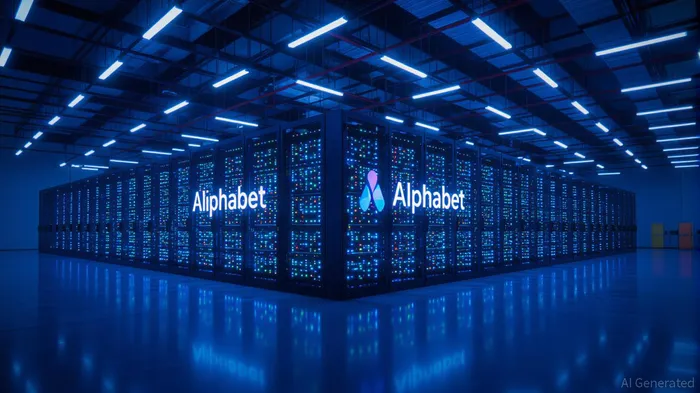
In the race to define the next era of technology, Alphabet Inc. (GOOGL) has placed its chips on artificial intelligence. The company's 2025 Q1 earnings report, coupled with a $85 billion capital expenditure plan, signals a bold bet that AI will be the cornerstone of its long-term dominance. Yet, as with any high-stakes gamble, the risks are as formidable as the rewards. Investors must weigh Alphabet's strategic vision against a backdrop of regulatory scrutiny, antitrust battles, and the looming shadow of market saturation.
The Financial Engine Behind the Bet
Alphabet's AI transformation is not a side project—it is a full-throated commitment. The company allocated 15% of its R&D budget to AI-related initiatives in Q1 2025, a figure that underscores its prioritization of innovation. This spending has already yielded tangible results: GoogleGOOGL-- Cloud's revenue surged 32% year-over-year to $13.6 billion, driven by demand for Vertex AI and AI-driven cybersecurity tools. The acquisition of Wiz, a cloud security platform, further cements Alphabet's push into enterprise AI.
However, the financial metrics tell a more nuanced story. While Alphabet's free cash flow reached $72.76 billion in Q1 2025, the company's $85 billion CapEx plan—$10 billion above earlier forecasts—raises questions about the strain on short-term profitability. Two-thirds of this investment is directed toward servers, including custom-built Ironwood TPUs and NVIDIA's Blackwell GPUs, to fuel large-scale AI deployments like Gemini. The remaining third targets data centers and networking equipment to address a $106 billion cloud demand backlog.
Strategic Positioning in a Crowded Field
Alphabet's AI strategy is built on three pillars: foundational research, infrastructure, and product integration. The launch of Gemini 2.5 Pro—a model lauded for its reasoning and coding capabilities—positions the company as a leader in enterprise AI. With 200% year-over-year growth in active users of AI Studio and Gemini API, Alphabet is not just building tools; it is cultivating an ecosystem.
Yet, competition is intensifying. Microsoft's partnership with OpenAI and Amazon's Bedrock platform are direct threats. Meanwhile, Chinese firms like BaiduBIDU-- and AlibabaBABA-- are closing the gapGAP-- in applied AI, leveraging their domestic markets to commercialize innovations faster. Alphabet's 89.6% global search market share and YouTube's $30 billion in ad revenue provide a moat, but the company's reliance on consumer data for training AI models has drawn regulatory ire.
The Risks of a High-Stakes Game
Regulatory challenges loom large. The European Union's AI Act, which imposes strict compliance obligations on “high-risk” AI systems, could force Alphabet to overhaul its operations in the region. Fines of up to 7% of global revenue—potentially exceeding $20 billion—add a layer of financial risk. In the U.S., the Department of Justice's antitrust case against Google argues that its search dominance creates a “bottleneck” in AI development, demanding remedies that could force data sharing or structural changes.
Internally, Alphabet is grappling with cultural fractures. The 2023 merger of Google Brain and DeepMind aimed to accelerate innovation but has led to friction between research-driven and product-oriented teams. Employee attrition and ethical concerns over military AI contracts further complicate the company's ability to retain top talent.
Balancing the Ledger: Rewards vs. Risks
For investors, the question is whether Alphabet's AI investments will translate into sustainable growth. The company's vision of transitioning from an advertising-based model to a transactional AI services model is ambitious. Features like AI Overviews, which now reach 1.5 billion monthly users, hint at a future where Alphabet's AI tools generate revenue beyond ads.
Yet, the path is fraught. Market saturation in core services like search and YouTube could erode margins, while the environmental costs of AI training and deployment—measured in energy and water consumption—pose reputational risks. Moreover, the ethical implications of agentic AI, where autonomous systems execute tasks, require careful governance to avoid misuse.
Investment Advice: Patience and Caution
Alphabet's forward P/E ratio of 17x suggests it is undervalued relative to its peers, but this metric masks the volatility of its AI bets. For long-term investors, the company's financial flexibility—bolstered by $72.76 billion in free cash flow—offers a buffer against short-term headwinds. However, those with a shorter time horizon may find the regulatory and antitrust risks too unpredictable.
A diversified approach is prudent. While Alphabet's AI initiatives have the potential to redefine its business model, investors should monitor key indicators: the adoption rate of Gemini in enterprise settings, the outcome of antitrust lawsuits, and Alphabet's ability to navigate the EU's AI Act without sacrificing innovation.
Conclusion
Alphabet's AI transformation is a high-stakes bet that could redefine the tech landscape—or leave it scrambling to catch up. The company's financial firepower, strategic foresight, and product integration capabilities are formidable, but so are the challenges. For now, the market remains divided: some see Alphabet as a visionary, others as a cautionary tale. In the end, the verdict will depend on whether the company can balance its ambition with the realities of a rapidly evolving world.







Comentarios
Aún no hay comentarios