
Alphabet's AI Chip Ascendancy and Its Implications for the Semiconductor Sector
Alphabet's Vertical Integration: A Strategic Edge
Alphabet's seventh-generation Tensor Processing Unit (TPU), codenamed Ironwood, exemplifies the company's commitment to self-reliance in AI hardware. According to a report by Google Cloud, Ironwood delivers 4,614 TFLOPs of peak compute power per chip, with 9,216-chip pods achieving 42.5 Exaflops-over 24 times the capacity of the world's largest supercomputer, El Capitan. This leap in performance is underpinned by innovations such as a 192 GB High Bandwidth Memory (HBM) per chip and a 1.2 TBps Inter-Chip Interconnect (ICI) bandwidth, which minimize latency and optimize distributed training for large language models (LLMs). According to technical specifications, this configuration enables efficient model training at scale.
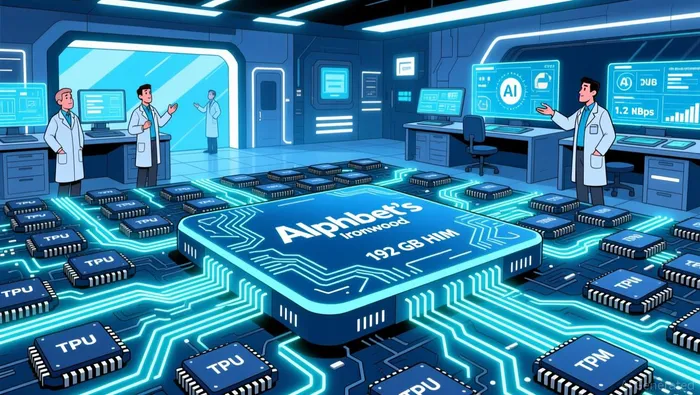
Such advancements are not merely technical milestones but strategic moves to reduce dependency on third-party suppliers. Alphabet's $75 billion investment in AI servers, data centers, and networking infrastructure in 2025 underscores its intent to control the entire AI value chain. This vertical integration provides a structural cost advantage, enabling Alphabet to deploy AI-driven services like Gemini 3 and AI Overviews at scale while maintaining margins. As stated by Business Engineer, this approach positions Alphabet to outcompе rivals reliant on off-the-shelf GPUs, particularly in an era where AI workloads are projected to consume 71% of global data center capacity by 2030.
Disrupting the Semiconductor Hierarchy
Alphabet's rise as a custom chip developer has profound implications for semiconductor incumbents. While the company remains a major customer for Nvidia-whose fiscal 2026 Q3 revenue reached $57 billion, driven largely by hyperscaler demand-its in-house solutions threaten to erode the latter's dominance in high-end AI training markets. According to industry analysis, NvidiaNVDA-- currently holds over 90% of the market for advanced GPUs used in AI training, but Alphabet's Ironwood TPUs are optimized for inference workloads, a segment where the company is now aggressively expanding.
This shift is already reshaping competitive dynamics. Advanced Micro DevicesAMD-- (AMD) and IntelINTC-- face heightened pressure to innovate, as Alphabet's custom chips reduce the need for off-the-shelf solutions. As noted by TechNewsWorld, AMDAMD-- has warned of a potential "alliance" between Intel and Nvidia to counter Alphabet's AI ambitions, signaling the intensifying rivalry in the sector. Meanwhile, smaller players like AMD must navigate a landscape where hyperscalers increasingly prioritize proprietary hardware, limiting opportunities for third-party vendors.
Supply Chain Reconfiguration and Geopolitical Tensions
The semiconductor supply chain is also being redefined by Alphabet's AI push and broader geopolitical forces. Export controls on advanced manufacturing tools, such as extreme ultraviolet (EUV) lithography equipment, are reshaping production geographies. The U.S. and its allies have restricted access to EUV technology, critical for sub-3 nm nodes, effectively channeling AI chip production to the U.S., Taiwan, and South Korea. Alphabet's $91–$93 billion CAPEX in 2025 for AI infrastructure aligns with this trend, as the company likely sources its TPUs from TSMCTSM--, which dominates sub-5 nm manufacturing. According to industry forecasts, this strategic positioning reinforces the company's supply chain resilience.
Conversely, China's semiconductor industry is adapting to these constraints by focusing on mature deep ultraviolet (DUV) lithography with multiple-patterning workarounds. While this approach allows for domestic production, it is slower and more costly than advanced nodes, limiting China's ability to compete in high-performance AI chips. According to Deloitte analysis, this domestic strategy may not be sufficient to close the performance gap with leading Western foundries. Alphabet's strategic investments thus indirectly reinforce global supply chain fragmentation, as companies prioritize local production to mitigate geopolitical risks.
Investment Implications
For investors, Alphabet's AI ascendancy signals a structural shift in the semiconductor sector. The company's vertically integrated model and aggressive CAPEX position it to capture long-term value from AI, while its competitors face margin pressures and market share erosion. Nvidia's dominance in training markets may persist, but inference-a domain where Alphabet is now a leader-could become a battleground for the next decade.
Moreover, the reconfiguration of supply chains underscores the importance of foundries like TSMC and equipment manufacturers like ASML, which supply EUV lithography tools. As AI demand accelerates, these firms are likely to benefit from sustained capital expenditures by hyperscalers. Conversely, companies unable to adapt to the AI-driven shift-such as those focused on legacy semiconductor technologies-may struggle to remain relevant.
In conclusion, Alphabet's AI chip strategy is not just a corporate initiative but a catalyst for broader industry transformation. By controlling its AI hardware and infrastructure, the company is redefining competitive advantages in the semiconductor sector while navigating the geopolitical realities of the AI era. For investors, the key takeaway is clear: the future of semiconductors is inextricably linked to AI, and those who fail to adapt risk being left behind.







Comentarios
Aún no hay comentarios