
Alnylam's Strategic Financing Move and Its Implications for Shareholder Value
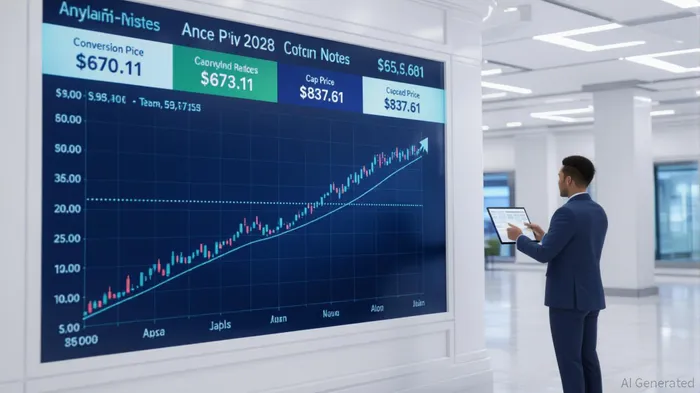
Alnylam Pharmaceuticals has pulled off a masterstroke in capital structure management with its recent $575 million convertible debt offering, a move that balances the need for liquidity with a deft strategy to mitigate shareholder dilution. Let's break down how this transaction could reshape the company's risk profile and reward potential.
The New Debt: A Low-Cost Lifeline
Alnylam priced its 0.00% convertible senior notes due 2028 at a 40% premium to its stock's weighted average price on September 9, setting the initial conversion price at $670.11 per share [1]. This premium ensures the notes won't convert immediately, giving the company breathing room while locking in a cost-effective funding source. With net proceeds of $561.6 million (or $645.9 million if the $86.25 million over-allotment option is exercised), AlnylamALNY-- has secured a financial cushion without burdening its balance sheet with high-interest debt [2].
Repurchasing the 2027 Notes: A Dilution Deterrent
The company plans to use $637.8 million of the proceeds to repurchase its existing 1.00% convertible senior notes due 2027, which carry a lower conversion price of $286.20 per share [3]. By retiring these cheaper-to-convert obligations, Alnylam is proactively reducing the risk of future dilution. This is a smart move: the 2027 notes, issued in 2022, represented a 35% premium at the time but now look like a bargain compared to the 2028 notes' 40% premium. The repurchase effectively raises the average conversion price of Alnylam's debt, aligning it with current market conditions and protecting shareholders from overhang.
Capped Calls: The Anti-Dilution Shield
Here's where Alnylam's strategy shines brightest. The company spent $30.7 million on capped call transactions, capping potential dilution at $837.61 per share—a 75% premium to its stock price on the deal's announcement date [4]. This cap acts as an insurance policy: if Alnylam's stock surges past $837.61, the capped calls will offset the dilution from converting the 2028 notes. For shareholders, this means the worst-case scenario—massive share issuance at a discount—is now a controlled risk.
Risk-Adjusted Returns: A Calculated Gamble
Critics might argue that convertible debt is inherently dilutive, but Alnylam has turned this weakness into a strength. By layering the 2028 notes atop the 2027 debt and pairing them with capped calls, the company has created a multi-tiered defense. The 40% conversion premium ensures the notes won't trigger dilution unless the stock jumps significantly, while the capped calls limit downside if it does. This structure is particularly appealing in a high-growth sector like biotech861042--, where volatility is the norm but capital preservation is critical.
The Bottom Line
Alnylam's financing move is a textbook example of risk-adjusted capital allocation. It's not just about raising money—it's about doing so in a way that rewards shareholders when the stock rises and protects them when it doesn't. For investors, this signals a management team that understands the delicate balance between growth and dilution. If Alnylam's pipeline delivers, the capped calls will act as a tailwind, amplifying returns without eroding ownership. If the stock stagnates, the 2028 notes' premium ensures the debt remains a non-event. Either way, this is a win for long-term value creation.





Comentarios
Aún no hay comentarios