
Almonty Industries Inc: A Strategic Play in the Rare Earths and Tungsten Value Chain
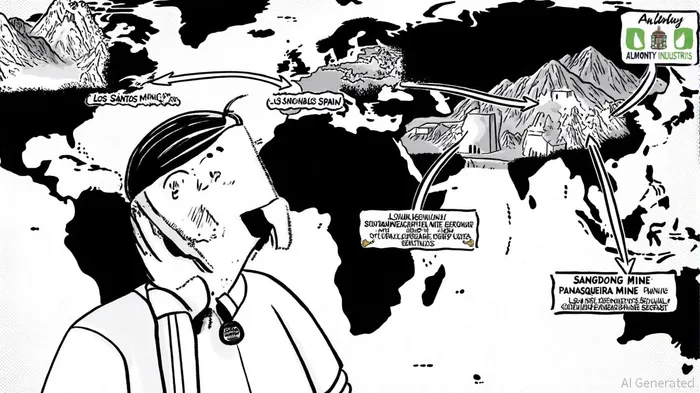
In an era defined by decarbonization and geopolitical realignment, critical minerals like tungsten have emerged as linchpins of global industrial and defense resilience. Almonty IndustriesALM-- Inc. (ALM) stands at the intersection of these forces, positioning itself as a pivotal player in the rare earths and tungsten value chain. With a strategic focus on supply-side resilience, margin expansion, and alignment with decarbonization trends, Almonty's operations and partnerships offer a compelling case for investors seeking exposure to the next phase of the critical minerals boom.
Supply-Side Resilience: Diversifying a China-Dominated Market
Tungsten, a critical component in defense systems, electric vehicles (EVs), and industrial machinery, has long been dominated by China, which controls over 80% of global production[1]. This concentration has spurred urgent efforts by Western nations to secure alternative supply chains. Almonty's Sangdong Mine in South Korea, set to become the largest non-Chinese tungsten producer, is a cornerstone of this strategy. With a projected 90-year mine life and high-grade deposits, Sangdong is expected to supply up to 40% of non-Chinese global tungsten demand by 2027[1].
The company's recent redomiciling to the United States further underscores its alignment with U.S. national security priorities. As noted by the U.S. House Select Committee on Strategic Competition with China, Almonty's operations are critical to reducing reliance on Chinese supply chains[1]. This repositioning not only enhances regulatory and geopolitical alignment but also opens access to U.S. capital markets, a strategic advantage highlighted by its planned NASDAQ listing[1].
Defense and Industrial Partnerships: Securing Long-Term Demand
Almonty's supply-side resilience is reinforced by its defense-focused offtake agreements. A binding three-year contract with Tungsten Parts Wyoming (TPW) and Metal Tech ensures a minimum of 40 metric tons of tungsten oxide per month for U.S. defense applications, including missiles, drones, and ordnance systems[3]. This agreement includes a price floor with no ceiling, offering downside protection while capturing upside potential as tungsten prices rise.
Beyond defense, Almonty has secured long-term contracts with industrial partners such as SeAH M&S and the Austrian Plansee Group. These agreements guarantee revenue streams, with SeAH M&S committing to purchase up to 5,600 tons of molybdenum annually at a minimum price of $19 per pound[3]. Such partnerships provide financial stability while diversifying demand across sectors.
Tungsten in Decarbonization: A Growing Market Tailwind
The global tungsten market is projected to grow at a compound annual growth rate (CAGR) of 8% from 2025 to 2032, reaching $10.26 billion by 2032[5]. This growth is driven by tungsten's role in decarbonization technologies. In EVs, tungsten's high density and thermal stability make it indispensable for battery components, vibration-damping systems, and precision welding electrodes[4]. For example, global EV production surged to 17.3 million units in 2024, a 25% year-over-year increase, directly boosting demand for tungsten-based materials[4].
Renewable energy applications further amplify this trend. Tungsten alloys are critical in wind turbine components and solar panel manufacturing, where durability and heat resistance are paramount[5]. As the EU and U.S. accelerate wind power expansion and energy efficiency retrofits, tungsten's strategic importance will only deepen[2].
Financials and Margin Expansion: Navigating Near-Term Challenges
Despite near-term financial headwinds, Almonty's long-term margin expansion potential is robust. Q2 2025 results showed a net loss of $58.2 million, primarily due to non-cash warrant revaluation losses[4]. However, the company raised $90 million through a U.S. public offering and secured offtake agreements that stabilize revenue. Management targets gross margins of 50-60% and net income margins of 30-40% assuming a tungsten price of $350 per metric ton unit[3].
Cost optimization strategies, including optimizing Sangdong's throughput and reducing debt, are central to margin expansion. With Sangdong transitioning to pre-production and projected revenue of CAD 314 million by 2027[1], Almonty is poised to capitalize on tightening supply and rising demand. Analysts project over 30% upside potential in its stock price, reflecting confidence in its strategic positioning[1].
Conclusion: A Strategic Play in a Fragmenting Market
Almonty Industries is uniquely positioned to benefit from the convergence of decarbonization, supply chain diversification, and geopolitical realignment. Its Sangdong Mine, defense partnerships, and focus on non-Chinese supply chains address critical vulnerabilities in the global tungsten market. While near-term financial metrics require careful scrutiny, the company's long-term growth trajectory—backed by rising demand in EVs, renewables, and defense—is compelling. For investors seeking exposure to the critical minerals revolution, Almonty represents a strategic play with significant upside potential.





Comentarios
Aún no hay comentarios