
Almonty Industries' Q3 Performance and Share Price Reaction: Assessing the Disconnect Between Profitability and Market Sentiment in Resource Stocks
The Almonty Case: Accounting Gains vs. Operational Realities
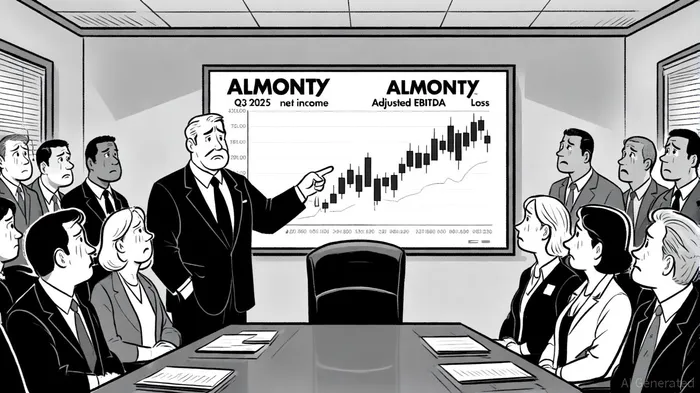
Almonty's Q3 results highlight the interplay between non-recurring items and core operational performance. The $34.5 million gain-stemming from the re-denomination of CDI options into Canadian dollars-was a technical adjustment to remove foreign exchange volatility under IFRS, as outlined in a Business Wire release. While this simplified the company's capital structure, it also masked underlying operational challenges. Adjusted EBITDA for the quarter was negative at $2.2 million, and general and administrative expenses surged to $3.7 million, reflecting costs tied to its Nasdaq uplisting, per MarketScreener.
The market's reaction, therefore, was not merely a rejection of the results but a recalibration of expectations. Investors appear to have discounted the one-time gain, focusing instead on the company's transition phase: ramping up production at the Sangdong Mine in South Korea and navigating the costs of regulatory compliance in a newly public Nasdaq listing. As one analyst noted in Nairametrics, "The market is voting with its feet. Almonty's operational cash flow remains unproven, and the EBITDA loss signals that the company is still in a capital-intensive growth phase."
Broader Trends in Resource Stock Valuation
Almonty's experience mirrors a sector-wide pattern. Q4 2025 market sentiment for resource stocks is cautiously optimistic, with investors weighing macroeconomic risks-such as sticky inflation and delayed Fed rate cuts-against sector-specific opportunities, according to an Ameriprise outlook. However, the disconnect between accounting-driven earnings and operational performance has become a critical differentiator. For instance, a Morningstar piece highlights Julius Berger Nigeria's Q3 2025 profit surge driven by forex gains, while Freshpet's $77.9 million deferred tax benefit masked operational inefficiencies. These cases underscore a growing skepticism toward non-recurring items, particularly in sectors where capital intensity and geopolitical risks amplify volatility.
Resource investors are now demanding clarity on two fronts:
1. Operational Cash Flow: Can companies sustain earnings without relying on one-time gains?
2. Strategic Positioning: Are they addressing critical supply chain gaps (e.g., Almonty's tungsten projects in the U.S. and South Korea)?
Strategic Resilience and the Path Forward
Almonty's long-term prospects hinge on its ability to convert operational progress into financial stability. The company's $90 million Nasdaq listing and $111.6 million cash reserves provide a buffer, but the path to profitability remains uncertain. The Sangdong Mine's ramp-up to commercial production and the acquisition of a U.S. tungsten project in Montana are strategic moves to diversify supply chains amid geopolitical tensions with China, according to Almonty's release. However, these initiatives require sustained capital and execution discipline.
The market's reaction to Almonty's Q3 results reflects a broader recalibration of risk in resource stocks. As one industry commentator observed in a Meyka blog post, "Investors are no longer seduced by headline figures. They want to see operational momentum, not just accounting magic." This shift is likely to persist as macroeconomic uncertainties linger and sector-specific challenges-such as regulatory scrutiny and supply chain disruptions-intensify.
Conclusion
Almonty Industries' Q3 2025 results exemplify the growing tension between accounting-driven profitability and operational reality in resource stocks. While the company's strategic positioning in the tungsten supply chain is compelling, the market's skepticism highlights the need for transparency and consistency in earnings. For investors, the lesson is clear: in a world of volatile markets and stretched valuations, the true test of a resource company lies not in its ability to engineer accounting gains but in its capacity to deliver sustainable cash flow and operational resilience.







Comentarios
Aún no hay comentarios